
A customer story becomes a strong podcast episode when it begins with a real operating decision, not a polished testimonial. Choose a customer who can explain the problem, the choice they made, the work involved, and what changed. Record a focused conversation, give the customer a review step, then reuse the approved episode as a sales asset.
Written case studies still matter. But a good customer conversation can show how a decision felt in the moment: what made the old approach untenable, what people disagreed about, and what finally changed their mind. That texture is hard to get from a quote box.
The obstacle is usually not recording equipment. It is the missing editorial system around the customer. Marketing needs a credible story. The customer needs clear boundaries. Sales needs something useful after the episode goes live. A producer often becomes the person holding all of that together.
That job can be designed into the workflow instead.
Start with a story that has a decision in it
Do not invite a customer because they are happy. Invite them because they can explain a specific business decision.
Good starting points include:
- A team replaced a process that had quietly stopped working.
- A leader made a difficult tradeoff under a deadline.
- A new approach changed how a team serves customers, sells, or operates.
- A project failed first, then taught the company what to do differently.
The episode does not need a dramatic transformation. It needs a real sequence: before, choice, work, result, lesson.
That is also the boundary between a useful customer story and an infomercial. A customer should be able to say what was difficult, what did not go to plan, and what they would do differently next time. Never write the claimed result into the guest's mouth.
Write a one-page episode brief before you invite anyone
The brief is what lets a lean team run the conversation without a full-time producer. Keep it to one page and answer five things:
- Who is the intended listener?
- What decision or problem will the guest unpack?
- What can the customer discuss publicly, and what is out of bounds?
- What proof, examples, or numbers are already approved for mention?
- What should a sales rep or marketer be able to use after the episode?
Then list eight to ten questions in chronological order. Start with the old reality. Move to the trigger for change. Ask how the decision was made. Finish with what changed and what the listener should take away.
Avoid writing a script. A script makes the customer sound coached. A focused question path gives them room to tell the story in their own words.
Make the guest request small and specific
Customers are more likely to participate when the ask is clear: one conversation, one topic, a defined review process, and no surprise promotion.
Mato's live-interviews workflow is built around that sequence: create a brief, share a scheduling link, run the conversation, then move through production and review. The public interview setup guide and guest recording guide are useful references for the operational handoff.
The current Mato setup flow also makes the stages visible: find the guest, set up the interview, prepare questions, then send the invite.
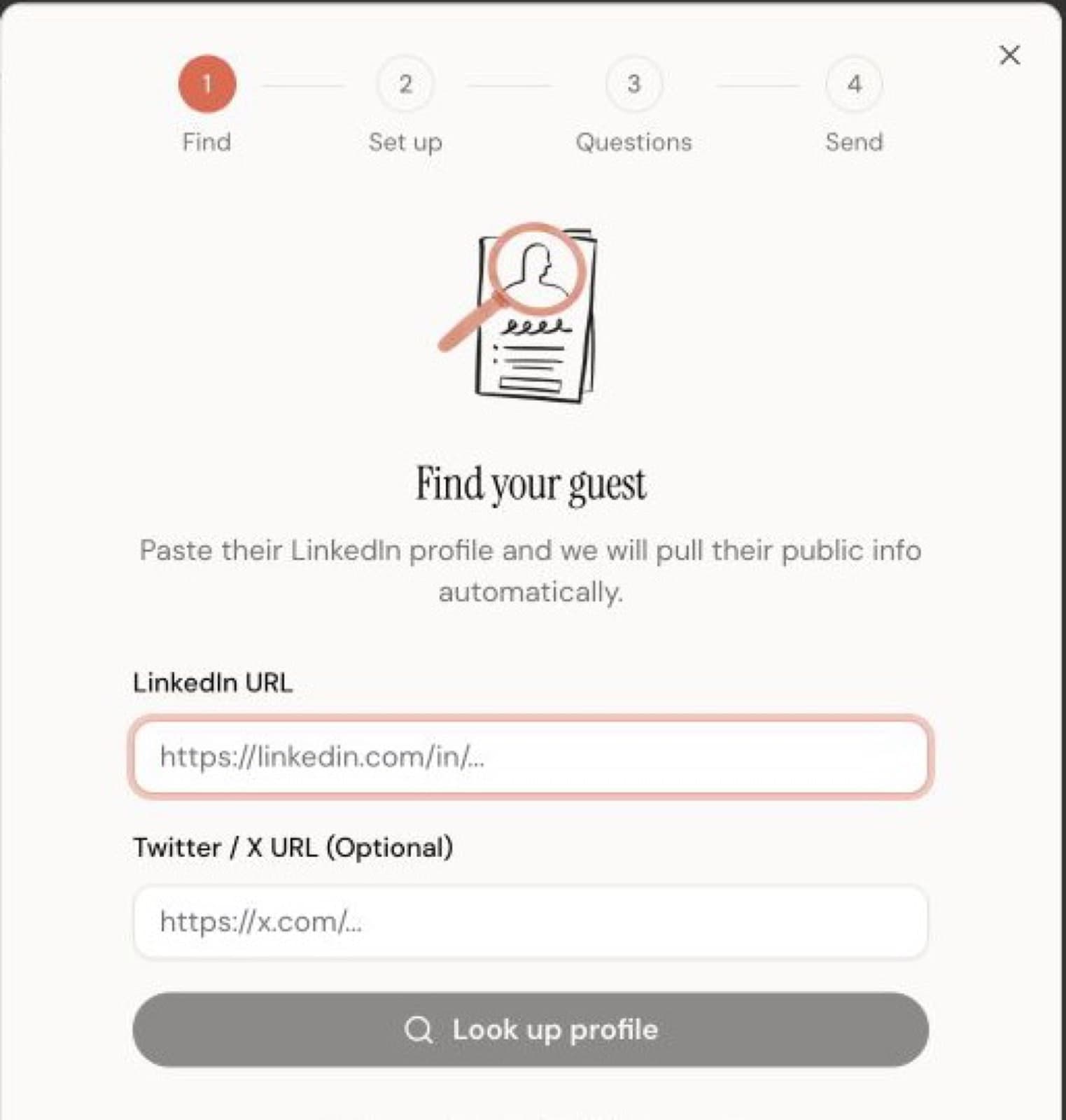
Give the customer the topic and question areas before the call. Ask them to flag anything that requires approval. Do not hand them a list of approved claims and call it preparation.
Keep the conversation anchored in moments, not messaging
The strongest customer episodes usually turn on a few concrete moments. Use questions that pull those moments forward:
- What was happening when you realized the old approach could not continue?
- What alternatives did the team consider?
- Who had to agree before the decision could move forward?
- What changed in the first thirty days?
- What would you tell a peer who is facing the same problem?
Those questions give an AI host, human host, or internal interviewer enough structure to follow up without flattening the story. Mato's how-it-works overview describes the broader flow from planning through recording, clips, distribution, and measurement. Let the production system carry the administrative work while the customer keeps their own point of view.
Put approval and disclosure into the workflow
Customer stories have different rules than a founder interview. Before recording, agree on who can approve the episode, the show notes, the clips, and any written pull quotes. Keep a written record of the boundaries that matter to the customer.
The Federal Trade Commission's endorsements, influencers, and reviews guidance is a useful baseline: endorsements need to be truthful, and material connections may need to be disclosed. Build the approval step into the process rather than treating it as cleanup.
Practical rules:
- Let the customer correct factual errors.
- Do not edit the conversation to imply a claim they did not make.
- Get explicit approval for clips that use a sensitive result or a named customer.
- Keep compensation, commercial relationships, and disclosures visible where they matter.
Turn one approved conversation into useful sales material
The full episode is only the start. Once the customer approves it, create a short set of assets that each preserve the original context:
- One full episode for buyers who want the complete story.
- Two or three clips tied to a specific decision or lesson.
- Show notes that name the problem, the decision, and the takeaway.
- A sales follow-up link for prospects facing the same issue.
- A short internal brief with the approved claims, objections answered, and quotes that can be reused.
Mato's public product pages describe a workflow that takes an interview through production, show notes, clips, and distribution. The social clips documentation is the relevant next step when the aim is to give a sales or customer-marketing team material they can actually use.
Do not turn a customer story into thirty disconnected posts. Keep the assets tied to the one decision the customer explained. A prospect who hears the full context is more likely to trust the clip.

Measure whether the story helped the right conversations
Downloads are useful, but a customer-story episode should also be judged by the conversations it starts.
Track the obvious distribution signals, then ask sales and customer teams a few direct questions:
- Did a prospect mention the episode or clip?
- Did it help a rep explain a difficult use case?
- Did it give a customer team a credible peer example?
- Did the guest relationship lead to another conversation, introduction, or event?
Use consistent measurement definitions for any audience reporting. The IAB Tech Lab podcast measurement guidelines are a useful reference for the limits of download and audience metrics. Mato's distribution analytics guide can help frame the operational side of reviewing what happens after an episode is released.
A simple first episode plan
For a first customer-story episode, keep the operating model small:
- Pick one customer with a clear decision to explain.
- Write the one-page brief and get the boundaries approved.
- Share the topic and question areas before the recording.
- Record one focused conversation.
- Give the customer a defined review window.
- Publish the approved episode, clips, and sales follow-up asset together.
- Review what the story changed in customer, sales, and audience conversations.
This is enough to prove whether the format belongs in the content program. It is also enough to see where a production workflow is slowing the team down.
Start with one story
Turn your next customer conversation into a show.
Mato handles the interview workflow, production, clips, and distribution so your team can stay focused on the customer and the story.
FAQ
How long should a customer-story podcast episode be?
Use the length needed to explain one real decision without rushing the customer. Mato's public live-interviews flow is designed around a focused guest conversation, but the better test is whether the episode gives the listener a complete before, choice, work, and result sequence.
Should a customer approve the episode before it goes live?
Yes. Agree before recording on who approves the episode, show notes, clips, and quotes. The review should correct facts and protect agreed boundaries, not rewrite the customer's point of view.
What is the difference between a customer story episode and a case study?
A case study is a structured proof asset. A customer-story episode can show the uncertainty, decision process, and tradeoffs behind that proof. The two formats work well together when they use the same approved facts.
Can a small B2B marketing team run this without a producer?
Yes, if the team has a repeatable brief, question path, approval workflow, and production system. The team still needs editorial judgment; the production system should remove the coordination work that normally forces a producer into every episode.