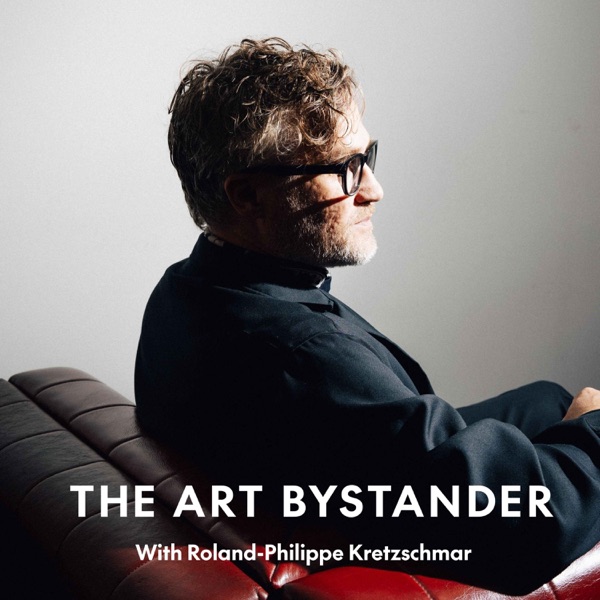
Meet the individuals who drive the art industry today and tomorrow; from artists to gallerists, curators, financial backers, advisors, collectors, and more. Hosted by Roland-Philippe Kretzchmar. More on www.theartbystander.com and www.instagram.com/theartbystander Hosted on Acast. See acast.com/privacy for more information.
For this summer episode, I’m joined by The Art Daddy for their first-ever interview. The Art Daddy is a New York City-based art and culture reporter, critic, educator and artist who has spent more than a decade covering the contemporary art world. Their writing has appeared in The Art Newspaper, ELLE, ARTnews, Artnet News and many other publications, and they have taught and lectured at universities across the United States. They studied performance art at the School of the Museum of Fine Arts in Boston and minored in Women’s Studies. That background remains central to The Art Daddy, which they see not simply as a media platform, but as an extension of their artistic practice. Across Substack and Instagram , The Art Daddy combines reporting and criticism with gossip, satire and cultural analysis. Often described as the TMZ of the art world, the platform looks beyond official narratives to examine the personalities, hierarchies and power structures shaping contemporary art. I am, of course, a middle-aged white man working within the art world, precisely the demographic that frequently appears in Art Daddy’s criticism. This gave us a particularly open, self-aware and entertaining starting point. We talk about the art market, generational shifts in taste and power, the problem with middle-aged men, and the often invisible labour dynamics sustaining the art world. We also get into the individuals, behaviours and hypocrisies that frustrate The Art Daddy most, and much more. It is candid, intelligent and very funny. Perfectly relaxed summer listening, but certainly not without bite. Hosted on Acast. See acast.com/privacy for more information.
In this episode, our host Roland-Philippe Kretzschmar is joined by Miramar Al-Nayyar , the Iraqi artist whose UK solo debut opens today (July 3, 2026) at Saatchi Yates in London. Miramar is the inaugural winner of the Saatchi Yates Fellowship Prize, selected from more than 5,000 submissions worldwide. She is 29, based between Amman and Abu Dhabi, and paints with a maturity that shows in her command of atmosphere, silence, and inner force. Her exhibition brings together paintings shaped by the vastness of the Middle Eastern desert: rock formations, flowers, solitude, and the slow intelligence of nature. Made between Lebanon and Jordan against a backdrop of conflict and unrest, these are not abstract landscapes. They are meditations on endurance, on what can still bloom under pressure. At the centre of the exhibition is the desert rose: a formation at once geological and floral, mineral and symbolic. In Miramar's hands it becomes visionary, a flower of the mind that emerges from silence, heat, distance, and memory. Her surfaces hold that tension between barrenness and abundance, fragility and force, the physical world and the invisible one. The work draws from desert landscapes and natural movement, but also from meditation, seclusion, and the ornamental rhythms of classical Islamic geometry. The paintings unfold like inner architectures: psychedelic, atmospheric, embodied. Her process is intuitive and physical, gesture as a way of listening. She paints less to depict nature than to receive it. What stayed with me was the spiritual depth of our conversation. We spoke about art as a form of surrender, about solitude as a creative condition, about the desert as both real landscape and inner state, about how images arrive from somewhere beyond language. Something in the way Miramar speaks about nature, intuition, prayer, and the unseen resonated with me. It reminded me that painting, at its most powerful, is not only visual. It can be a vessel for transformation, a way of making contact with what is buried, what is sacred, and what is still becoming. We speak about the desert rose, movement, memory, meditation, conflict, hope, and what it means for a young Iraqi artist to bring this personal, spiritually charged visual language into her first UK solo show. Hosted on Acast. See acast.com/privacy for more information.
I'm speaking today with Lea Bischofberger , a Zurich-based gallerist and art dealer whose life and work are bound up with one of the most remarkable legacies in postwar and contemporary art. The Bischofberger name runs through some of the defining artistic relationships of the late twentieth century. Her father, Bruno (who passed away in late spring 2026), was a legendary gallerist who worked with Andy Warhol, Jean-Michel Basquiat and Jean Tinguely, as well as Francesco Clemente, Julian Schnabel, David Salle, George Condo, Miquel Barceló, Enzo Cucchi, Peter Halley and Mike Bidlo. But Lea's story isn't only one of inheritance. It is also one of proximity, intuition, independence and renewal. Having grown up close to the artists, collections and conversations that helped shape art history, she now carries that experience into her own gallery work in Zurich. Through Lea Bischofberger Gallery and Lele Projects, she has shown artists including Kate Daudy, Geraldina Bassani Antivari, Ashkan Sahihi, Roberto Ruspoli, Aryana Sheibani and Ulf Saupe. The programme suggests a more intimate and exploratory chapter, one attentive to memory, materiality, portraiture, language and psychological presence. In this conversation we talk about legacy, taste, the changing role of the art dealer, Zurich as an art-world city, and what it means to carry history forward without being defined by it. Hosted on Acast. See acast.com/privacy for more information.
Today, Roland-Philippe Kretzschmar is joined by Nadya Tolokonnikova — conceptual artist, musician, activist, wanted criminal, and one of the founders of Pussy Riot, the Russian feminist protest-art collective formed in Moscow in 2011. Tolokonnikova spent nearly two years in a Russian prison after Pussy Riot’s 2012 performance Punk Prayer inside Moscow’s Cathedral of Christ the Saviour — an action that transformed a brief act of punk dissent into one of the defining works of political performance art of the 21st century. Since then, her work has continued to confront the spaces where power presents itself as untouchable: the church, the state, the prison system, the museum, the media image. That history matters in Venice. A national pavilion at the Biennale is never just architecture. It is a state speaking through culture. Last week, in May 2026, as Russia returned to the Venice Biennale for the first time since the full-scale invasion of Ukraine, Pussy Riot and FEMEN staged two connected protests. On May 6, they confronted the Russian Pavilion itself, using Ukrainian flags, pink balaclavas, smoke, flares, punk music, and slogans against Russia’s war. The action forced the pavilion to close temporarily. On May 7, the confrontation moved from the pavilion to the institution that had allowed Russia back in. At Ca’ Giustinian, the headquarters of the Biennale Foundation, Tolokonnikova and the protesters challenged the Biennale’s leadership and its president, Pietrangelo Buttafuoco, over the claim that culture can remain neutral while being used by the Russian state. Reuters reported that the demonstration continued from the previous day’s action at the Russian Pavilion and was redirected by police to the Biennale Foundation’s headquarters, where flares in the colours of Ukraine were ignited. This continuity — from the cathedral in Moscow to the pavilion in Venice, and from the pavilion to the Biennale’s own leadership — sits at the centre of our conversation. Tolokonnikova’s recent work has only sharpened this confrontation between art, punishment, and political theatre. Her 2023 performance and exhibition Putin’s Ashes , later shown at institutions and galleries including Dallas Contemporary, turned the image of Putin into ritual material and helped place her back on Russia’s wanted list. In 2025, POLICE STATE premiered at MOCA in Los Angeles as a durational performance and installation built around the architecture of confinement, before travelling to MCA Chicago later that year. Her accolades include Time Woman of the Year, the Hannah Arendt Prize for Political Thought, the LennonOno Grant for Peace, the Woody Guthrie Prize, and an Honorary Doctorate from RISD. She also carries, as a kind of involuntary badge of honour, the Russian Federation’s 2025 designation of Pussy Riot as an extremist organisation — a reminder that, in authoritarian systems, art is not treated as metaphor when it threatens power. Reuters also reported that Pussy Riot was declared an extremist organisation and banned in Russia in 2025. So this episode is about protest as art, culture as power, exile, propaganda, and the impossibility of neutrality when neutrality itself becomes a political position. Hosted on Acast. See acast.com/privacy for more information.
In this episode, Roland-Philippe Kretzschmar speaks with Galerie Nordenhake about the role of the gallery today, the importance of sustained artist relationships, and how a gallery with Nordic roots continues to operate within an increasingly global contemporary art world. Founded by Claes Nordenhake in Malmö in 1976 (meaning celebrating 50 yr in 2026), Galerie Nordenhake is one of Scandinavia’s most internationally respected contemporary art galleries. Today, the gallery operates across Stockholm, Berlin and Mexico City, connecting a Nordic point of origin with a broader European and Latin American presence. Over nearly five decades, Nordenhake has built a reputation for a rigorous and intellectually grounded programme, representing both established and emerging artists across painting, sculpture, photography, installation, conceptual practice and performance. The gallery is particularly known for its long-term commitment to artists, its close dialogue with institutions, and its ability to support practices that often unfold slowly, critically and with lasting cultural depth. Historically, the gallery has played an important role in introducing and supporting artists such as Anthony Gormley, Hreinn Friðfinnsson, John Coplans, Esko Männikkö and Mirosław Bałka, while continuing to work with a diverse international roster. Its programme reflects a clear belief in art as a space for visual precision, material intelligence and conceptual seriousness. Hosted on Acast. See acast.com/privacy for more information.
In this episode of The Art Bystander , our host Roland-Philippe Kretzschmar is joined by Marc Spiegler , one of the key figures shaping the global art market over the past decade. Having led Art Basel from 2007 to 2022, he helped transform the fair from a marketplace into a global cultural platform—redefining how art is experienced, communicated, and sold. Today, Spiegler operates across a portfolio of cultural, strategic, and advisory initiatives at the intersection of art, business, and technology. He is co-founder of Art Market Minds , including the course AI & The Art Market , which explores how AI is beginning to reshape structures, behaviours, and opportunities across the industry. Alongside this, Spiegler is a Visiting Professor at Bocconi University, where he teaches cultural management and the impact of artificial intelligence on the art world, and serves as President of the Board of Directors of Superblue, as well as Chairman of the Advisory Board of the future UBS Digital Art Museum. Spiegler collaborates with the Luma Foundation, sits on the boards of the ArtTech Foundation and Art Explora Foundation, and advises companies including Prada Group, KEF, and Sanlorenzo on cultural strategy. In this conversation, we trace that full arc—from journalism to Art Basel to AMM—and what it reveals about the structural shifts shaping the art world today. Also mentioned in the episode New York Real Estate and the Ruin of American Art and Will AI Slop and Deep Fakes Kill Culture . Sign up to join AI & THE ART MARKET Artificial intelligence is rapidly redefining many industries. While there are parts of the Art Market to which it may never apply, it would be foolish to think that our industry won't be strongly impacted. This sprint course - designed and moderated by Marc Spiegler, and featuring experts from inside and outside the artworld - will examine where things stand now, where they're likely to go and how you can deploy artificial intelligence to the benefit of your art world activities. Discount code: TABAI15, and booking HERE . Hosted on Acast. See acast.com/privacy for more information.
In this episode, Roland-Philippe Kretzschmar meets with Frej Forsblom a Finnish gallerist and the founder of Makasiini Contemporary , which he established in Turku in 2016. With a clear international outlook from the outset, Makasiini has developed into one of the more dynamic contemporary art platforms in Finland, working with a new generation of artists while actively positioning them within a broader European and global context. Before founding Makasiini, Frej was closely connected to the Finnish gallery landscape through Galerie Forsblom, gaining early insight into the mechanics of building and sustaining an international gallery program. With Makasiini, however, he has shaped a distinct identity — one that is less tied to legacy structures and more attuned to the shifts in how artists, galleries, and collectors operate today. The gallery’s program spans painting, sculpture, and conceptual practices, with a particular sensitivity to materiality, narrative, and emerging artistic voices. At the same time, it reflects a strategic understanding of how to operate from a smaller market like Finland while remaining globally relevant. In this conversation, Frej Forsblom speaks about building a gallery from the ground up, the realities of working within the Nordic ecosystem, and the evolving role of the gallerist in a market that is increasingly international, network-driven, and relationship-based. We also touch on artist development, collector behaviour, and what it takes to create momentum beyond the traditional centres of the art world. Hosted on Acast. See acast.com/privacy for more information.
In this episode of The Art Bystander , host Roland-Philippe Kretzschmar sits down with Daniel Arsham , one of the most influential contemporary artists working today — an artist whose work treats the present as if it were already history. Arsham is internationally known for what he calls “fictional archaeology”: sculptures, objects, and environments that imagine contemporary culture as relics of the future — eroded, crystallized, and excavated from time yet to come. Born in Cleveland, raised in Miami, and educated at The Cooper Union in New York, Arsham has built a practice that moves fluidly between fine art, architecture, design, fashion, and popular culture. His work is held in major museum collections around the world and has reached audiences far beyond the traditional art world, shaping how an entire generation encounters contemporary art. With his recent book Future Relic , Arsham turns the lens inward. The book offers a rare and unvarnished account of what it actually takes to build a life in art — the failures, detours, discipline, and belief that exist behind the finished works we usually encounter only at the end of the journey. From photographing the aftermath of Hurricane Andrew as a teenager in Miami, to formative years at Cooper Union, to collaborations with Merce Cunningham, Pharrell Williams, Christian Dior, and the Cleveland Cavaliers, Arsham shares the experiences that shaped both his work and his worldview. Future Relic is not a romanticized memoir. It’s closer to a masterclass — a brutally honest guide to the realities of building a creative life. Arsham speaks candidly about the grind behind the work: how to find a gallery, why having the right lawyer matters, how to think like a creative entrepreneur, and why surrounding yourself with ambitious people is essential. In this conversation, we talk about time, ambition, rejection, visibility, and the long game of making art — not just objects, but a practice capable of enduring. Hosted on Acast. See acast.com/privacy for more information.
In this episode of The Art Bystander , Roland-Philippe Kretzschmar meets with Barbara Corti, Partner at Hauser & Wirth and Senior Director overseeing the gallery’s spaces in Zurich Limmatstrasse and St. Moritz. Having spent more than two decades with the gallery across Europe and the United States, Corti brings a rare perspective on the evolving geography of the contemporary art world. After fourteen years in New York — including leading Hauser & Wirth’s Manhattan location in the former Roxy disco and roller-skating rink — she returned to Switzerland in 2020, where she now helps shape the gallery’s programming and presence across Zurich and St. Moritz. The conversation moves between continents and contexts: from the velocity of the New York art world to the quieter but deeply rooted collector culture of Switzerland. We discuss the particular rhythms of Zurich and St. Moritz, the role of seasonality in shaping art audiences, and the long-term relationships between galleries and artists that continue to define Hauser & Wirth’s approach. Alongside her institutional role, Corti works closely with artists including Rita Ackermann, Anna Maria Maiolino, Mary Heilmann and Nicolas Party. As always on The Art Bystander , the discussion unfolds in a conversational format — offering insight into how galleries, artists, places and collectors shape one another over time. Mentioned in the episode: Upcoming exhibitions at Hauser & Wirth Zurich, Limmatstrasse opening during Zurich Art Weekend 2026: War_overlays — Avery Singer and Sometimes a straight line has to be crooked — James Jarvaise & Henry Taylor Some of the hotels and restaurants discussed in the episode belong to Artfarm, the hospitality company founded by Iwan Wirth and Manuela Wirth. Artfarm operates independently from Hauser & Wirth. Hosted on Acast. See acast.com/privacy for more information.
This episode is for you — my loyal friends and followers who share my deep love for the purest form of human expression there is: art. Many of you have asked me to open up more, to share what sits behind the platform, the voice, and the choices — so here we are. As The Art Bystander marks its three-year anniversary this February, I sit down for an intimate conversation with my life and business partner, Ellen. Together we reflect on why I started The Art Bystander, what has driven it from the beginning, and what continues to guide everything we do. From the bottom of my heart — thank you for being part of this journey, for your curiosity, your trust, and your presence. I’m deeply grateful you’re here with us. #theartbystander Hosted on Acast. See acast.com/privacy for more information.
Today on The Art Bystander , I speak with Marlies Wirth , Curator for Digital Culture and Head of the Design Collection at the MAK in Vienna, about one of the most quietly radical figures of late-20th- and early-21st-century culture: Helmut Lang. Our conversation turns not to his later sculptural practice, but to the architecture of a legacy that reshaped how we understand design, communication, identity, and the very idea of what a fashion house could be. The MAK’s new exhibition, Excerpts from the MAK Helmut Lang Archive — running 10.12.2025 → 03.05.2026 — reflects on the years 1986–2005, a period in which Lang’s vision dissolved the boundaries between disciplines. His work unfolded across clothing, graphics, architecture, staging, branding, and digital experimentation — not as separate gestures, but as parts of a single cultural language. Long before he stepped away from fashion, Lang had already begun to operate like an artist moving across mediums, using every surface as a site of meaning. This retrospective reveals how deeply his ideas anticipated the world we now take for granted. It recalls the moment he livestreamed a runway before the internet had become a stage; the years when he turned New York itself into an extension of his voice; the way his presentations and stores became environments rather than commercial spaces. Lang’s legacy is not simply a story of minimalism or aesthetic restraint — it is a study in how form can become communication, and how identity can be constructed with both precision and quiet intensity. In speaking with Marlies, the past becomes newly vivid: not nostalgic, but architectural. We explore how Lang’s decisions — from the shape of a jacket to the rhythm of a campaign, to the destruction of his own archive — can be understood as part of a larger narrative about authorship, memory, and the courage to redefine oneself. This episode looks back at the cultural landscape Helmut Lang helped build, and the echoes of his vision that continue to structure how we see and experience the world today. Hosted on Acast. See acast.com/privacy for more information.
Welcome back to The Art Bystander , the podcast that explores the stories, ideas, and people shaping the world of contemporary art. Our host Roland-Philippe Kretzschmar is taking you behind the scenes of one of the most influential art fairs in the world — Paris Photo . Founded in 1997, it has become the leading international fair dedicated entirely to photography, a place where artists, collectors, curators, and institutions converge to celebrate and challenge the medium. Joining me are Florence Bourgeois , Director of Paris Photo, and Anna Planas , Artistic Director. Together, they’ve been redefining what a photography fair can be — expanding its cultural scope, international reach, and curatorial ambition. In this conversation, we’ll discuss the evolving role of photography in the art ecosystem, how Paris Photo bridges artistic and commercial worlds, and what it takes to curate a fair that remains both relevant and visionary. So whether you’re a collector, a photographer, or simply curious about how images shape our times — this episode is for you. Hosted on Acast. See acast.com/privacy for more information.
Today on The Art Bystander, our host Roland-Philippe Kretzschmar is joined by Francesca Grima — Creative Director of GRIMA Jewellery , and the guardian of one of the most influential design legacies in modern jewellery. Her father, Andrew Grima , changed everything. Often called the father of modern jewellery , he treated gold like sculpture, embraced raw stones in their natural form, and pushed the art of adornment into the realm of architecture and abstraction. His pieces were worn by royalty, collected by icons, and displayed in major museums — yet his spirit always remained independent and quietly rebellious. Francesca has carried that legacy forward in her own way. Since taking over the house in 2007, she’s reimagined GRIMA as a contemporary atelier — producing small, handcrafted collections and bespoke pieces alongside her mother, Jojo . Each work still bears that unmistakable GRIMA DNA — sculptural, textured, and fearless — but now infused with Francesca’s own sensitivity to form, emotion, and modern life. In our conversation, we’ll talk about what it means to inherit and evolve a creative legacy, the emotional side of making wearable art, and how Francesca balances intuition, heritage, and innovation in a world that moves faster than ever. Hosted on Acast. See acast.com/privacy for more information.
The art world is undergoing a profound transformation. Traditional models of collecting and dealing are giving way to new players, platforms, and hybrid business models that blur the lines between galleries, auction houses, advisors, and digital marketplaces. At The Art Bystander , we are closely following these shifts—where technology, luxury, and creativity intersect to redefine how art is experienced, bought, and sold. In this context, our host Roland-Philippe Kretzschmar is joined by Elliot Safra , a figure at the forefront of these changes. Safra is the co-founder of The Art Marketplace , an online platform facilitating global private sales, and the founder of AndArt Agency , a creative consultancy dedicated to building collaborations between luxury brands and the art world. With a background that includes leadership in the Chairman’s Office at Christie’s and as Senior Director of Global Strategy at Lévy Gorvy (now Lévy Gorvy Dayan), as well as early experience in Management Consulting and Private Equity, he brings a unique vantage point on how the evolving art economy is reshaping opportunities for collectors, brands, and cultural institutions alike. Hosted on Acast. See acast.com/privacy for more information.
In this episode, our host Roland-Philippe Kretzschmar turns the spotlight on two art fairs that have each shaped the mid-tier ecosystem in distinct ways. The Affordable Art Fair , founded in London in 1999 by Will Ramsay, has grown into a global franchise with editions in over a dozen cities — from Hong Kong to Hamburg, New York to Stockholm. With its price cap of around €10,000, the fair has opened the art market to tens of thousands of new collectors and offered emerging artists a platform to reach international audiences. Representing AAF in this conversation is Carl-Wilhelm Hirsch , who has helped steward its mission of accessibility and growth. The Volta Art Fairs , launched in Basel in 2005, are known as the “discovery fair,” championing solo presentations and younger galleries that bring experimental voices to the fore. Active today in both Basel and New York, Volta has built a reputation as the place where collectors often encounter artists just before they break through. Here, we hear from Francesca Starling , who has been instrumental in shaping Volta’s evolving vision. Together, these two fairs embody a vital counterpoint to the mega-fairs that dominate headlines. They prioritize intimacy, accessibility, and discovery — serving as laboratories where new collector generations are nurtured and where artistic risk-taking remains possible. As always, I’m fascinated by how the future of the art market unfolds, and conversations like this reveal how fairs at this scale — human, innovative, and open — might shape the next chapter of global collecting. Hosted on Acast. See acast.com/privacy for more information.
In this episode of The Art Bystander, the host Roland-Philippe Kretzschmar, is meeting a guest who is one of the most distinctive cultural commentators of her generation: Brenda Weischer , known to many simply as BrendaHashtag . Brenda is a writer, editor, and podcaster whose work moves fluidly between fashion and art. A graduate of Central Saint Martins in London, she has always approached fashion less as a marketplace and more as a form of cultural language and archive. She first made her mark with Disruptive Berlin , a project that treated vintage fashion as living cultural memory. Later, during her time as Fashion Editor at 032c, she developed Brenda’s Business —a series of interviews and essays that quickly became essential reading for their fearless look at designers and creatives through the lens of philosophy, critique, and cultural storytelling. At the same time, she built a wide audience as BrendaHashtag —a voice that is direct, unfiltered, and unmistakably her own. Her sharp commentary, minimalist aesthetic, and instinct for connecting fashion back to art, identity, and culture have made her a reference point far beyond the fashion industry. Today, through her own podcast Brenda Awareness , she continues to create dialogues that are as much cultural reflections as they are interviews. What fascinates me about Brenda is the clarity of her vision: she doesn’t play a role, she embodies it. She shows us how fashion, writing, and culture can merge into one continuous practice of thinking and making. Hosted on Acast. See acast.com/privacy for more information.
In this episode, Roland-Philippe Kretzschmar of The Art Bystander is honored to have Camilla Engström as guest—an artist whose bold, dreamlike paintings have captured audiences around the world. Born in Örebro and now based in Los Angeles, Camilla has developed a unique visual language where landscapes, flowers, and the female form intertwine—often playful, always deeply connected to nature, and full of vitality. This September she opens her ninth solo show with Carl Kostyál , Två Hjärtan , at Hospitalet in Stockholm. The exhibition is a true full-circle moment: her very first show with the gallery was also at Hospitalet, back in 2022, and now she returns to the newly restored space as one of their most celebrated artists. What makes this show especially meaningful is that Camilla is expecting her first child. The works are infused with that experience—pregnancy as transformation, as mystery, as strength. As she herself has said, the presence of the female form is intentional, a way to center and give shape to this life-changing journey. After this exhibition she will take a hiatus, making Två Hjärtan the last chance for audiences to see new work from her for some time. In today’s conversation we’ll explore her evolution as an artist, the inspirations behind her latest paintings, and how personal transformation is shaping her practice. Hosted on Acast. See acast.com/privacy for more information.
In this episode of The Art Bystander , Roland-Philippe Kretzschmar is joined by Alexandre Diop — one of the most compelling and radical voices in contemporary art. Born in Paris in 1995 to a Senegalese father and a French mother, Diop lives and works in Vienna. His practice spans painting, sculpture, and assemblage, anchored in what he calls “object-images” — emotionally charged compositions made from discarded doors, rusted metal, fabric, and street debris. His work doesn’t just recycle materials — it resurrects them. Each surface holds a memory, each gesture a call to truth, justice, and spiritual reckoning. Diop’s art operates in the tradition of Arte Povera , but is equally shaped by his Afro-European roots, Berlin’s rave scene, and Vienna’s expressionist legacy. At once poetic and political, his works are raw, deeply autobiographical, and grounded in the belief that art should speak directly — “from the street, to the street.” In his most recent exhibition at CFHill in Sweden In Puer Veritas , Diop enters into a bold transgenerational dialogue with Keith Haring’s subway drawings. “In puer veritas” — “in the child lies truth” — becomes a mantra for both artists’ shared commitment to radical honesty, social responsibility, and art as public testimony. Diop paints on abandoned doors as Haring once drew on subway billboards — urgent, unfiltered, and unafraid. As Diop puts it: “Children don’t judge. They see with clarity. Haring and I create from that place — not just for children, but through them. They inherit the world we paint.” In 2022, Diop was selected by Kehinde Wiley for the Reiffers Art Initiatives mentorship, leading to major solo exhibitions and a residency at the Rubell Museum. In 2026, he will become the youngest artist ever to have a solo show at Vienna’s Albertina Museum. This is an artist who doesn’t just challenge the art world — he reimagines its materials, its histories, and its soul. Let’s dive in. Hosted on Acast. See acast.com/privacy for more information.
The Art Bystander No27: Marcus Jansen. In this episode our host Roland-Philippe Kretzschmar, sit down with internationally acclaimed artist Marcus Jansen whose work has been exhibited at the Bronx Museum of the Arts, the Smithsonian Institution, and Documenta among others. From his early years between the Bronx and Germany to serving in the U.S. Army and later becoming one of the most important painters of his generation, Jansen’s journey is as compelling as his art. His new exhibition Faceless at CFHILL , Stockholm, in collaboration with Almine Rech and the Marcus Jansen Foundation, dissects power structures, anonymity, and the systems that shape our lives. Jansen’s raw, gestural abstraction meets a deeply political and emotional narrative, making his work a powerful lens through which to view contemporary society. We talk about: His transition from soldier to artist; the unseen forces of control in today’s world; how his art challenges historical narratives; the intersection of street art in his practice and the socialist structure of the military. Jansen’s work has been described as a 21st-century response to Jackson Pollock and Robert Rauschenberg, but his voice is distinctly his own—urgent, fearless, and unfiltered. Hosted on Acast. See acast.com/privacy for more information.
In this episode of The Art Bystander , host Roland-Philippe Kretzschmar engages in a captivating conversation with Cristina Ljungberg, founder of the Firestorm Foundation —a non-profit organization based in Stockholm that was established in 2021 to support female and nonbinary artists while fostering inclusivity in the art world. Cristina opens up about the foundation's mission to champion underrepresented voices through impactful acquisitions, collaborations, and partnerships. The Firestorm Foundation’s impressive collection features works by groundbreaking artists including Louise Bonnet, Louise Bourgeois, Arvida Byström, Ann Böttcher, Lena Cronqvist, Cecilia Edefalk, Marie-Louise Ekman, Dame Tracey Emin, Marisol Escobar, Leyla Faye, Edith Hammar, Katrine Helmersson, Sigrid Hjertén, Josefina Holmlund, Tove Jansson, Gittan Jönsson, Barbara Kruger, Lotte Laserstein, Martina Müntzing, Cindy Sherman, Monica Sjöö, Ylva Snöfrid, Paloma Varga Weisz, Ambera Wellmann, Ulla Wiggen, Kennedy Yanko, Lynette Yiadom-Boakye, Hilma af Klint, and Barbro Östlihn. Each artist represents a unique perspective and contributes to the foundation’s mission of showcasing art that challenges conventions and sparks meaningful dialogue. Cristina also shares insights into the foundation’s partnerships with leading institutions such as Moderna Museet, the Guggenheim, the Swedish Institute in Paris, and the Stockholm School of Economics. These collaborations focus on research, exhibitions, publications, and artist dialogues that amplify the foundation’s impact on the cultural landscape. Join us for an inspiring discussion on the transformative power of art, the importance of diversity and representation in the creative sector, and the stories behind some of the most influential artists shaping contemporary culture. Hosted on Acast. See acast.com/privacy for more information.