
A lot happened this week. The interview system got a deep reliability pass, the podcast creation wizard got a full visual redesign, and the AI host can now remember things guests said in previous episodes.
New features
Cross-episode memory for AI interviews
Your AI interview host can now recall quotes and moments from earlier episodes with the same guest. If Priya mentioned "the latency tax" three weeks ago, the host might bring it up naturally in the current conversation. Memory is extracted after each interview, stored with privacy boundaries per podcast, and retrieved between turns so it never adds latency to the live conversation. The host receives these callbacks as contextual notes, not scripted lines, so the references land naturally.
Email reply scheduling agent
Guests can now book their interview by replying to the invite email. An AI agent reads the reply, classifies the intent (accept, suggest a time, reschedule, cancel, ask a question), infers the guest's timezone from their LinkedIn location, generates available slots during business hours, and sends a confirmation with a calendar invite attached. If the conversation gets complicated, it escalates to the creator after five rounds. All replies are threaded, and old messages are automatically purged after 90 days.
Personalized AI interview openers
The AI host now opens each interview by naming the guest, referencing the topic, and weaving in a real detail from their background before handing off with a light question. No more generic "I've been looking forward to this conversation" followed by dead air. The opener is generated per interview, validated for safety, and degrades to a warm template if generation fails.
Day-of-week selection for daily podcasts
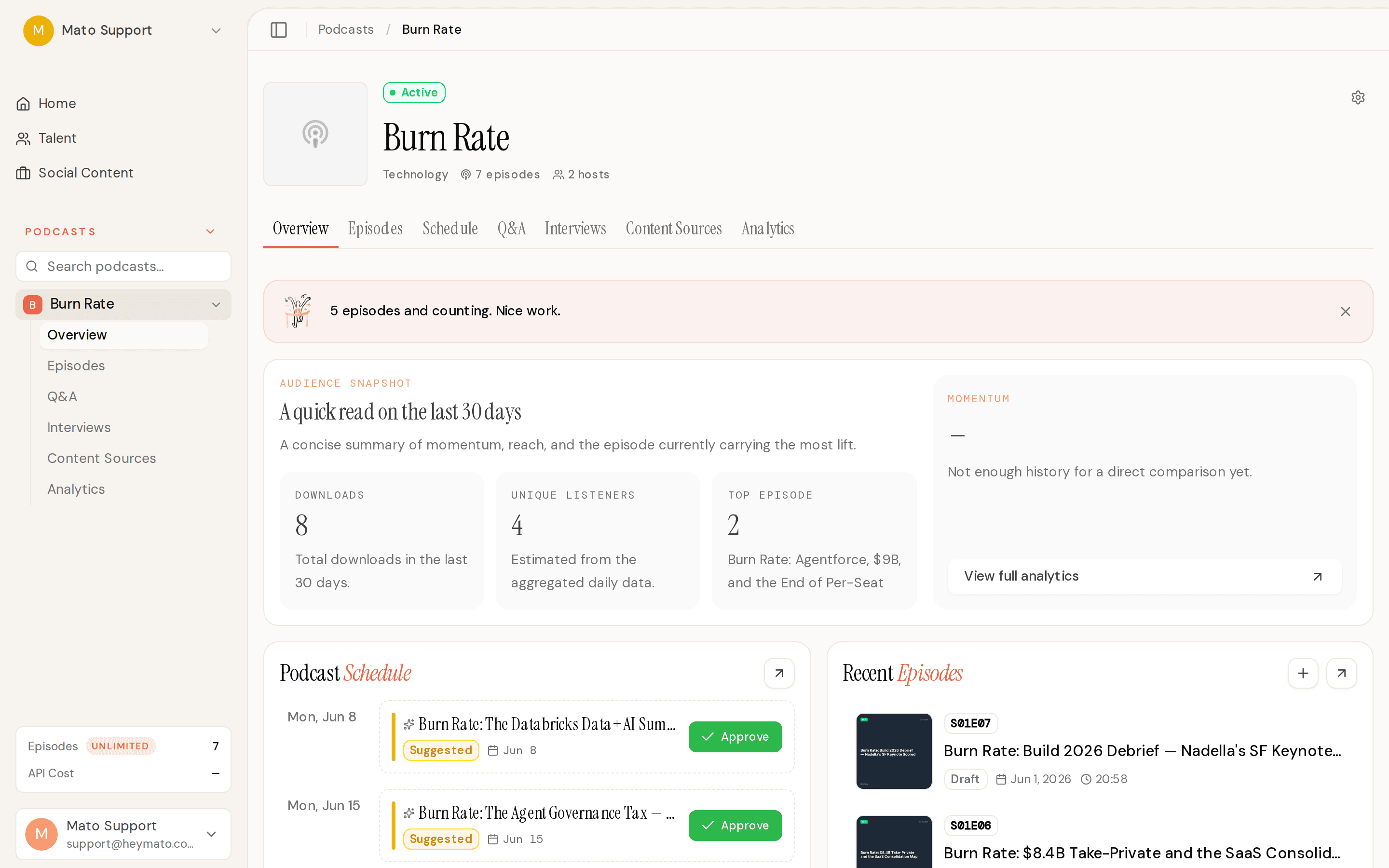
Daily podcasts can now pick which days of the week to publish. A row of toggle buttons (Sun through Sat) appears in both the settings cadence section and the creation wizard when you choose Daily frequency. All seven days are active by default. Select Monday through Friday for a weekday-only show, or pick any combination you want. Existing daily podcasts continue publishing every day unless you change the setting.
Click-to-edit host lines in interview episodes
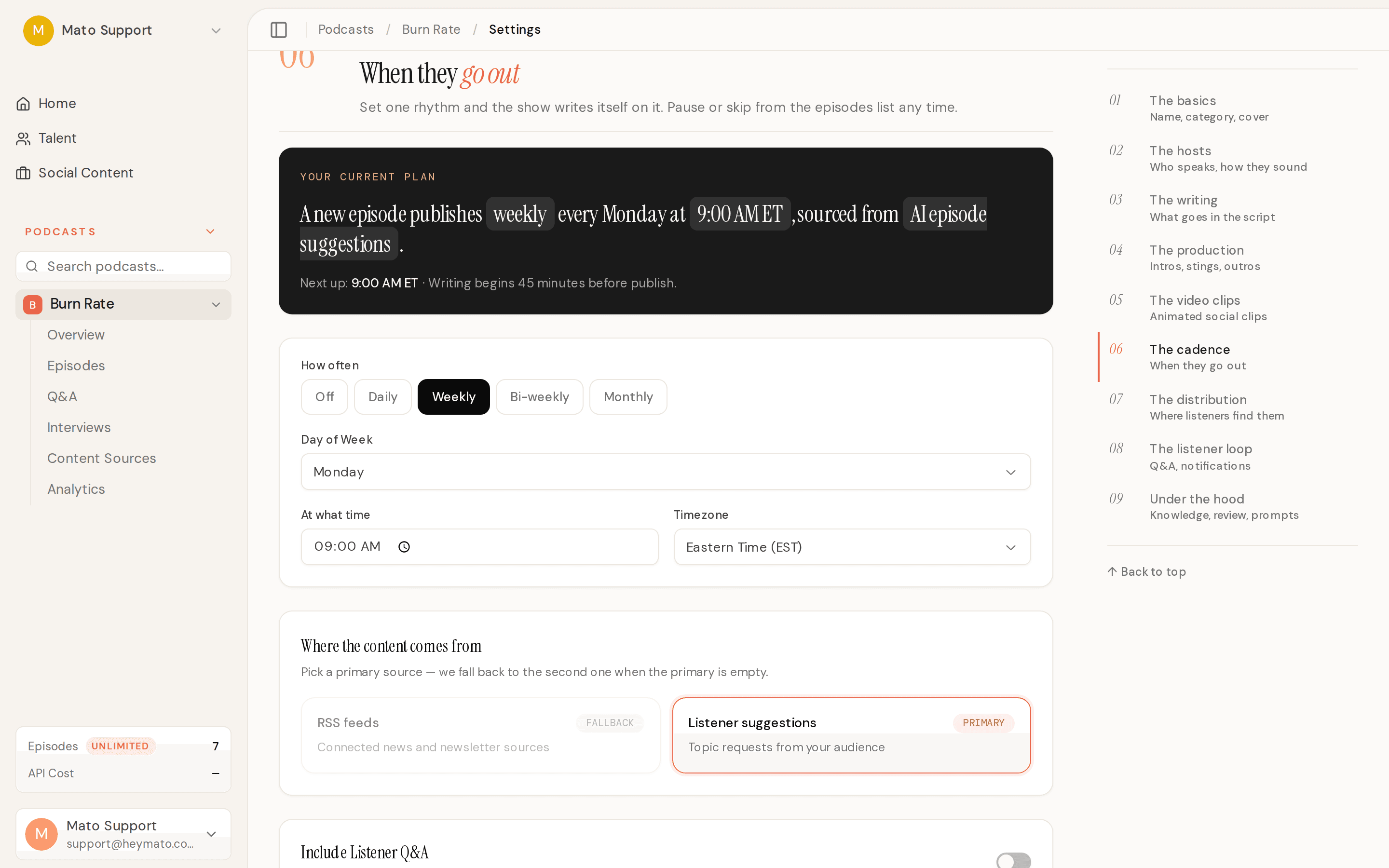
The interview edit page now uses a click-to-edit pattern for host lines instead of showing every line as an always-open textarea. Host turns appear as plain text with a pencil hint on hover. Click to open an auto-growing editor, press Cmd+Enter to save or Escape to cancel. Guest turns stay read-only. Each line saves independently, and edited text is honored during episode regeneration.
Improvements
Redesigned podcast creation wizard
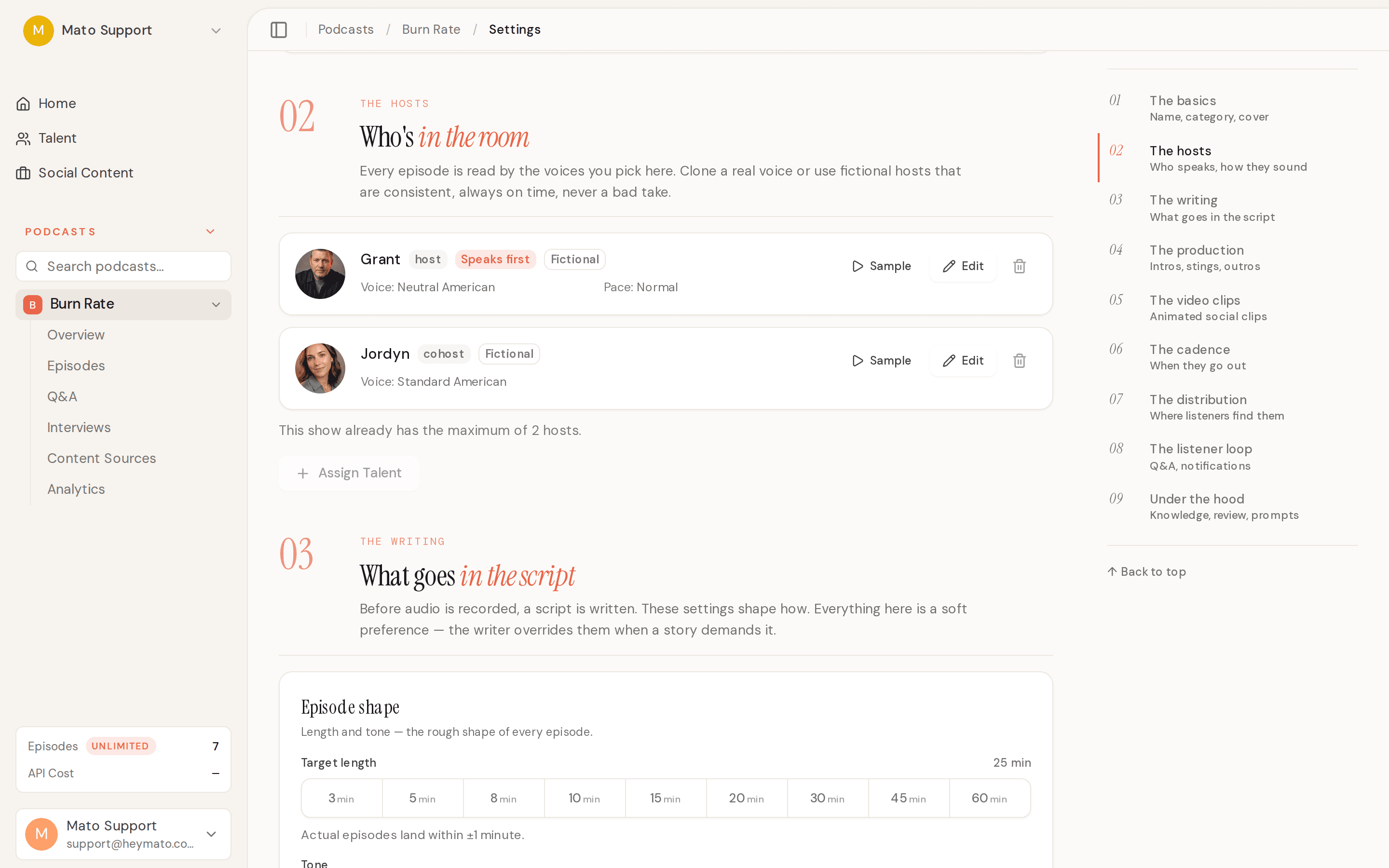
The five-step wizard got a full visual overhaul. Steps 2 and 3 now use numbered accordion sections that mark themselves done as you complete them. Host cards in step 4 show portrait banners, role badges, and voice metadata pills. The talent picker now shows both platform templates and your own custom talents. Step 5 fires confetti and points you to distribution settings instead of a page that would 404. Dark mode works across all steps.
Better interview audio pacing
Host questions in interview episodes now get director-style voice coaching and mood hints based on the guest's previous answer. The gap between a guest's answer and the next host question was increased from 40ms to 700ms, giving the episode a more natural conversational rhythm. This pacing is preserved even when you regenerate individual sections.
Live transcript gets real-time indicators
The live transcript panel in the interview room now shows what the host is doing in real time. A shimmer chip in the header indicates Speaking, Thinking, or Listening states. Emotion tags like [happy] or [curious] render as colored pill chips instead of raw brackets. Non-verbal placeholder turns like [listening] are filtered out so they don't clutter the transcript or get read aloud in the final episode.
Unique voice descriptions for search
All 23 Gemini voices now have unique, specific descriptions and tagged styles instead of the generic "Male/Female voice with distinct characteristics" placeholder. Searching the voice picker for terms like "documentary", "tech", "calm", or "storytelling" now returns meaningfully different results.
Nora Producer v2
The behind-the-scenes AI producer that guides interviews was rebuilt. Nora Desk (the between-turn planner) now runs with the full guest context, including LinkedIn facts, suggested questions, and a rolling transcript summary. Nora Live (the in-turn decision maker) is now LLM-driven instead of purely rule-based, reading the Desk plan and current moment to author contextual cues. Duplicate question suppression and reconnect state preservation are built in.
Mato Player listener telemetry
The embedded Mato Player now tracks listener engagement: impressions, play/pause events, progress milestones, seeks, speed changes, and completion. All events are stored with account, show, and episode dimensions for analytics. Audio URLs are tagged so media logs can distinguish Mato Player traffic from other sources.
Bug fixes
Live interview recording got a deep reliability pass across 18 debugging sessions. The host audio track could silently lose data when the browser's AudioContext suspended during recording. A constant source signal now keeps the encoder running. Recording segments rotate every 15 seconds instead of 60 to minimize data loss on page refresh, and a server-authoritative segment cursor prevents post-refresh overwrites. Auto-reconnect on page load eliminates the dead time gap where users had to manually click "Reconnect" after a refresh.
Interview duration accounting was fixed. A stale sessionStorage offset from prior attempts on the same invite token could inflate the reported duration to 10 minutes for a 2-minute interview. Duration is now clamped server-side, and the restore key is scoped per token.
The generation progress UI no longer gets stuck when a job fails with a null error message. Canceling a job that finishes right before the cancel arrives (409 response) now closes the dialog cleanly instead of showing an error toast.
Custom host invite previews no longer return 500 when the invite has a selected host that is not one of the configured demo hosts.
Podcast card titles and hero headings no longer clip descenders on letters like g, y, and p.