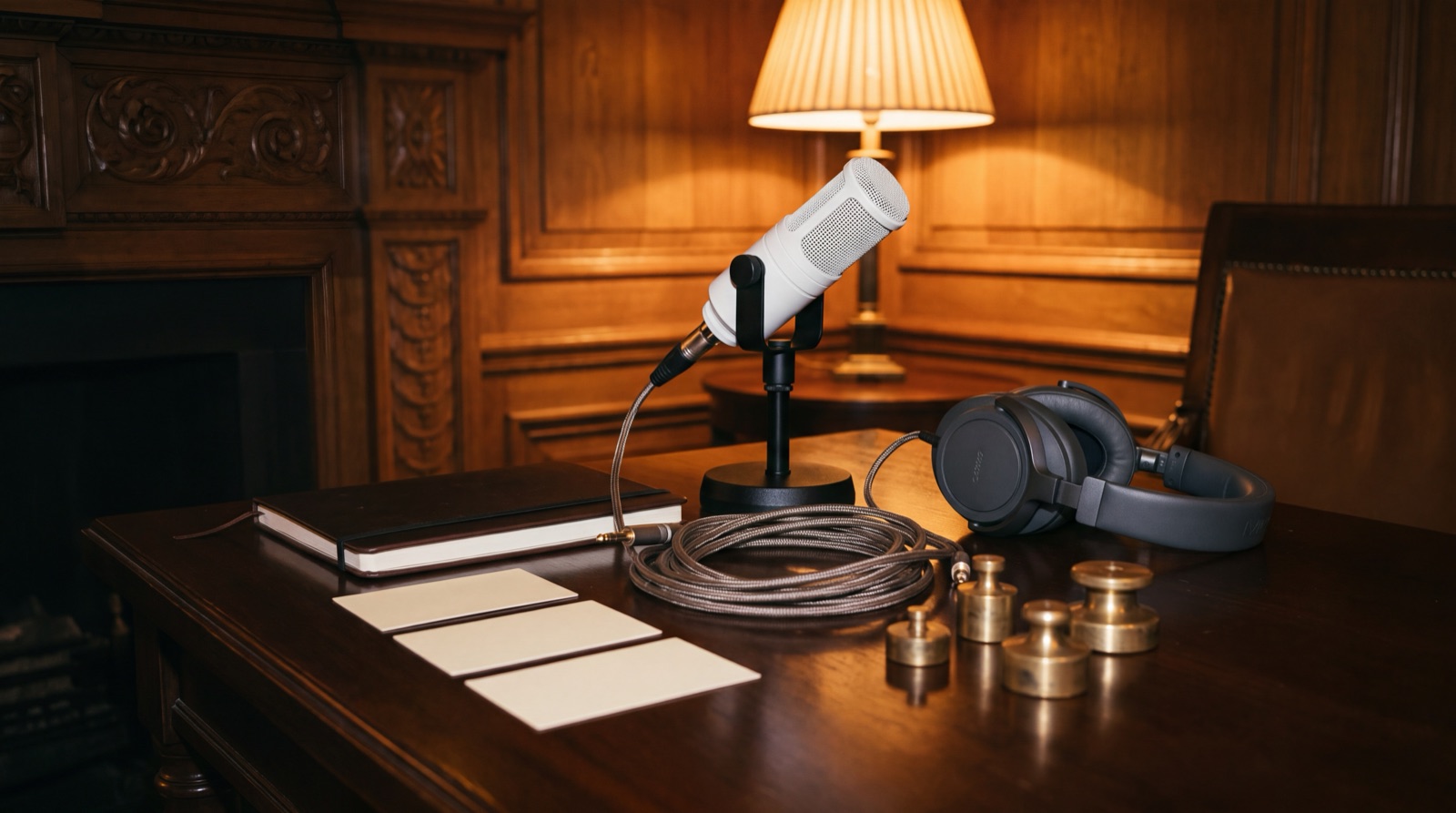
The fastest way to find out whether a company podcast should exist is not to name it, design the cover, or buy a microphone. Plan the first three episodes.
Three episodes are enough to expose the decisions that a vague show concept hides. You have to choose who will speak, what each conversation is actually about, why the same audience would want all three, how often you can repeat the process, and who has to approve the result.
That is a much better test than asking whether “a podcast would be good for the brand.”
If you want the concrete version first, use the free 3-episode podcast pilot builder. It turns three choices into a sample pilot with guest types, episode angles, opening questions, follow-ups, takeaways, and a realistic cadence. No email gate.
Why three episodes are a better starting point than a show name
A show name can make an idea feel more developed than it is. So can a logo, a trailer, or a list of broad themes.
An episode plan is less forgiving. It has to answer five operational questions:
- Who has firsthand knowledge worth hearing?
- What question can that person answer better in conversation than in another article?
- Why would the same audience care about the next episode?
- Can your team repeat the preparation and approval work at the planned cadence?
- What happens after the recording?
If those answers are weak by episode three, a polished launch will not fix the underlying show.
If the answers get stronger as you plan each episode, you are beginning to see the actual format.
Episode 1 should prove that the premise produces a useful conversation
Start with the guest or source you can access now, not the dream guest you hope to book six months from now.
For a B2B company, that might be a customer, executive, analyst, engineer, advisor, or operator. For a media company, it might be an existing contributor, creator, athlete, specialist, or reporter. For an agency, it may be a client expert whose knowledge is already being turned into webinars, articles, or social content.
Then give the episode one decision-sized question.
Weak:
“Let’s talk about the future of AI in finance.”
Stronger:
“Where are financial firms actually refusing to automate, and why?”
The stronger version gives the guest something to react to. It gives the interviewer room to ask why, request an example, challenge a generalization, or follow an unexpected answer.
Your first episode is testing whether the show premise creates specificity, not whether the recording sounds like a finished network production.

What to write before recording episode 1
Keep the brief small:
- one audience
- one central question
- three to five facts or source points that matter
- one boundary the conversation should not cross
- one example you hope the guest can explain
- one useful outcome for the listener
Do not write a script for the guest. If the value of the format is expert conversation, over-scripting removes the part you are trying to test.
Episode 2 should prove that the idea is repeatable
The second episode is where many podcast concepts break.
Episode 1 can survive on founder energy, a favorite guest, and a topic everyone already understands. Episode 2 asks whether there is an actual editorial system underneath it.
Keep the audience and format stable. Change the person, case, or decision.
For example, a wealth-management show might move from “what retirees misunderstand about sequence-of-returns risk” to “when an estate plan stops matching the family it was written for.” Different specialist, same audience promise: useful decisions explained by people who work on them.
A media network might move from one athlete’s preparation routine to another insider explaining a tactical decision. An agency might move from one client’s customer story to another executive unpacking the choice behind a result.
The question is simple:
Does this still feel like the same show when the first guest is gone?
If not, your premise may be a one-off interview rather than a recurring format.
Episode 3 should prove that the operating model works
By the third episode, stop evaluating only the editorial idea. Measure the workflow.
Track what required a person:
| Step | What to measure |
|---|---|
| Guest or source selection | Minutes to identify and confirm the right person |
| Brief preparation | Minutes to gather context, questions, and boundaries |
| Scheduling | Number of messages or handoffs required |
| Recording | Time spent by host, guest, and producer |
| Review | Number of review rounds and correction types |
| Packaging | Time for title, description, transcript, clips, artwork, and distribution |
| Approval | Who had to approve and how long the episode waited |
The third episode should answer the question that matters commercially: can we repeat this without a heroic amount of coordination?

A format that produces strong conversations but consumes two days of senior-team coordination every week is not yet a reliable company media system.
Test the guest bench before you test the brand
One of the easiest ways to overestimate a podcast idea is to assume there will always be someone interesting to interview.
Write down the next ten credible voices before launch. They do not all need to be famous. They need to have firsthand knowledge that fits the show’s promise.
A strong guest bench often already exists inside the business:
- customers with a real before-and-after story
- executives who make consequential decisions
- technical specialists who can explain trade-offs
- advisors or analysts who see recurring client questions
- partners who work across several companies
- contributors who already appear in written or live formats
If you cannot name ten realistic voices, lower the cadence or narrow the format before you build the brand around it.
If you can name 30, the production model matters more. Your problem is probably not access to expertise. It is turning that access into publishable conversations consistently.
Give the first three episodes one job
A pilot becomes easier to evaluate when the show is hired for one job.
Common jobs include:
Build authority
The episodes should reveal useful judgment that is difficult to get from generic search results. Measure depth, specificity, and whether sales or customers reuse the conversations.
Capture customer stories
The episodes should surface decisions, constraints, implementation details, and outcomes in the customer’s own words. Measure how useful the finished conversations are in sales and customer education.
Create a contributor format
The episodes should give an existing expert or creator bench a repeatable way to publish more original material. Measure throughput, programming fit, and how much new production work the format creates.
Support a vertical or sponsorship package
The episodes should create a focused body of inventory around a valuable audience or topic. Measure whether the format can exist at an economic production cost before projecting sponsorship revenue.
Do not make a three-episode pilot responsible for brand awareness, demand generation, executive thought leadership, customer advocacy, and direct revenue at the same time. You will learn nothing because every result can be explained away by another objective.
Choose the cadence after you see the work
A weekly show sounds more serious than a monthly one. That does not make it better.
Use the pilot to calculate the cadence your guest bench and review process can actually support.
If one episode requires several days of guest coordination and legal review, a weekly promise will create pressure immediately. If the expert bench is deep and the approval path is simple, weekly or biweekly may be realistic.
The best cadence is the fastest schedule you can keep without lowering the quality of the guest, the question, or the review.
It is easier to increase frequency after a six-episode run than to repair a show that starts weekly and disappears after a month.
Keep the first pilot private
A pilot is more useful when the team can change its mind.
Record or build the first three episodes privately. Review them as working material, not as public commitments. Look for:
- questions that produced generic answers
- follow-ups that exposed the real story
- sections that required factual correction
- topics the guest understood differently from the team
- review steps that protected the brand
- production tasks nobody should repeat manually
- moments that would make the same audience want episode 4
Only then decide what should be published, re-recorded, shortened, or discarded.
That is also the right time to decide whether the show needs a human host as part of the product. Some shows absolutely do. A personality-led creator show or a narrative program built around a specific journalist is not the same problem as recurring expert interviews.
For teams whose value comes from the guest’s expertise, the host may be production infrastructure rather than the reason people listen.
What an AI interviewer changes
Mato is built around an AI host interviewing a real human guest live. The guest remains the source of the substance. The system listens, asks, and follows up; the publisher retains the editorial boundaries and final approval.
The architecture separates two timing problems. The live host has to react quickly enough for a natural exchange. A slower producer layer can track the wider interview arc and what should happen next. AI Business recently profiled that design.
That model is useful when a company, agency, or network already has credible people to interview but cannot justify assigning a human host and production team to every recurring format.
It is not a reason to publish more mediocre interviews. It is a way to test formats whose economics or scheduling would otherwise stop the conversation from happening.
A simple three-episode scorecard
After episode 3, score the pilot from 1 to 5 on each dimension:
| Dimension | Question |
|---|---|
| Audience fit | Would the same specific audience choose all three episodes? |
| Guest depth | Did each guest know something worth hearing firsthand? |
| Repeatability | Can you name the next five episodes without stretching the premise? |
| Conversation quality | Did follow-ups uncover information the brief did not already contain? |
| Review burden | Can your team approve an episode without creating a new project every time? |
| Production burden | Can the recurring work fit the intended cadence? |
| Reuse value | Did the episode produce material useful beyond the podcast feed? |
Do not average the scores blindly. A 2 on repeatability or guest depth is a bigger problem than a 2 on artwork or promotional packaging.
The pilot is successful when it makes the next decision obvious: launch, revise, lower the cadence, change the format, or stop.
Build the pilot now
You can do this on a blank document. Write three guest types, three questions, and one cadence, then evaluate the operating work honestly.
Or use Mato’s free 3-episode podcast pilot builder. Choose the voices you already have access to, the job the show needs to do, and a realistic cadence. It will return a concrete three-episode plan with opening questions, follow-ups, takeaways, and a repeatable operating plan.
No email is required.
If the resulting pilot looks worth producing, have Mato run the pilot and judge the finished conversations rather than a pitch deck.
FAQ
How many podcast episodes should I plan before launch?
Plan at least three concrete episodes before launch. Three is enough to test whether the same audience, format, guest bench, and production workflow remain coherent after the first easy idea.
Should I record episodes before choosing a podcast name?
For a company or expert-interview show, it is often useful to plan or privately record the pilot before spending much time on naming and branding. The conversations reveal the real format and language of the show.
What should a podcast pilot test?
Test audience fit, guest quality, repeatability, conversation depth, review burden, production burden, cadence, and the value of the finished material outside the feed.
Should the first three episodes be published?
Not necessarily. A private pilot gives the team room to change the format, correct the workflow, or discard a weak episode without a public commitment.
When does an AI podcast host make sense?
It makes sense when the human guest or expert is the source of the value and the recurring bottleneck is host scheduling and production capacity. It is a weaker fit when a specific human host’s personality or authorship is the main reason people listen.