Mato just raised pre-seed Read more

Podcast charts
Published by Todd Conklin
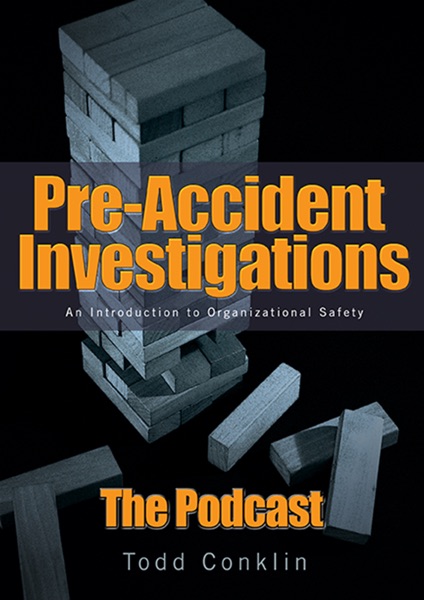
The Pre Accident Podcast is an ongoing safety podcast conversation of Human Performance, Systems Safety, & Safety Culture.
On the charts
Every published chart this podcast appears in, in the snapshot behind this page. Each one links to the chart it came off.
From the feed
The latest episodes published to this podcast’s own RSS feed. Titles and descriptions are the publisher’s.
In this episode Todd Conklin talks with David Keeling, Assistant Secretary of Labor for Occupational Safety and Health, about OSHA’s shift toward partnership, refreshing VPP, the new Safety Champions program, and focusing on serious injuries and fatalities (SIF). They discuss mental health, vehicle safety, leadership’s role, predictive analytics, and incentives to drive abatement and innovation so employers and regulators can work together to prevent catastrophic events.
Todd joins James Newman and Ken Madsen on a special excerpt from the Counter-Errorism podcast to discuss productive safety, leadership change, and how investigations should inform solutions rather than impose them. They cover practical ideas: shifting leaders' thinking, treating workers as problem-solvers, using judgments of need, and how DOE-style investigations differ from industry practices.
Todd Conklin hosts Jen Long on the Pre-Accident Investigation Podcast to introduce "accountability labs": practical, small-group exercises that help teams practice having each other’s back instead of weaponizing blame. The episode explains how labs create psychological safety and readiness through real scenarios, skill-building, and debriefs so participants develop the language and muscle memory to speak up when it matters. Listeners will learn who benefits (middle managers, safety teams, healthcare, operations), what to expect from a lab, and the promise—and risks—of turning accountability into a sustained, constructive practice.
Host Todd talks with safety professional and singer-songwriter Toni Vere about human and organizational performance (HOP), accountability, and the power of fixing systems instead of blaming people. Toni performs "Don't Shoot the Dog," a song that turns shop‑floor experience and worker expertise into a memorable lesson on creating safer, smarter workplaces.
Host Todd Conklin chats with Harvard’s Amy Edmondson about psychological safety, learning from failure, and how leaders can create workplaces where people speak up and learn. They cover just culture, systems thinking, and practical steps to choose curiosity over certainty. This warm, wide-ranging conversation blends research with real-world stories and leaves listeners with a clear call to action: build environments that support candid dialogue and collective learning.
Part two of a deep conversation with Professor David Woods examines five decades of safety practice and argues for a stronger science base, foresight, and continual revitalization. Topics include the Command–Adapt Paradox, the fluency law, the law of stretch systems, and the novelty inequality, showing why plans must be paired with guided adaptability. The episode urges putting safe and effective outcomes first, working together to innovate, and rebuilding practical tools and research so safety programs scale and adapt in an increasingly complex world. Here is the cited article for your reading pleasure: https://link.springer.com/chapter/10.1007/978-3-031-45055-6_8#:~:text=The%20Command%E2%80%93Adapt%20Paradox%20arises,%E2%80%9D%E2%80%94being%20poised%20to%20adapt.
https://link.springer.com/chapter/10.1007/978-3-031-45055-6_8#:~:text=The%20Command%E2%80%93Adapt%20Paradox%20arises,%E2%80%9D%E2%80%94being%20poised%20to%20adapt. Todd hosts Dr. David Woods in a two-part episode challenging the current state of safety science, arguing for more synthesis across disciplines and a shift from one-off fixes to ongoing capacity for safe, effective, and viable organizations. They examine the history and fragmentation of safety work, the rise of resilience thinking, barriers like short-term pressure and limited budgets, and why the safety community must collaborate to create stronger, long-term approaches.
Join Ra Donda Vought and Todd Conklin and they meet up to discuss how Ra Donda has refined her message to the world and how surprised she is in other, non-medical industry. It is always so much fun to talk with Ra Donda - she has great energy and is so much fun to spend time in discussion. See what you think - I think you will enjoy this Pod a bunch.
Join Todd and Dr. Anne Lynne from the CHOL conference as they explore “modern safety” in children’s hospitals and the SPS mission — how new lenses on risk, leadership behaviors, and a willingness to try small experiments are reshaping safety, reliability, and improvement work. They discuss practical examples like reducing unplanned extubations, the role of leaders in creating capacity and permission, and how sharing success stories fuels innovation and wider adoption across healthcare.
Host Todd interviews his mother, Gyla Conklin, who recounts a true 1933 encounter when her father, Bill Brock, and friends were held up by Bonnie and Clyde near Meade, Kansas. The episode highlights a dramatic rescue at a park, a croquet mallet that saved the day, and a family newspaper account. Short, vivid, and personal, this episode underscores why recording family stories matters and offers a human look at a famous criminal story.
Todd Conklin talks with Rob Fisher about how leadership, workforce shifts and compassion are reshaping safety and reliability. They explore why organizations must move from fixing problems to improving systems, and how worker engagement becomes the key source of learning. The episode covers practical approaches—small experiments, better leader conversations, and data from observations (TEDS)—that help leaders act differently without adding more work. They also discuss legacy, cultural change, and why a pull from curious leaders and workers is replacing the old push. Listen for concrete questions leaders can ask, ways to prototype improvements, and a reminder that compassion leads and safety follows.
This episode recounts a medical emergency that occurred during a large conference and explains how a quick critical incident stress debrief helped restore the group and the organization. Todd outlines a simple restoration framework—who's hurt, what they need, and who will help—and walks through a seven-step debrief process that turns trauma into learning, supports people emotionally, and improves future response.
Host Todd Conklin interviews Red Bull athlete Will Gadd about adventure sports, recent tragic incidents (a parachute crash in Butler, Mo., a Moab base-jump, and a bungee failure), and how the outdoor world approaches risk. The episode explores the difference between being robust and being resilient, the limits of individual skill, and how controls, recoverability, and community learning can reduce harm in high‑hazard activities.
In this episode Todd Conklin explores the paradox of procedures: they keep work stable but also limit flexibility. He explains how procedures can be both necessary and constraining in high-risk, high-consequence environments. Todd highlights the value of incremental safety—making small, thoughtful changes over time—while building communities of practice to better prepare organizations for an uncertain future. He closes with practical advice: treat procedures as thresholds rather than one right way, focus on learning from everyday work, foster resilient systems, and remember to take care of yourself while having some fun.
Todd Conklin talks with Gilval Menezes about Brazil’s growing movement to adopt the New View of safety: translating resources into Portuguese, building community, publishing a field guide, and running learning teams to shift culture away from blame. They discuss practical work on HOP implementation, the cultural challenges of translation, the urgency driven by workplace fatality rates, and the push to develop methods that fit Brazil and wider Latin America.
Todd chats with Ron Gantt about the future of safety — from AI-driven pre-task tools to the limits of rote checklists — and why listening to frontline workers matters more than ever. They explore leadership’s role in shaping responses to incidents, bridging power gaps with contractors, and designing systems that actually support real work. Through examples from healthcare to construction and candid anecdotes, the episode argues for intentional, human-centered change: test tools in context, focus on creating success, and set leaders up to respond thoughtfully when things go wrong.
In this part two conversation, Todd Conklin and Bob Edwards explore what the future holds for operational learning and safety. They discuss learning teams, storytelling, the power of curiosity and not-knowing, and how the people closest to the work provide the best solutions. The episode highlights successes from pediatric patient safety, the Navy, and industry examples, and emphasizes cultural shifts away from quick fixes and metrics toward continuous, practical improvement and clearer stop-work practices.
Todd Conklin and Bob Edwards discuss Solutions for Patient Safety (SPS), a grassroots movement of learning teams that used operational learning to dramatically reduce harm in pediatric care. The episode covers emotional stories from the SPS meetings, practical methods like soak time and learning teams, the power of continuous improvement, and the real-world impact of saving thousands of young lives.
In this episode, Todd Conklin questions whether risk can ever truly be removed or if it simply moves around. He distinguishes between hazards and risk, discusses how organizations shift risk through contracting and worker practices, and argues that while hazards can be managed, risk remains dynamic and persistent. Todd also highlights the role of controls, barriers, and margin in starting work safely, and teases upcoming conversations on psychological safety, AI and safety, and leadership.
Todd Conklin interviews Martha Acosta, a pioneer in human performance and instructional design, about using organizational "pain points" and paradoxes as early indicators of system failures. They discuss why near misses and workplace frustrations are valuable signals and how leaders can turn those tensions into opportunities for learning and improvement. The episode offers practical advice for managers: be present, look for pressure points across roles, and treat minor pains as diagnostic cues to prevent larger incidents. Martha translates high-level ideas into actionable steps leaders can use tomorrow.
Ranking source
Apple Podcasts rankings via the Mato Topic Intelligence Platform.
Observed September 20, 2026.
Apple and Apple Podcasts are trademarks of Apple Inc., registered in the U.S. and other countries.
Pairs with
Bring this source into Mato to read its transferable patterns, then turn them into an original show for your own audience.