Mato just raised pre-seed Read more

Podcast charts
Published by cxcpub@cfa.harvard.edu (Chandra webmaster)
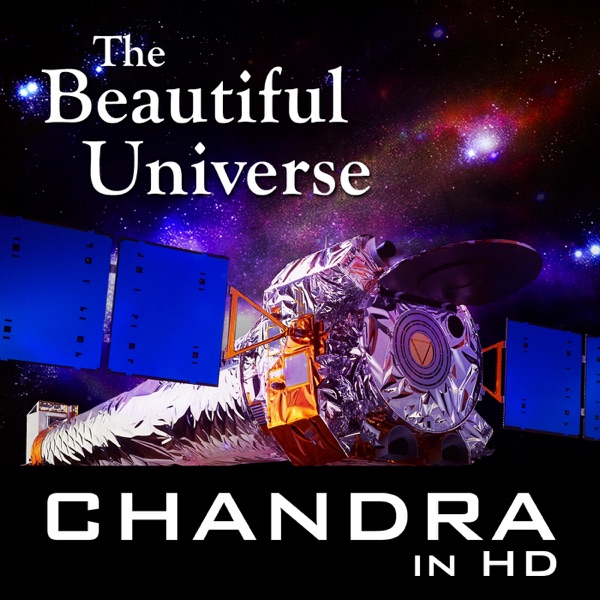
High definition views of Chandra's exciting science
On the charts
Every published chart this podcast appears in, in the snapshot behind this page. Each one links to the chart it came off.
From the feed
The latest episodes published to this podcast’s own RSS feed. Titles and descriptions are the publisher’s.
Before fall gives way to winter in the northern hemisphere, NASA's Chandra X-ray Observatory has several images that celebrate autumn and its many delights to share.
A black hole is growing at one of the fastest rates ever recorded. This discovery from NASA's Chandra X-ray Observatory may help explain how some black holes can reach enormous masses relatively quickly after the Big Bang.
The star that exploded to become the Cassiopeia A supernova remnant appears to have undergone a dramatic event right before its demise. New evidence from Chandra indicates that the star's interior was violently rearranged just hours before the explosion.
In 2009, Chandra released a captivating image: a pulsar and its surrounding nebula that is shaped like a hand. Since then, astronomers have used Chandra and other telescopes to continue to observe this object.
A baby planet is shrinking from the size of Jupiter with a thick atmosphere to a small, barren world, according to a new study from NASA's Chandra X-ray Observatory.
Astronomers study Andromeda to better understand the structure and evolution of our own spiral galaxy, the Milky Way.
A black hole has blasted out a surprisingly powerful jet in the distant universe. This jet exists early enough in the cosmos that it is being illuminated by the leftover glow from the big bang itself.
New observations have captured a powerful cosmic event: two galaxy clusters have collided and are now poised to head back for another swipe at each other.
Scientists have discovered a star behaving like no other seen before, giving new clues about the origin of a class of mysterious objects.
This new trio of sonifications represents different aspects of black holes.
Astronomers have discovered a black hole has torn apart a star in a surprising location.
Astronomers have discovered a likely explanation for a fracture in a huge cosmic "bone" in the Milky Way galaxy, using NASA's Chandra X-ray Observatory and radio telescopes.
New three-dimensional (3D) models of objects in space have been released by NASA's Chandra X-ray Observatory. These 3D models allow people to explore – and print – examples of stars in the early and end stages of their lives.
People often think about archaeology happening deep in jungles or inside ancient pyramids. However, a team of astronomers has shown that they can use stars and the remains they leave behind to conduct a special kind of archaeology in space.
After tracking a puzzling X-ray signal from a dying star for decades, astronomers may have finally explained its source: the old star might have destroyed a nearby planet.
A bouquet of thousands of stars in bloom has arrived. This composite image contains the deepest X-ray image ever made of the spectacular star forming region called 30 Doradus.
Astronomers have taken a crucial step in showing that the most massive black holes in the universe can create their own meals.
Planets around other stars need to be prepared for extreme weather conditions, according to a new study from NASA's Chandra X-ray Observatory and ESA's XMM-Newton that examined the effects of X-rays on potential planets around the most common type of stars.
Since antiquity, wreaths have symbolized the cycle of life, death, and rebirth. It is fitting then that one of the best places for astronomers to learn more about the stellar lifecycle resembles a giant holiday wreath itself.
Astronomers have found an unusual mark from a giant black hole's powerful jet striking an unidentified object in its path.
Ranking source
Apple Podcasts rankings via the Mato Topic Intelligence Platform.
Observed November 4, 2026.
Apple and Apple Podcasts are trademarks of Apple Inc., registered in the U.S. and other countries.
Pairs with
Bring this source into Mato to read its transferable patterns, then turn them into an original show for your own audience.