Mato just raised pre-seed Read more

Podcast charts
Published by The Guardian
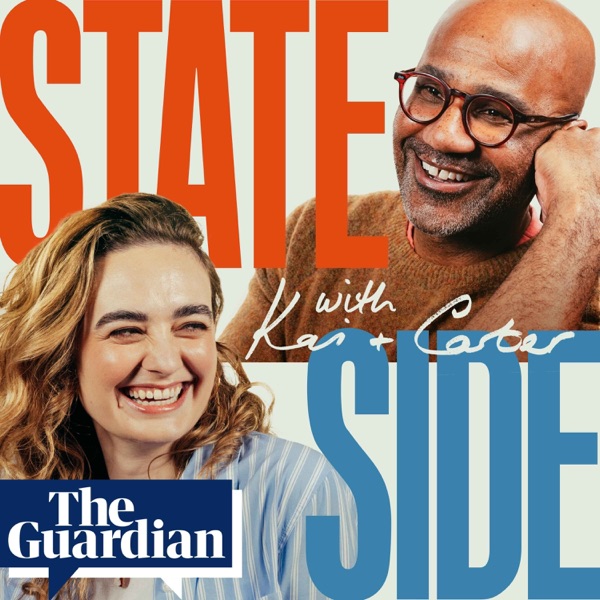
The news is stressful. Talking about it doesn’t have to be. Join The Guardian’s Kai Wright and Carter Sherman for conversations with the best journalists and biggest thinkers. New episodes every Tuesday and Thursday Hosted on Acast. See acast.com/privacy for more information.
On the charts
Every published chart this podcast appears in, in the snapshot behind this page. Each one links to the chart it came off.
From the feed
The latest episodes published to this podcast’s own RSS feed. Titles and descriptions are the publisher’s.
In a new book, writers Naomi Klein and Astra Taylor have created a term to define the era we are living in: End Times Fascism. A response to the climate crisis, the rise of the far-right and advancing AI technology, they spell out how the damage being wrought by the super-rich is becoming normalized. Klein and Taylor join Carter Sherman to talk about the recent events that have made us all feel like we’re hurtling towards the apocalypse, and how we can fight back through ‘hereness’. End Times Fascism And The Fight For The Living World is out now. Hosted on Acast. See acast.com/privacy for more information.
A former Anthropic researcher’s apocalyptic declaration about artificial intelligence has led to a global panic that the technology might be the end of us all. At an event in Washington today to warn about the dangers of AI, US senator Bernie Sanders said that Congress has been ‘asleep at the wheel'. Oddly, Steve Bannon appeared at the same event. But is this response a distraction from the more immediate problems AI is already causing? Kai Wright and Carter Sherman are joined by Guardian tech reporter Johana Bhuyian to put this moment in context, and she explains why we should be cynical about industry calls for regulation Hosted on Acast. See acast.com/privacy for more information.
What are we going to do about kids and social media? Lawsuit after lawsuit has accused the biggest social media platforms in the US of designing their products to be addictive and of endangering children. Meta recently settled one of those lawsuits, agreeing to pay up to $17.1bn in penalties and to limit how kids use its platforms, like Instagram and Facebook. (They did not admit to any wrongdoing.) The rest of the world is embracing a different solution that tech journalist Taylor Lorenz tells Carter Sherman would forever change the way we use the internet: social media bans. Last year, Australia became the first country to ban people under 16 from social media, and this week, the European Union is expected to propose a similar ban. If it goes into effect, the EU ban would be, by far, the world’s biggest effort to block kids from social media. But, as Lorenz points out, these laws raise all kinds of questions about civil liberties, data privacy, and the future of free speech on the internet. Hosted on Acast. See acast.com/privacy for more information.
Charlie Kirk's death created a vacuum of power that still consumes the Maga right a year later. Immediately after Kirk was shot and killed, his ultraconservative activist organization Turning Point USA announced that his widow, Erika Kirk, would replace her late husband as CEO. But as Guardian reporter J Oliver Conroy tells Kai Wright , conspiracy theories pushed by Kirk's former allies and proteges have dogged both the organization and Erika Kirk herself. Real questions remain about whether Erika Kirk can maintain the enormous power and influence Turning Point holds on the right and what she is planning to do with the organization. Conroy spent months reporting on Charlie Kirk’s legacy talking to dozens of people within Turning Point USA and the larger Maga movement who view Charlie Kirk as a martyr. Conroy says martyrdom is a powerful force that can’t be controlled. J Oliver Conroy's Guardian story on Charlie Kirk and Turning Point USA: Grief, fury, conspiracy: inside Turning Point USA after Charlie Kirk’s killing Hosted on Acast. See acast.com/privacy for more information.
In the hours after the 9/11 attacks, the journalist Rozina Ali remembers her parents telling her that as Muslims, they would now be under suspicion. It took years for Ali to understand what they meant. She talks to Carter Sherman about this journey and how it led her to write about the history of Islamophobia in the US. Ali explores how attacks on Muslims by successive administrations since 9/11 cemented Islamophobia in all areas of American life, and she explains why she believes these prejudices are more pervasive now than ever. Seasons of Fury: Four Families, and the Rise of Islamophobia in America by Rozina Ali is out now Hosted on Acast. See acast.com/privacy for more information.
Stateside with Kai and Carter is taking a short end of summer break. We'll be back with new episodes after Labor Day. Make sure to catch previous episodes on YouTube, Apple, or Spotify. See you soon! Hosted on Acast. See acast.com/privacy for more information.
The trial of Lindsay Clancy, a former nurse accused of murdering her three children, is wrapping up its fifth week. On Friday morning, the defense rested, and the public attention to the case is at a fever-pitch — especially on social media. Clancy, 36, does not deny that she strangled her children, but has pleaded not guilty due to lack of criminal responsibility, also known as an insanity defense. She argues that she was in the throes of postpartum psychosis, a rare and devastating condition that can go unrecognized and untreated. Host Carter Sherman speaks with Jenna Amatulli, deputy head of news for Guardian US, about how the case has renewed attention on the fundamental shortcomings in America's maternal healthcare system, and about why Clancy's story has captivated—and polarized—so many people. Correction added September 1st 2026: This episode referenced a study that appeared to overstate the prevalence of postpartum depression in the US as more than 80%. In 2020, the Centers for Disease Control found that about 1 in 8 women in the U.S. report experiencing symptoms of postpartum depression up to 6 months after giving birth. This was based on data the CDC analyzed from the Pregnancy Risk Assessment Monitoring System (PRAMS). Hosted on Acast. See acast.com/privacy for more information.
Ten months into a ceasefire in Gaza, Israel and Hamas seem like they are no closer to a real end to the war. Israel reportedly says they will carry on with their military operation until Hamas fully disarms. Hamas has said they will not begin disarming until Israel begins withdrawing. At the center of it all are Gazans living without the basic infrastructure of electricity, water sanitation and hygiene. Kai Wright speaks with two surgeons – Dr Mark Perlmutter and Dr Feroze Sidhwa – who worked under those conditions. The doctors are at the center of the new documentary, American Doctor , which chronicles what they witnessed first-hand while volunteering on the frontline in a Gaza hospital. The film follows the doctors and a third, Dr Thaer Ahmad, in their work on the ground and their subsequent return to the US to tell the media and congress what they saw. Hosted on Acast. See acast.com/privacy for more information.
When 18-year-old Nolan Wells went missing, his story immediately touched a nerve in Black families. He was last seen while hanging out with a group of white friends, at a popular beach near Ocean Springs, Mississippi. Nolan never came home from the trip, and he was found dead days later. Many questions about how he died remain unanswered publicly. And the mystery surrounding his death has revived an old conversation within Black communities: are we ever truly safe in white-dominated spaces? Who will feel responsible for our children’s safety when we send them out into a world where Black life is not valued? Host Kai Wright talks with historian Stacey Patton and writer Ashley Stoney about why Nolan Wells’ story has captured so much attention – and sparked so much anxiety – among Black parents, in particular. What does our collective reaction to Nolan Wells’ disappearance and death reveal about the limits of interracial society today? Hosted on Acast. See acast.com/privacy for more information.
We should, in theory, be happy. Thanks to our phones, we can do practically anything – listen to our favorite bands' entire discographies, have extravagant meals delivered to our door, travel the world through an endless scroll. So why do so many of these experiences feel so joyless? Why do so many of us feel so empty all the time? Hosts Kai Wright and Carter Sherman wrestle with these questions with academics Michèle Mendelssohn and Charlie Tyson , who argue that we are living in an era of decadence without pleasure. While decadence always arises in times of extreme inequality, they say that tools like AI and GLP-1s reveal how we've lost our ability to truly enjoy things – and, ironically, reclaiming decadence may help us finally have fun. Michèle Mendelssohn and Charlie Tyson’s Guardian essay: Why does everything feel joyless? Welcome to the age of decadence without pleasure Hosted on Acast. See acast.com/privacy for more information.
On 13 August, three states are set to carry out executions by lethal injection. It’s the first time since 2010 that three people will be put to death on the same day in the US. In Tennessee, the execution of Darrell Hines is in the spotlight, because the last lethal injection in the state was botched. Ed Pilkington speaks to Kai Wright about the doctor at the center of that botched execution, whose identity was revealed inadvertently last year. Ed explains how his reporting has lifted the lid on a role that is usually hidden away from public view, and what it tells us about the American death penalty today Hosted on Acast. See acast.com/privacy for more information.
Andrew Tate and his brother Tristan may soon be extradited back to the UK – but the manosphere influencers' case will have lasting consequences in the US, where the Tates reportedly maintained multiple ties to the Trump administration. (The Tates have been charged with rape, trafficking and numerous other crimes, but deny all criminal wrongdoing.) Host Carter Sherman talks with author and Guardian columnist Rebecca Solnit about what the Andrew Tate saga reveals about Republicans' approach toward sexual violence and Donald Trump's connections to the manosphere. They ask: do people secretly like it when the US president hates women? Hosted on Acast. See acast.com/privacy for more information.
An outspoken conservative endorsed by Donald Trump was sworn into office as Colombia’s new president on Friday. Abelardo de la Espriella is the seventh rightwing politician to take office in Latin America since the start of Trump’s second term. Kai Wright speaks to former US ambassador to Panama John Feeley about why the region is moving rightwards, and how it is boosting Trump’s foreign policy objectives, from immigration to containing China. Hosted on Acast. See acast.com/privacy for more information.
There are more than 120,000 Flock surveillance cameras in 6,000 communities across the US. These ALPRs (automatic license plate readers) are largely used by law enforcement, and have come under criticism from privacy campaigners, who say they are being used to surveil private citizens and target immigrants. Flock says their cameras are integral to public safety, but critics fear that the company is creating a mass surveillance network. Cities across the US are cancelling Flock contracts, but some concerned citizens feel the fightback isn’t happening quickly enough. Carter Sherman speaks to Sanya Mansoor about the underground vigilante movement taking matters into their own hands, and speaks to a self declared Flock vigilante known as Nomark, who is on a mission to destroy every Flock camera across the country Hosted on Acast. See acast.com/privacy for more information.
Democrats are pissed off – and they're taking their anger straight to the ballot box. In the wake of Donald Trump's return to the White House, progressives (including members of DSA – Democratic Socialists of America) have defeated established moderates in elections in liberal cities like New York, Washington DC and Seattle. Now, they're trying to win a series of major primaries in the deep-purple midwest. Host Carter Sherman speaks with Guardian midwest political correspondent Rachel Leingang , who has traveled all over the region covering several key races – including this week's Democratic Senate primary in Michigan, where progressive Abdul Al-Sayed is squaring off against the establishment candidate, Haley Stevens. Can leftist politics win outside of blue bubbles? And what do these races reveal about the fight for the midterms and the White House? Hosted on Acast. See acast.com/privacy for more information.
With Republicans' chances in the midterms looking shaky, Donald Trump is increasingly trying to rewrite the rules that govern US elections. Voting rights groups say he's really laying the groundwork to suppress voters. Trump has already moved to change mail-in voting, but he now wants Congress to pass the Save America Act, which includes strict voter ID restrictions. He's also accused China of interfering in the 2020 election. (Trump didn't back up that claim with evidence.) Host Kai Wright speaks with Garrett Epps, legal affairs editor at Washington Monthly, about the threat to US elections and what voters can do to protect them. Read Garrett Epps' story in Washington Monthly Hosted on Acast. See acast.com/privacy for more information.
After a lull in fighting, airstrikes between the US and Iran resumed Wednesday, killing at least 20 members of Iraq’s popular mobilization force. The conflict between the US and Iran has now entered its fifth month, with no obvious conclusion in sight. Analysts have warned that the latest escalations are pushing the Middle East region into "unchartered territory". Carter Sherman is joined by the Guardian’s senior international correspondent Julian Borger and Deepa Parent , an independent journalist who reports on Iran, to answer the question: is this a forever war? Hosted on Acast. See acast.com/privacy for more information.
A parasite called cyclospora has sickened thousands of people across at least 41 states and prompted waves of headlines about weeks-long "explosive diarrhea". But as Guardian health contributor and reporter Melody Schreiber tells host Carter Sherman , Donald Trump's cuts to the CDC and FDA have kneecapped the agencies' ability to contain the dangerous outbreak – which is now growing rapidly. Melody and Carter trace one food supplier's role in the outbreak, discuss the future of public health and reveal tips for safe eating and cooking. Read Melody Schreiber's reporting in the Guardian about cyclospora: Confusing product recall adds to US cyclospora outbreak uncertainty CDC cuts leave US less prepared for disease outbreaks, former officials warn Hosted on Acast. See acast.com/privacy for more information.
After years of trying to be skinny, Guardian reporter Madeleine Aggeler did a 180 and decided to 'bulk'. Bulking, or gaining weight on purpose to get stronger, challenged everything she had been taught about her body, and transformed her relationship to food. Madeleine speaks to Carter Sherman about her owns body image struggles, and they discuss why strength training and weightlifting has become so popular for women. Is this actually healthy, or just an extension of toxic diet culture? Hosted on Acast. See acast.com/privacy for more information.
Earlier this year, Congress reached a depressing milestone: 86% of Americans, a record high, disapproved of its job performance. But this summer, there have been some signs that shifts are underway. On the left, House Democrats have just voted in unprecedented numbers to withhold military aid from Israel, and across the country, progressive candidates are running competitive primary campaigns that are energizing a base fed up with the status quo. On the right, Republicans are reeling from the sudden death of South Carolina Senator Lindsey Graham, one of President Trump's staunchest supporters, and former Senate Majority Leader Mitch McConnell remains sequestered following a health scare in June, raising questions of if a changing of the guard might be underway there too. Kai Wright and Carter Sherman are joined by Guardian Washington bureau chief David Smith and Midwest political correspondent Rachel Leingang to discuss gerontocracy, transparency, the rise of the Democratic Socialists of America, and just how much of an inflection point this summer might be for both parties. Hosted on Acast. See acast.com/privacy for more information.
Ranking source
Apple Podcasts rankings via the Mato Topic Intelligence Platform.
Observed September 20, 2026.
Apple and Apple Podcasts are trademarks of Apple Inc., registered in the U.S. and other countries.
Pairs with
Bring this source into Mato to read its transferable patterns, then turn them into an original show for your own audience.