Mato just raised pre-seed Read more

Podcast charts
Published by Healey Cypher
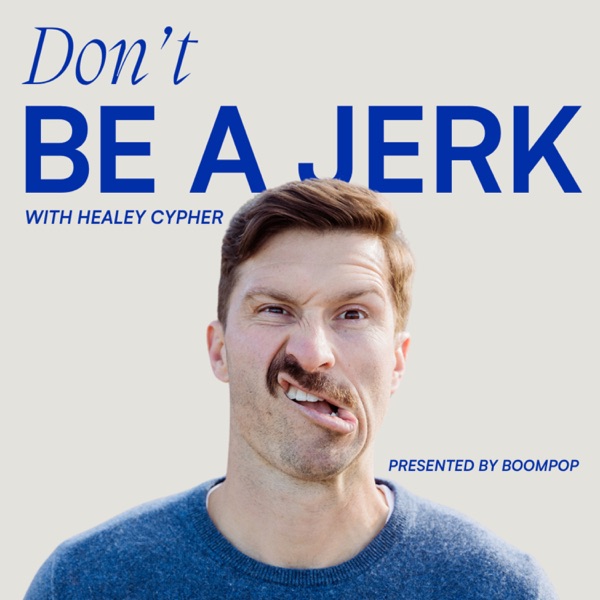
👋 Hey there, Healey Cypher here. My brother once said all CEOs are inherently bad, and I get it. Headlines glamorize ruthless success, but there’s another story: leaders who win because they’re good people. “Don’t Be a Jerk” explores real-world examples and tactical insights proving kindness and integrity aren’t just nice; they’re strategic advantages. Each episode reveals actionable lessons to build success without compromising values. Let’s rewrite the narrative of leadership, one story at a time.
On the charts
Every published chart this podcast appears in, in the snapshot behind this page. Each one links to the chart it came off.
From the feed
The latest episodes published to this podcast’s own RSS feed. Titles and descriptions are the publisher’s.
A year ago, Healey Cypher started Don't Be a Jerk as a personal quest to prove that being a jerk isn't the way to get ahead. Twelve guests later, the evidence keeps pointing the same way: most people are fundamentally good, and the jerks just get more airtime. For the show's one-year anniversary, Healey pulls together his favorite moments from year one. The guests include the Stanford psychologist behind The No Asshole Rule, an 11-year-old who produces his own podcast, negotiation coaches, a VC, founders, and leading researchers on empathy and happiness from Stanford and UC Berkeley. You'll hear why yelling means you've already lost, what happens to people who lead with leverage once the leverage runs out, and why the science says the "me or them" mindset doesn't hold up. Highlights - Why Bob Sutton says you can win in business and still lose as a human being - 11-year-old Sam Schwartz on the difference between being nice and being kind - The VC line Derek Blazensky never forgot, and why deals built on leverage don't last - How Brianne Kimmel's generosity keeps coming back to her - Why Ilana Nankin says kindness buys leaders back time - Bing Chen on the screamers at Google and making people feel bigger - Jamil Zaki and Emiliana Simon-Thomas on the science of our social nature Subscribe on YouTube and follow Don't Be a Jerk on Spotify and Apple Podcasts. Have a guest, topic, or hard question you want Healey to take on? Drop it in the comments. CHAPTERS 00:00 One year of Don't Be a Jerk01:10 Bob Sutton on winning vs. being a good human03:00 Sam Schwartz on nice vs. kind04:15 Faith Cohen on leaning into discomfort05:45 Derek & Todd on leverage and payback07:30 Brianne Kimmel on generosity that comes back09:15 Ilana Nankin on kindness buying back time10:40 Carolina García Jayaram on leading with love12:35 Alan Ross on gratitude vs. kindness14:05 Bing Chen on why yelling means you lost16:05 Emiliana Simon-Thomas on the me-or-them myth18:05 Jamil Zaki on our true nature19:50 What's next for year two
In 1994 Keba Konte flew to South Africa to photograph the first election where everyone could vote. He had no press credential, so when Mandela appeared, the fifty accredited photographers had the front position and Keba was stuck in the stands with the crowd. Then Mandela turned his back on the press, faced the people, and raised his fist. Keba got the frame. He has been standing on that side ever since. Twenty years later he started Red Bay Coffee in Oakland, roasting at home on a popcorn popper after the bank declined his loan. He was in his late forties with two careers already behind him, photojournalist and exhibited artist, and he built the company around a question most founders never ask out loud: how do you open a coffee shop in a neighborhood you grew up near without becoming the front edge of its gentrification. The hiring is where it gets specific. Keba went out to re-entry programs and recruited returning citizens on purpose, and he can tell you both halves of what happened. They worked twice as hard. They also came in with real trust issues, and he leaned on counselors from those same programs to work through it. Healey brings him a 2018 study of a million applicants across eleven firms that found the same performance and 13% lower turnover. Keba already knew. The rest is the stuff you only get from someone who has run the thing for twelve years. Where you find talent for an industry that never trained anyone who looks like your customers. Why his farmers get paid more than fair trade to pick only the red cherries. How a tagline got flagged by the Black Panther Party's IP holders and why that ended well. And what he would put on a billboard in front of a billion people, which nobody saw coming. In this episode: - What a day behind the press line taught him about where to stand - Why he refused to build a coffee company that would speed up gentrification - Recruiting out of re-entry programs, and the part he will not sugarcoat - The study that says the risky hire is the one who stays - Mercenary employees, missionary employees, and which one is the founder's fault - Hiring from chocolate, wine, kitchens and bars when your industry has no bench - Where "beautiful coffee to the people" came from, and who had to approve it - Why the red in Red Bay is about ripeness, and what that costs - Naming coffee blends after protest anthems in the middle of a political crisis - Coffee is a fruit Subscribe for more conversations about doing well without being a jerk. New episodes on YouTube, Spotify, and Apple Podcasts. Timestamps: 00:00 Intro 01:19 South Africa, 1994, and no press credential 03:15 Stay with the people, not the VIP section 04:30 Starting Red Bay, and gentrification in Oakland 06:27 Roasting at home after the bank said no 07:48 Going out to re-entry programs on purpose 08:15 Working twice as hard, and the part he will not sugarcoat 08:58 A million applicants, eleven firms, 13% lower turnover 10:36 Mercenary vs. missionary, and the purpose part 11:53 Building a team for an industry that never trained one 15:30 Where “beautiful coffee to the people” came from 16:58 The Black Panther Party trademark flag 19:02 Coffee is a fruit 21:41 Why Red Bay is called Red 26:23 The Hero Collection and the protest anthems 28:51 Red Bay as a piece of art 32:10 The billboard
When Emiliana Simon-Thomas was a teenager in Berkeley, a man named Mr. Charles stood on a street corner every morning and told strangers they were beautiful. Decades later she ran a study with tens of thousands of people across more than 200 countries to find out whether small acts like that actually change anything. Emiliana is the Science Director of UC Berkeley's Greater Good Science Center and one of the researchers behind the Big Joy Project. She and Healey get into what seven days of tiny, deliberate acts of kindness did to people's mood, their sense of agency, and their willingness to sacrifice for others. Then they follow the same thread into leadership, where a study of 3,500 CEOs found that pro-social leaders ran companies that objectively performed better. This one runs on evidence, and most of it points the same direction: the thing that makes you happier is the thing that makes you better to be around. In this episode: - What the Big Joy Project found after just seven days of micro acts - Why the people who need well-being research most are the least likely to sign up - The arrival fallacy, and why the next milestone won't fix it - What Emiliana says to do with a spare $100 if happiness is the goal - Why power quietly erodes the skills that earned it - The case for forgiveness as a performance advantage - Collective effervescence, and why walking beside someone resolves conflict faster than facing them Subscribe to Don't Be a Jerk on YouTube, Spotify, and Apple Podcasts. Try the Big Joy Project and explore the research at greatergood.berkeley.edu . Episode Chapters: 0:00 Mr. Charles on the corner 1:50 Seven days, 200 countries 8:20 When the world feels too big to fix 12:05 The arrival fallacy 21:35 Why happy teams close more deals 23:05 What to do with a spare $100 28:50 We stopped practicing friendship 32:55 The punishment we now choose 39:00 The paradox of power 43:35 Forgiveness as a performance advantage
Most of your day already happened without you. The drive to work, the meeting you walked into cold, the ten minutes after you got home. You didn't decide how any of it would go, so it went however it went. Healey Cypher has a fix that takes about ten seconds, and it's older than every productivity book on your shelf. It's called segment intending: you break the day into small pieces, and before each one you say what you want out of it. In this solo episode he walks through the practice, why he thinks of willpower as a muscle rather than a trait, and what changed in his calendar and his marriage once he started running it every day. He also does the unglamorous part: two concrete examples, one from a boardroom and one from his own living room, so you can try it before your next meeting. In this episode: - The 10-second practice Healey uses before meetings, drives, and walking through his own front door - Why he treats willpower as a muscle you can train, and how he trains it - The one sentence to open a meeting with so nobody wastes an hour - How he segments and grades his weeks, and why most of them now come back green - What setting an intention before seeing his wife did for a 14-year marriage - The reframe of "let there be light" that changed how he thinks about wanting things Try it this week and tell Healey how it went, he actually wants to hear it. Subscribe for new episodes of Don't Be a Jerk every Wednesday. Listen on YouTube, Spotify, and Apple Podcasts. Timestamps: 00:00 Intro 01:37 Willpower, creation, and “let there be light” 02:10 What segment intending actually is 02:38 The drive, the kids, the front door 02:56 How much of the day runs on autopilot 03:20 Why willpower grows the more you use it 04:08 Doing it daily, and grading the week 04:46 Writing out what a successful meeting looks like 05:09 Saying it out loud, and the side benefit 05:37 A 14-year marriage, and his number one goal 06:16 Try it and tell him how it went
There's an award for everything in our society. The Emmys give awards for giving awards. Nobody gives one for kindness. Alan Ross noticed that during Covid, on a walk in the Berkeley Hills, when he passed a girl handing out free cookies because she thought everyone seemed sad. Four years later he writes a $1,000 check every month, out of his own pocket, to a stranger who did something quietly extraordinary: a gas station attendant, a locker room attendant, an 86-year-old who's folded origami at Children's Hospital every Thursday for a decade. Most of them try to give the money back. Alan has taught at Berkeley Haas for 36 years and has been the business school's only ethics teacher for 25 of them, which means every Haas graduate has passed through his classroom. He opens each semester by asking how many students would be there if the class weren't required. His record answer is ten out of 240. He tells Healey about it laughing. In this episode: - Why Alan says he could never win his own award, and means it - The case against gratitude, and what he'd replace it with - What the New York banker making seven figures told him about "just $100K more" - How to gamify kindness with your kids at the drive-through window - Why nobody has ever faked their way to the $1,000 in four years - The student whose entire Harvard interview became about a kindness award - What Alan would put on a billboard a billion people could see Subscribe for more conversations about doing well without being a jerk. New episodes on YouTube, Spotify, and Apple Podcasts. Learn more or nominate someone at chriskindnessaward.org Timestamps: 00:00 Intro 01:39 What the Chris Kindness Award actually is 02:46 The cookie stand that started it 03:11 An award for everything in our society except kindness 04:02 Who Chris was 05:25 Why handing over the check is the best day of his month 05:50 The origami volunteer at Children's Hospital 07:05 Why he says he could never win his own award 09:48 What spending money on others does to happiness 10:41 Abstraction, and how people become numbers 12:20 The New York banker and just a hundred thousand more 14:44 Writing down his real top ten goals 15:51 The hours you don't get back 19:39 The ripple effect 21:34 The fifth grader on why the news is all bad 26:34 The interview that starts with how you treat the waiter 27:45 Gamifying kindness at the drive-through 30:32 The ethics class, and why nobody has faked it in four years 31:24 The student whose Harvard interview became about the award 38:40 What he'd put on a billboard
Bob Sutton has spent twenty years being asked to prove that decency pays. He can do it: the productivity data, the health data, the turnover math, all of it. He mostly refuses to. His actual argument is harder to shrug off. Sutton is a Stanford professor emeritus who got the idea for the most famous management book with a swear word in its title from his father, at the San Diego Zoo, when he was about four years old. He also once flew across the country for heart surgery, past a hospital two miles from his house, in part because the Cleveland Clinic's CEO told him something Stanford's wouldn't: you reward a**hole heart surgeons, and I fire them. Healey and Bob get into the moral case, the business case, and the uncomfortable middle where jerks really do win. It's the rare conversation about workplace behavior that never once sounds like an HR training. In this episode: - Why Sutton has given up arguing decency on ROI, and what he says instead - The one sentence that tells you everything about a company's culture - The hidden-tape-recorder study on coaches who lose it at halftime, and why the nice ones get results - How to tell whether you're the difficult person in the room - Why calling someone a jerk is the most reliable way to turn them into one - What Google did to cut interviews from 25 rounds to four - The Kurt Vonnegut poem Sutton wrote a letter to get permission to use, and the postcard he got back Subscribe for new episodes of ‘Don’t Be a Jerk’ every week. Watch on YouTube, listen on Spotify and Apple Podcasts. Find Bob at bobsutton.net or on LinkedIn.
Charlie Munger said "show me the incentive and I'll show you the outcome." Dr. Amy Gershkoff Bolles has spent an entire career proving it from the inside. She built the media operation for Obama's 2012 campaign, served as a C-level executive at companies including Zynga, Ancestry, and Levi Strauss & Co., and sits on public and private company boards. The throughline: most bad behavior at work isn't malice. It's good people responding rationally to a broken system. In this conversation with Healey Cypher, Amy turns that lens on the everyday problems leaders misdiagnose: the sales team fighting the support team, the "cost center" incentivized to hang up on customers, the marketing budget spread too thin to work. She shares the exact fixes that sent revenue "through the roof," why she asks every new hire what they want in twelve months (not five years), and why a Princeton Ph.D's real value was learning how to learn, a skill she argues matters more than ever now that AI can write the code while you sleep. She also makes the case for the generalist, the discipline of saying "I will find out," the campaign trick of going broke on purpose, and why, after 20 years in big tech, she's betting on Main Street. In this episode: - The one change that erased the war between a sales team and its support staff - Why customer-support incentives quietly destroy customer loyalty, and how to balance them - The marketing budget mistake ("love all your children equally") that starves your best products - The question Amy asks every new hire to unlock "exponential" performance - Why AI can hand you the answer but never the fortitude to act on it - The hidden penalty generalists pay, and why the boardroom finally rewards it - How to sound confident when you don't know the answer - The Obama-campaign discipline of being "bankrupt by election day" Subscribe to Don’t Be a Jerk for more conversations on leadership, incentives, and building companies worth working at.
It's harder to place a 16-year-old intern than a $200,000 software engineer. Alex Funkhouser learned that the hard way: his firm SherlockTalent places senior engineers for a living, but when he volunteered to find internships for Miami high schoolers, a full year of work placed exactly eight kids. So he built the machine himself. GetMyInterns has now launched over 40,000 student careers, and this summer alone put more than 3,000 Miami-Dade teenagers into paid, insured internships that cost employers nothing. Healey sits down with Alex to unpack his central claim: agency can be engineered. Give a young person a real mission, a learning contract they write themselves, actual decision-making authority, and real consequences, and the switch can flip in a single day. Alex has watched it happen 40,000 times, starting with a timid student who was raised not to talk to strangers and ended her first day of cold-calling glowing. Highlights: - Why placing a 16-year-old is harder than placing a $200K engineer, and what Alex built to fix it - The "learning contract" that hands ownership to kids who've never had it - How Hard Rock Stadium turns 1,000 interns into its full-time hiring pipeline - Alex's contrarian take on AI: kids don't need jobs, they need missions - The one human skill he says you can't outsource to a model - What employers actually ask for from Gen Z hires (it's not technical) - The 1966 Mustang he bought at 15 with lawn-mowing money and rebuilt nut by nut Subscribe to Don't Be a Jerk for more proof that good people finish first. Watch on YouTube, or listen on Spotify and Apple Podcasts.
Chad Bernstein showed up at a juvenile detention center with his band, ready to play, and the guards stopped him at the door. The guitar strings, they said, could be used as weapons. So he walked in empty-handed, into a room of kids with crossed arms and cold stares, and the distance between them felt impossible to cross. Then the band started playing with nothing but their voices and a beat on the table, and within seconds the whole room cracked open. That afternoon became Guitars Over Guns, an organization that has now reached thousands of young people across four cities. Chad is a working trombonist who's played with Pitbull, Shakira, and members of James Brown's band, earned a doctorate studying his own program, and sat as a Governor on the Grammys board. On this episode of Don't Be a Jerk, he and Healey get into what musicians understand about leadership that most MBAs never learn: how to listen, when to create space, why vulnerability is a tool instead of a weakness, and how to build the kind of safety where people finally stop bracing and do their best work. It's a conversation about the spaces between the notes, and why the people who master them tend to lead better than everyone else. In this episode: - Why the guards confiscated the guitars, and how the band won the room with no instruments - The five words from one kid that changed the entire direction of Chad's life - Why "failure" is an official value at Guitars Over Guns, and what that unlocks - What a brain scan reveals about the "self-auditing" switch that keeps people from taking risks - The Fred Wesley line about leaving "space for God to walk through," and what it means for any leader - Why the most powerful move in a negotiation (and a jam session) is 7 seconds of silence - How to build psychological safety before you ever ask anyone to perform🎧 Subscribe to Don't Be a Jerk for more conversations on leading like a good human.
Most foundations write a check and walk away. Carolina Jayaram does the opposite. As founding CEO of The Elevate Prize Foundation, she gives changemakers $300,000 and then carves $50,000 of it out for the leader, not the mission. Her argument is blunt: a depleted founder can't carry the work forward, so funding the human isn't a perk, it's the investment. Healey sits down with Carolina in Miami to unpack the two bets behind Elevate. "Make Good Famous" treats storytelling as the line item philanthropy forgot, the same marketing muscle every for-profit company spends millions on. "Whole Leader" treats founder wellbeing as a structural problem instead of a personal one. Along the way she explains why she stopped using the word "unrestricted," what a five-day retreat in Mexico actually does for a burned-out leader, and why one still person can change an entire room. This is a conversation about doing good and being honest about what it takes from the people who do it. In this episode: - Why "the most underfunded line item in philanthropy" is the one every business spends millions on - The $50K-to-the-leader bet and how Carolina makes the case for it - Why she traded the word "unrestricted" for "trust-based" and what changed - The playwright who was about to quit the week she got the call - How a forest's underground network reframed how she thinks about a team - Why meditation is "for the crisis, not the pillow" - What leading with love "unapologetically" looks like inside a foundation Subscribe for new episodes of Don’t Be a Jerk every week. Watch on YouTube, listen on Spotify and Apple Podcasts. Learn more about Carolina's work at elevateprize.org.
A clip from Don't Be a Jerk went viral for the wrong reasons. It was a vulnerable story: Healey's friend Danh Trang, a little person, recounting how a CEO once used a slur and how Danh responded with grace instead of anger. The CEO apologized and grew. It was the show in two minutes. Then it hit 400,000 views, and the comment section filled with cruelty from people whose own profiles said "man of God," "artist," "classical violinist." Healey's first reaction was anger. His second was curiosity. In this solo episode he goes down the rabbit hole of why decent people turn cruel the moment they're behind a screen, pulling in the research that explains it and landing somewhere more useful than "just be nicer." This is the most on-brand episode the show could make: the exact behavior it's named against, happening at full volume, met with curiosity instead of a lecture. In this episode: - Why the internet is an "empathy removal machine," and the 2004 study that named it - The 47-likes finding: how cruelty gets socially rewarded until it becomes a group's identity - What Healey found when he actually looked up the people leaving the comments - Why the algorithm pulls negative people deeper into negativity - The "reverse dogpile" idea: what happens if you flood cruelty with kindness - Why leaving cruel comments costs you more than the person you aim them at - The one question to ask yourself before you ever hit post Subscribe to Don't Be a Jerk on YouTube, Spotify, and Apple Podcasts, so you never miss an episode!
Kevin Kissi spent years at Microsoft leading teams that shipped software to hundreds of millions of people. Then he walked away to build Zof AI with no institutional funding, betting on one idea most of the industry still gets wrong: a system that looks perfect but can't be trusted has already failed. Born in Accra, raised between Ghana, Atlanta, and the snows of North Dakota and Minnesota, Kevin built a worldview where transparency beats polish and humility beats ego. In this conversation with Healey Cypher, he explains why he wants his own team to forget he's the boss, how he reads a single conversation to know whether to hire someone, and why he treats his mental energy like a budget he refuses to overspend. It's a conversation about reliability, in software and in people, and the courage it takes to build things that admit when they're broken. In this episode: - Why Kevin says "perfect without trust is failure," and what he builds instead - The restaurant test for whether you're actually leading or just managing - How he spots a bad hire by listening for one missing trait - The Friday memo habit that revealed how much his team relied on him - Why he walked away from a degree, a math professorship, and Microsoft - How he budgets his mental energy like a bank account - Building AI agents that carry human judgment instead of removing it Subscribe to Don't Be a Jerk for conversations with leaders who prove you can build great things while doing good in the world.
Most people think selling is about the pitch. Kalina Bryant built $9 million in six months doing the opposite through relationships, built so well that the customers came to her. As she puts it, once you learn the art of relationships, you'll never sell a day in your life. Kalina is the Founder and CEO of UnapologeTECH and was the first head of customer advocacy at Asana, where she turned community into one of the company's highest-converting revenue engines. She's a Forbes 30 Under 30 honoree and now an Executive in Residence at First Round Capital. In a moment when every inbox is flooded and every message sounds AI-generated, she makes the case that genuine human connection is the last real advantage left in business. Healey and Kalina get into why the hard sell is dead, how she courts a customer like it's a first date, and what the best salespeople do that makes you forget you're being sold at all. In this episode: - Why "always be closing" is the worst advice in modern sales - How she built $9M in six months with "dinners that weren't really dinners" - Why she treats every customer relationship exactly like dating - The reason the best salespeople never sound like they're selling - How to turn a single cup of coffee into a deal that lasts years - Why your credibility is the one asset you can't afford to spend carelessly - What it actually means to be human in a transactional world Subscribe to Don't Be a Jerk for more on the business case for being a good human.
Paul Bakaus started coding at 11, sold his first company to Zynga, and spent years at Google working on Search, Chrome, and ultimately as their first head of creator relations with a focus on bringing creators back to the open web. Later on at Spotter, he built AI tools for creators like Dude Perfect and MrBeast. He's now the founder of Renaissance Geek and building Impeccable, an AI-powered creative tool for YouTube creators. In this episode, Paul and Healey get into the social skill that separates good leaders from great ones, why most people are terrible at asking the right questions, and why being nice at work can be the unkindest thing you do. In this episode, we get into: - Why everyone in the room is the main character of their own story, and how the best communicators use that to win every room they walk into - The pitch deck trick Paul watched a colleague use at Google to get promoted every single time, and what it actually reveals about how people make decisions - Why being nice and being kind are completely different things, and how California's passive-aggressive culture gets this exactly backwards - What FBI hostage negotiators and top Google executives have in common when it comes to getting people to say yes - Why the world's best car salesman outperformed everyone else by 10x using a single postcard - How AI sycophancy is actively making you worse at thinking, and what to do about it - Why Paul's team at Renaissance Geek now needs a one-hour standup just to stay aligned, and what that tells us about where product teams are headed - The open source move that made Paul "criminally" generous, and why it kept coming back to him in ways money couldn't buy - Why most early managers kingdom-build out of fear, and what Paul did when he flipped the script entirely This full episode of Don’t Be a Jerk is live on Spotify, Apple Podcasts, and YouTube.
Blake Hudelson is my co-founder at BoomPop (and we probably spend more time with each other than we do with our wives). We met at a startup studio in San Francisco six years ago. I proposed we try three companies simultaneously to see what clicked. He said yes without hesitating. That tells you everything about him. Six years, a lot of 11pm calls, a few near-death moments, and one company (BoomPop) we're really proud of later… Blake is our Chief Product & Design Officer and still one of my favorite people to talk to every single day. 65% of high-potential startups fail because co-founders can't get along. We’re grateful we found a way to get along (and thrive) on this crazy journey. If you’re a co-founder (or looking for a co-founder), you’re going to want to tune into this one. Here's what we get into: 1. How we actually met and why we tried three companies first 2. Why our most pivotal moments always came from disagreement 3. The "Swoop and Poop” problem 4. The pre-parade and pre-mortem: two exercises every co-founding pair needs 5. Why telling your team the real problem is your strongest tool 6. Why being too similar is the actual danger zone for co-founders 7. Integrity in the micro-decisions and why it's the whole architecture 8. The outsider advantage, and when it runs outSubscribe and listen to this episode of “Don’t Be a Jerk” wherever you get your podcasts!
Danh Trang was standing near the finish line when the 2013 Boston Marathon bombs went off. He was watching friends and family. He came back the following year and ran it. At 4'2", in 5:36. Raised $14,000 for Little People of America. He's done it seven times since and cut 73 minutes off his time. He also won gold representing Team USA in para-badminton in 2016. Professionally: Citigroup, Bridgewater Associates, early product hire at Blend (IPO at $4B), years quietly helping his wife Dr. Ilana Nankin build Breathe for Change, which trained 20,000+ teachers and reached 20 million students. Now he's a partner at South Park Commons, a $275M fund that invests in founders before they've decided what to build. Portfolio includes Gamma, Baseten, Render, and Profound, among many others. Danh and I went to Wharton together. He's one of my closest friends. Somehow I had never asked him most of what we talked about in this conversation. In this episode, we get into: - Why SPC watches founders for 9-12 months before writing a check, and what you actually learn when someone can't perform anymore - What Danh reads in body language during a pitch and why he trusts it less than 9 months of watching someone in the wild - Why the #1 cause of startup failure is team dysfunction, not the product or the timing - Marshall Rosenberg's four-step nonviolent communication framework and why the smallest word swap changes everything - What happened when a CEO called him the M word, and how he responded with more grace than most of us could manage - Why the first three minutes of a hard conversation determine the entire outcome - What his parents taught him about belief and persistence and how it now shapes everything about how he invests - Why the best thing SPC gives a founder is the room full of the right people. Danh has spent his entire career running toward the hard thing. This one is going to stay with you. Full episode is live on Spotify, Apple Podcasts, and YouTube. Follow Danh at: https://x.com/danh_trang Check out South Park Commons at: https://www.southparkcommons.com/
What happens when a prosecutor walks into a prison, sits across from someone she could have sent there, and realizes she can't say she wouldn't have done the same thing in their shoes? That's the story of Hillary Blout. She spent six years as a prosecutor in the San Francisco DA's office handling violent crimes against women and children. She was good at her job. Then she visited a prison, heard the stories of the people inside, and couldn't keep going. So she left. And she built something that had never existed: a legal pathway for prosecutors to bring people back to court and recommend shorter sentences. She drafted the nation's first Prosecutor-Initiated Resentencing law, founded the nonprofit For The People, and has since helped resentence over 1,000 people across six states. In this conversation, Hillary and Healey explore: - Why she couldn't sit in judgment after hearing the full stories of incarcerated people - The 500% increase in women in American prisons and the trauma-to-prison pipeline - Why perspective-taking outperforms emotional empathy in changing minds (76% success rate, per Stanford/Kellogg research) - The data: 3-8% recidivism for resentenced people, up to $287M saved in one county, 97% court success rate - Why everyone loves a comeback story, except in the one place people need it most This is a conversation about justice, leadership, and what happens when you choose partnership over combat. Whether you're running a company, managing a team, or trying to change someone's mind about anything, Hillary's playbook applies.
What separates the people everyone wants to be around from the people who quietly drive others away? In this solo episode, Healey Cypher breaks down the 7 behaviors that make someone genuinely great to be around and the 5 traps that make you look like a jerk, even when you have the best intentions. The science is real, and the examples are specific. And none of it costs you a thing. You'll learn why the brain treats criticism like physical danger (and what to do instead), how smiling triggers a chain reaction of dopamine in everyone around you, why real listening has become one of the rarest skills in business, the one word that activates more brain regions than anything else in language, and why arguing almost always makes things worse. You'll also hear about the weird trap of being "too polished," why trying to convince someone is the least effective way to change their mind, and the billboard study that increased voter turnout by 41% just by asking a single question. This episode is about how people feel when they walk away from you and whether they want to come back. Listen wherever you get your podcasts!
Brianne Kimmel is the founder and managing partner of Worklife Ventures, a $45M early-stage venture firm backed by Marc Andreessen and Eric Yuan. Her portfolio includes Deel, Supabase, Public, and Metronome (zero to $1B exit). She recently opened Worklife Studios: a physical gathering space for founders, creators, and technologists who believe the best work happens when real humans are in the room together. But before all of that: Youngstown, Ohio. Rust belt. Ukrainian immigrant family. A journalism degree from Kent State. A move to Sydney, Australia alone at 22 and four years there, chasing something she couldn't quite name. She came back and started writing $1,000 angel checks to founders most people hadn't heard of, helping them get into rooms with Andreessen Horowitz before she had any leverage to offer. She had a philosophy instead: lead with generosity before you have anything else. In 2019, inspired by Robert Putnam's Bowling Alone and a personal craving for real connection she couldn't shake, she launched Worklife Ventures. The mission: make work more human. This episode is about a thesis Brianne has been building her entire career: that corporate culture stripped something essential out of us, that the internet took another 100 things we haven't gotten back, and that the best founders are the ones Silicon Valley keeps overlooking: the ones with zigzag lives, real taste, and a reason that's bigger than the exit. In this conversation, Brianne and I get into:- Why the MBA founder almost always builds a generic company and what the zigzag life produces that no business school can teach - The "culture sourcing" strategy that gave her more deal flow than anyone chasing it the conventional way - Why Gen Z hates dating apps for the exact same reason they hate bad workplaces and what it tells us about the future of work - Why the "next door millionaire" (the plumber, the contractor, the skilled tradesperson) has more job security in the AI era than the Ivy League entry-level software engineer - The science of luck and why the unlucky person is usually trying too hard - Why vulnerability in the workplace isn't a nice-to-have but actually the foundation of high-performing teams - How becoming unrelatable is the number one thing that kills careers, even wildly successful ones - Why a mission without a "why" can't attract great people, no matter how good the salary is - What it means to "get outside the bubble" and why it's the most important leadership move of this decade Brianne is one of the most original thinkers I've had on this show. She leads like she believes humans actually matter. This one is going to stay with you. Full episode is live on Spotify, Apple Podcasts, and YouTube.
Sam started a podcast because he was tired of feeling helpless. He was consuming the news the way most of us do… headlines that made him anxious, stories that seemed designed to make the world feel like it was falling apart, a constant drip of fear and outrage that left him feeling worse, not better. And at some point, instead of just complaining about it, he made something. Sam built No Bad News: a podcast for kids and families that specifically spotlights what's working, who's solving problems, and where communities are getting things right. He was 10 years old. He pitched his own guests, scheduled his own interviews, edited his own audio, and published it himself. He's now 11. He's gearing up for the NPR Student Podcast Challenge. And he's on this show not as a novelty, not because it's heartwarming to watch a young person do grown-up things… but because his philosophy is EXACTLY what Don't Be a Jerk is about. In this episode, Sam and I dig into why negativity dominates media (and why the system is literally built to reward fear), what "good news" actually means versus fake positivity, how he runs his show like a real founder, and what adults might be missing about the relationship between what we consume and how we feel. This is one of my favorite conversations in the history of this show. What We Cover in This Episode: - Why bad news wins: the economics of negativity bias and how the attention economy turned news into an anxiety machine - What Sam was feeling that made him say "I'm not just going to complain, I'm going to make something" - The difference between solutions journalism (agency-building) and denial (toxic positivity) and why Sam understands the difference intuitively - How No Bad News is structured and what makes a story Sam will actually cover - Sam's full production workflow: pitching, booking, recording, editing, publishing, repeat - What repeated exposure to distressing news is doing to kids and what the research actually says - The one media rule Sam would teach every adult if he could - Why hope isn't something you wait for… it's something you engineer - What Sam is building toward with the NPR Student Podcast Challenge - What I learned about my own media habits from a conversation with an 11-year-oldIf you've ever felt like the news is making you worse, this episode is for you. And if you've got kids who consume media, this conversation will change how you think about their information diet too.
Ranking source
Apple Podcasts rankings via the Mato Topic Intelligence Platform.
Observed October 25, 2026.
Apple and Apple Podcasts are trademarks of Apple Inc., registered in the U.S. and other countries.
Pairs with
Bring this source into Mato to read its transferable patterns, then turn them into an original show for your own audience.