Mato just raised pre-seed Read more

Podcast charts
Published by Michael Moss
RE: A question on the recent Great Australian wildlife search with Murray Darling Basin authority. Cassie Duncan cassie@odonata.org.au You Hi Michael, I can confirm that the thylacine reference sequence is in the eDNA database and would have been detected if present in the Great Australian Wildlife Search samples in the Murray-Darling Basin. All the best. Cassie 1 million square kilometers of mainland Australia covering South Australia/Victoria/News South Wales and Queensland were screened for Tasmanian tiger Dna. https://www.envirodna.com/resources/n...
On the charts
Every published chart this podcast appears in, in the snapshot behind this page. Each one links to the chart it came off.
The Mato Topic Intelligence Platform does not report this podcast as charting in a published category in this snapshot.
From the feed
The latest episodes published to this podcast’s own RSS feed. Titles and descriptions are the publisher’s.
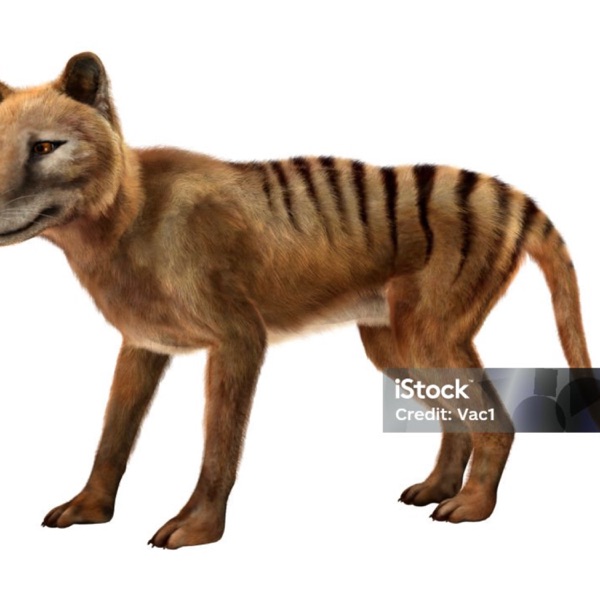
In this update, I breakdown the reality of modern thylacine de-extinction. While a corporate lab claims massive genetic advantages, I examine why these heavily funded projects could prove to be a complete waste of money compared to tracking active, surviving wild populations on the Australian mainland. https://www.sciencedirect.com/science... CommentaryEngineered proxies and the illusion of de-extinctionAuthor links open overlay panelDusko Ilic 1 21Department of Women and Children’s Health, School of Life Course and Population Sciences, Faculty of Life Sciences and Medicine, King’s College London, London, UKAvailable online 15 May 2025, Version of Record 10 June 2025SummaryThe recent creation of dire wolf-like canids by Colossal Biosciences marks a technical achievement in genome editing and synthetic embryology. But the project also demands a reevaluation of what we mean by “de-extinction”—and whether a phenotypic approximation constitutes species restoration.Colossal Biosciences (TX, USA; https://colossal.com/ ) announcement that it has successfully engineered and birthed three pups with phenotypic features reminiscent of the extinct dire wolf (Aenocyon dirus) has garnered significant attention. Using comparative genomics and multiplex CRISPR editing, researchers modified a gray wolf (Canis lupus) cell line to express twenty genetic edits across fourteen loci, informed by ∼91% of the reconstructed dire wolf genome. The resulting animals exhibit increased body mass, cranial robustness, and light coat pigmentation—traits consistent with the extinct species. But despite headlines declaring the dire wolf’s return, what has been achieved is not resurrection, but simulation: a synthetic proxy designed to mimic phenotype, not to replicate genotype.This distinction has profound implications for both the scientific and ethical framing of de-extinction. Genotype—the full genomic blueprint—is not simply a background variable. It encodes the developmental, behavioral, immunological, and ecological identity of a species. Phenotype, shaped by both genotype and environment, is its expression. In Colossal’s dire wolves, selected traits were prioritized for viability and recognizability, while potentially deleterious variants (e.g., pigmentation-associated mutations linked to sensory deficits) were excluded. The outcome is an engineered animal that resembles the dire wolf in form, but not in totality.Such work highlights the practical shift in de-extinction strategy from full genomic synthesis—still far beyond reach for mammalian genomes—to targeted phenotypic reconstruction. Instead, partial phenotypic fidelity—what Colossal’s team terms “functional de-extinction”—has become the operational endpoint: a pragmatic compromise that prioritizes outward resemblance and selected functional traits over complete genomic or ecological restoration.This raises essential questions for the field of synthetic biology. At what point does a heavily edited organism with partial trait recovery become a new species? How do we distinguish between de-extinction and de novo organism design? The dire wolf project also mirrors a growing commercial trend in synthetic biology: dual-use platforms that link scientific ambitions with monetizable applications. Colossal has positioned its work as ecologically restorative, yet its funding model, media strategy, and investor outreach (including celebrity partnerships and cinematic branding) signal an additional aim: to transform charismatic megafauna into biotech showcases and potential intellectual property assets. ConclusionColossal’s work advances genome editing and mammalian embryology in significant ways, and its technical achievements deserve recognition. But science progresses through clarity, not spectacle. As we build the tools to shape life with increasing precision, we must also build the conceptual frameworks to define what, exactly, we are creating.
Tasmanian devil Mary missing from Gold Coast’s Paradise Country after promising clues emergeSniffer dogs, drones and wildlife crews are focusing on bushland where fresh signs of the escaped marsupial have been found.By Katharina Loesche Search for Mary the Tasmanian Devil intensifies(Source: 7NEWS)The search for missing Tasmanian devil Mary is intensifying again, with sniffer dogs, thermal drones and wildlife teams narrowing in on bushland where fresh signs of the escaped marsupial have been found.Paradise Country said crews searching through the Kopps Rd area at Oxenford, Gold Coast, located fresh droppings overnight, adding to several reported credible sightings helping authorities map Mary’s movements after she vanished from the wildlife park earlier this week.Promising clues as hunt for runaway Tassie devil enters day four.https://7news.com.au/news/wildlife-crews-close-in-on-missing-tasmanian-devil-mary-from-gold-coasts-paradise-country-after-promising-clues-emerge-c-22390123Sadly this Tasmanian devil may meet the fate that this Escapee Tasmanian Devil did in 2009 from Maru wildlife Park in the state of Victoria on mainland Australia. Run over and killed by a car. EVS are very quiet!Escaped devil found dead. [Maru Koala & Animal Park]ZooChathttps://www.zoochat.com › Forums › Oceania › Australia27 Mar 2009 — Grantville Devil - Mainland Devils. The devil was found about 500m from the park, and the park admitted losing a devil 2 weeks ago. BREAKING NEWS 17/06/2026 This Tasmanian devil was found last night weak but ok after 14 days including 12 people looking for it.
Good afternoon Michael,Thank you for contacting BMRG via our website enquiry form.EnviroDNA screened for all vertebrates in their database using a metabarcoding approach. Thylacinus cynocephalus was not explicitly requested by BMRG, and none were returned for our region.Please advise if I can assist with anything further.Kind regards,LAURA MATTHEWSOffice Administration Manager 160 Hughes Road Bargara QLD 4670PO BOX 8601 Bargara QLD 4670Ph: (07) 4181 2999bmrg.org.au We acknowledge the Traditional Owners of the land on which we live and work and pay our respects to their Ancestors and their descendants, who continue cultural and spiritual connections to Country. We also respect the history and culture of the Traditional Owners and their ongoing connection to land and sharing of knowledge.
RE: A question on the recent Great Australian wildlife search with Murray Darling Basin authority.Cassie Duncan cassie@odonata.org.au You Hi Michael,I can confirm that the thylacine reference sequence is in the eDNA database and would have been detected if present in the Great Australian Wildlife Search samples in the Murray-Darling Basin. All the best. Cassie The "Great Australian Wildlife Search" is a citizen science project led by the Murray–Darling Basin Authority (MDBA) and the Odonata Foundation using environmental DNA (eDNA) to monitor biodiversity in the Murray-Darling Basin. Citizen scientists collect water samples from waterways, which are then analyzed for eDNA to identify the presence of various aquatic species. This project helps the MDBA understand the spread of wildlife in the Basin and inform conservation efforts.
Ranking source
Apple Podcasts rankings via the Mato Topic Intelligence Platform.
Observed September 6, 2026. Cached outside the daily freshness window; the positions keep the date they were taken on.
Apple and Apple Podcasts are trademarks of Apple Inc., registered in the U.S. and other countries.
Pairs with
Bring this source into Mato to read its transferable patterns, then turn them into an original show for your own audience.