Mato just raised pre-seed Read more

Podcast charts
Published by Pellegrino Riccardi & Francois Sibbald
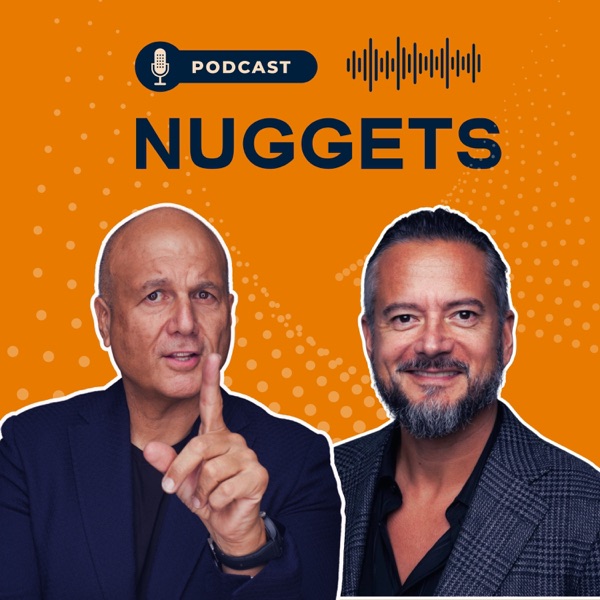
NUGGETS is a weekly podcast about human behaviour, emotional intelligence, mindset shifts, psychology, and personal growth — designed to help you think clearer, communicate better, and lead with more confidence. In every short, practical episode, Pellegrino and Francois explore the ideas that shape how we live and work: motivation, stress, happiness, relationships, decision-making, leadership, communication, culture, and the stories we tell ourselves. We break big concepts into simple insights you can use immediately — to improve your mindset, boost emotional resilience, increase self-awareness, and show up as your best self in everyday life. If you're interested in leadership development, self-improvement, emotional intelligence training, better communication, or understanding why people behave the way they do, you're in the right place. Modern life is noisy. NUGGETS cuts through the noise — giving you clarity, grounded thinking, and wisdom you can use in minutes. Because one good insight can change everything. Hosted on Acast. See acast.com/privacy for more information.
On the charts
Every published chart this podcast appears in, in the snapshot behind this page. Each one links to the chart it came off.
From the feed
The latest episodes published to this podcast’s own RSS feed. Titles and descriptions are the publisher’s.
Watch on YouTube too: Can you give too much? And do we ever really give without expecting something back? In this episode of NUGGETS, Pellegrino sits down with his son Christian, a physiotherapist and football coach who spends an extraordinary amount of his life helping other people. Christian rarely says no. He gives his time, energy and attention freely. But why? And what does he get back? Their father-son conversation explores giving, purpose, altruism, generosity and the sometimes hidden cost of always saying yes. They talk about finding work you would happily do for free, whether helping others ultimately makes us happier, why people may be willing to suffer for complete strangers, and what happens when generosity starts costing too much. Along the way, Christian reminds Pellegrino of a piece of advice his father once gave him: “Do something you would do for free. And then the money is just extra.” So perhaps the real question isn't simply whether giving is good. It's knowing when to give, why we give, and when enough is enough. Hosted on Acast. See acast.com/privacy for more information.
What does it really mean to be strong? Our guest this week knows something about strength. Lene Alexandra Øien – LA – is a coach, author, former recording artist and, quite literally, a world champion bench presser. But this conversation isn't really about lifting weights. We explore the different faces of strength: pushing through versus knowing when to stop, human doing versus human being , vulnerability, burnout, boundaries and sustainable performance. LA also takes us inside her work with high-performing leaders – people who can appear incredibly strong and in control on the outside, while showing a very different side of themselves behind closed doors. And we ask a bigger question: if you strip away the achievements, the titles, the body and the recognition… are you still strong? Perhaps real strength isn't about being strong all the time. Perhaps it's about being strong enough. Also available on YouTube: https://youtu.be/WQ1oP-jNpdk?si=EYF4ogF4nnFy82XY Hosted on Acast. See acast.com/privacy for more information.
My daughter Emily is about to leave home, move to Leeds and study songwriting and artist development. She’s choosing a notoriously uncertain career in music — and, in her own words, she’s terrified. So why do it? In this episode, we talk about courage, comfort, fear and the risks we take when we decide to pursue something we genuinely care about. Emily reflects on The Voice , releasing her own music, stepping outside her comfort zone, and why she doesn’t want to reach 90 wondering: “What would have happened if it actually worked?” We also hear part of her first single, Big Talk , and explore Susan Jeffers’ idea that fear doesn’t disappear before we act — the doing comes first. A father-daughter conversation about choosing uncertainty, facing fear and having a go anyway. Also available on YouTube - search @NuggetsPod and look for the distinctive ORANGE Nuggets graphics. Hosted on Acast. See acast.com/privacy for more information.
What do teenagers really want from family holidays? In this special episode of NUGGETS, François is still on holiday, so Pellegrino is joined by a very different co-host—his 15-year-old daughter, Olivia. It begins with a simple question ... What's the biggest mistake parents make when they go on holiday with teenagers? The answers start with photos, sleeping in and wanting a little more freedom. But the conversation quickly becomes something much deeper. Olivia shares what it's really like to be a teenager today, why adults often underestimate what young people are going through, why some feelings are difficult to explain, and why sometimes the best thing parents can do is simply listen. Whether you're raising teenagers, remember what it was like to be one, or simply want to understand the next generation a little better, this honest father-and-daughter conversation offers valuable insights into communication, empathy and growing up. Hosted on Acast. See acast.com/privacy for more information.
Fresh from completing the 850 km Camino de Santiago across Spain, Ken Lowe joins Pellegrino for an honest conversation about what the pilgrimage really teaches you. Most people think the hardest part of the Camino is the walking. It isn't. Ken has been one of Pellegrino's closest friends for more than forty years. They studied together, cycled together and shared countless adventures before life took Ken to Australia. Passing through Oslo after completing the Camino, he stepped into the NUGGETS studio for a completely unplanned conversation. Together they explore why getting to the start line is often the biggest challenge, how saying "yes" opens unexpected doors, why discomfort can lead to growth, and how strangers can become some of life's most memorable companions. Whether you're planning to walk the Camino yourself or simply navigating a new chapter in your own life, this episode offers practical insights into commitment, connection, and what happens when you choose to take the first step. Watch on YouTube: https://youtu.be/1dDGF-TniCA?si=N_4yfCNx07EGV122 Listen on Spotify: https://open.spotify.com/episode/65q6dBw5ehYYmqBxq1e6Bu?si=e5026a6fb2dd44fc Hosted on Acast. See acast.com/privacy for more information.
Most people think improvisation is something comedians, actors and jazz musicians do. We think it's one of the most valuable life skills you can develop. In this episode of NUGGETS , we explore why improvisation isn't about being reckless or making things up on the spot—it's about adapting, thinking creatively and having the confidence to deal with whatever life throws at you. Along the way, we tackle an intriguing question: Why do women often find funny men attractive? The answer has surprisingly little to do with jokes and much more to do with creativity, problem-solving and our evolutionary past. From speaking without notes and embracing mistakes to taking risks and thinking on your feet, this conversation is a reminder that life rarely follows a script—and perhaps that's exactly the point. So, if you've ever hesitated because you were afraid of getting it wrong, this episode might just persuade you to take the difficult path... and dare to improvise. Hosted on Acast. See acast.com/privacy for more information.
A bizarre French band sent us down an unexpected rabbit hole. Why do strange people capture our attention? Why are the most memorable comedians, musicians and creators often the ones who refuse to fit in? This episode explores why weirdness isn't something to hide—it might be your greatest advantage. Also available on YouTube - @NuggetsPod Hosted on Acast. See acast.com/privacy for more information.
After reading hundreds of self-help books over the years, we've started asking an uncomfortable question: Can too much self-improvement actually become... repetitive? In this episode of NUGGETS, Pellegrino and Francois explore why great stories may teach us things that advice never can. They discuss the limits of self-help, the enduring power of fiction, Robin Williams' unforgettable speech from Dead Poets Society , why reading a novel engages the brain differently from scrolling a phone, and why the best book you read this summer might not be a self-help book at all. Whether you're packing for a holiday or simply looking for your next great read, this episode is an invitation to slow down, disconnect, and rediscover the power of a really good story. What you'll take away: • When self-help stops helping • Why fiction develops empathy and imagination • The hidden value of reading stories • Three simple ideas to reconnect with books this summer Also available on YouTube: Hosted on Acast. See acast.com/privacy for more information.
Life has never been more comfortable. Food arrives at the door. Entertainment is instant. Difficult conversations can be avoided with a text message—or no message at all. But what if all this convenience is making us weaker? In this episode, Pellegrino and Francois explore why emotional resilience seems to be in decline and why many of us struggle more than ever with criticism, boredom, rejection and discomfort. They discuss parenting, ghosting, online trolling, personal responsibility and the surprising idea that some of life's most important lessons come from doing things we'd rather avoid. The conversation raises a provocative question: Has modern life become so comfortable that we're losing the ability to deal with discomfort? And if that's true, what should we do about it? Hosted on Acast. See acast.com/privacy for more information.
What happens when you stop running? In this episode of NUGGETS, Pellegrino does something unusual: he turns the spotlight on Francois. Francois arrives expecting a normal conversation. Instead, he becomes the subject of it. Together they explore a transformation Pellegrino has watched unfold over the last decade—from a life driven by performance, busyness, and constant activity to a life with more balance, reflection, and calm. The conversation covers busyness as a status symbol, the guilt many people feel when they're not being productive, the lessons of the pandemic, and why modern life makes it so difficult to switch off. This isn't really an episode about doing nothing. It's an episode about what happens when you finally stop long enough to hear yourself think. And why that might be one of the most important skills of all. Watch on YouTube: https://youtu.be/l6AK2Gv-lpA?si=rND9vuvSEGXA4aic Hosted on Acast. See acast.com/privacy for more information.
We often think ego is something negative. But without ego, would we ever take risks, pursue ambitious goals, or achieve anything meaningful? In this episode of NUGGETS, Pellegrino and Francois explore the difference between strong ego and fragile ego — and why that distinction matters in leadership, relationships, communication, social media, and everyday life. Using examples from football, business, politics and personal experience, they unpack a provocative idea: The louder you are, the more fragile your ego. Along the way, they discuss Cristiano Ronaldo, validation, defensiveness, criticism, confidence and arrogance. Most importantly, they explore a simple but powerful distinction: Strong egos contribute. Fragile egos consume. And how recognising the difference can make you a better leader, colleague, friend and partner. Three things you can do in your everyday life. WATCH ON YOUTUBE: https://youtu.be/diXlx6XckpE?si=HjdxLMdnIdJUZQ0S Hosted on Acast. See acast.com/privacy for more information.
Anxiety isn’t caused by uncertainty. It’s caused by how we respond to it. In this episode of NUGGETS, Pellegrino and Francois explore why the brain struggles so much with the unknown — and why anxious thinking often becomes an attempt to control things we simply can’t control. From football fandom and worst-case scenarios to leadership, work stress, finances, and everyday overthinking, this conversation looks at the psychology behind anxiety in a grounded and surprisingly practical way. They explore: why the brain creates negative stories the role of “anxious monkeys” as an early warning system how uncertainty affects performance and relationships why clarity and action calm people down practical ways to stop spiralling when life feels unpredictable The episode also includes simple tools for managing anxiety more effectively — without pretending you can remove it completely. Because anxiety may be part of life. But making it worse doesn’t have to be. Hosted on Acast. See acast.com/privacy for more information.
We’ve always compared ourselves to other people. That’s normal. Comparison helped humans learn, adapt, improve, and survive. But modern life has scaled comparison beyond anything we were built for. In this episode of NUGGETS, Pellegrino Riccardi and Francois Sibbald explore why comparison feels so exhausting today — from social media and status anxiety to money, relationships, parenting, self-worth, and identity. They discuss: Why humans are wired to compare Dunbar’s Number and social overload Why social media amplifies inadequacy Healthy vs destructive comparison Why awareness reduces psychological pressure How to build your own “scoreboard” “The more you use others for comparison, the less you see yourself.” 20-minute episodes. 3 practical takeaways. Things you can actually use in your everyday life. Hosted on Acast. See acast.com/privacy for more information.
Most people think procrastination is a time-management problem.It isn’t. In this episode of NUGGETS, Pellegrino and Francois unpack the real psychology behind procrastination — and why delaying things often has far more to do with emotion than laziness. From public speaking and perfectionism to relationships, health, and even an unfinished coffee table sitting in the house for nearly a year, they explore what we’re actually avoiding when we keep putting things off. The conversation moves from anxiety and self-doubt to pressure, visibility, fear of failure, and the strange comfort of postponement. Along the way, they disagree on preparation, freshness, perfectionism, and whether pressure actually helps performance. Because procrastination is rarely about the task itself. It’s about the feeling attached to the task. And now, for those of you who prefer to see the faces behind the voices, NUGGETS is also available on YouTube: https://youtu.be/CfzQNjP3oM4 Hosted on Acast. See acast.com/privacy for more information.
Have you ever avoided telling the truth because you were afraid of the reaction? At work. At home. In a relationship. Around a parent. Around a boss. Then this episode is for you. In this week’s NUGGETS, Pellegrino and François go one level deeper into honesty — and ask a more uncomfortable question: What if people stay silent because the environment doesn’t feel safe enough for the truth? We talk about: – psychological safety – fear at work – difficult conversations – feedback culture – leadership reactions – and why people often choose silence over honesty Because most people don’t fear the truth itself. They fear punishment. Embarrassment. Conflict. Rejection. And over time, fear settles into the culture. A sharp conversation about honesty, fear, trust, and the environments that either encourage truth — or quietly destroy it. Hosted on Acast. See acast.com/privacy for more information.
The Crown Princess Mette-Marit story has put one question back on the table: Why don’t leaders—and the people we look up to—just tell the truth early? When something goes wrong, there’s a moment—right after it happens—where you decide what to say… or what to hold back. Miss that moment, and the story starts running away from you. In this episode, we look at why leaders avoid difficult conversations—and how delayed honesty quietly destroys trust. Because this isn’t just about royalty. It shows up everywhere: – leaders avoiding difficult conversations at work – companies drip-feeding bad news – people protecting themselves instead of telling it straight And here’s the uncomfortable part: We often judge hypocrisy more harshly than outright lies. The Nugget: Say it early. Say the hard part. Say it once. That moment right after something goes wrong? That’s where your integrity lives. Hosted on Acast. See acast.com/privacy for more information.
🎥 Watch this episode on YouTube: https://youtu.be/Mr_ceD3tT6M First impressions happen fast—and they feel accurate. But they’re often wrong. In this episode, we break down why your brain forms snap judgments within seconds, and why it then works hard to defend them—even when they’re flawed. From the Thatcher effect to the halo effect, you’ll see how easily perception can be distorted. This shows up everywhere: job interviews, leadership, meetings, dating, even walking on stage. Before a single word is spoken, people have already made up their mind. The problem isn’t that we judge. That’s human. The problem is believing we’re right. We explore how these fast judgments shape behaviour, relationships, and decisions—and what you can do to interrupt them. What you can do: • Pause your judgment and delay the story • Be intentional about the signals you send • Stay curious longer than feels natural 🎥 Prefer to watch? Full episode on YouTube: https://youtu.be/Mr_ceD3tT6M Hosted on Acast. See acast.com/privacy for more information.
Why do we avoid change — even when we know it’s the right move? Whether it’s using new tools, having difficult conversations, or stepping into something unfamiliar, most people hesitate. The fear of the unknown feels safer than the risk of change. In this episode, we break down why that happens. From the psychology of hesitation to the moment when staying the same becomes more painful than moving forward, this conversation explores the real reason people delay—and what it costs over time. You’ll hear how this shows up in everyday situations: at work, in leadership, in relationships, and in personal habits. Not as theory, but as something we all recognise. The shift is simple, but not easy: clarity doesn’t come before the jump—it comes after. If you’ve been waiting for the “right moment” to act, this episode will challenge that instinct—and give you a more useful way to move forward. Hosted on Acast. See acast.com/privacy for more information.
Ambition gets a bad reputation. Too much of it, and you’re seen as arrogant. Too little, and you stay stuck. So what actually separates healthy ambition from toxic ambition? In this episode, we unpack why ambition often makes people uncomfortable, how cultural norms like “don’t stand out” shape the way we express it, and why being open about your ambition can increase—not decrease—accountability. At the core of the conversation is a simple but uncomfortable question ... Are you trying to prove something… or build something? Because that distinction changes how you lead, how you perform, and how others experience you. This episode will help you reflect on your own drive—and how to use ambition in a way that builds something meaningful, rather than slowly working against you. Hosted on Acast. See acast.com/privacy for more information.
Most people think they’re being kind when they hold back bad news. They’re not. They’re creating stress. In this episode, we explore why uncertainty is often more stressful than the truth—and what that means for how we communicate at work, at home, and in leadership. From a neuroscience study at UCL to everyday situations like difficult conversations, unclear leadership, and “we’ll see” answers… we break down why the brain struggles most with one thing: Maybe. You’ll learn: Why uncertainty creates more stress than bad news How unclear communication damages trust and psychological safety Why people imagine worse when you say nothing And three simple ways to communicate with more clarity Because this isn’t about being harsh. It’s about not leaving people in the dark. The brain can handle bad news. It struggles with maybe. Hosted on Acast. See acast.com/privacy for more information.
Ranking source
Apple Podcasts rankings via the Mato Topic Intelligence Platform.
Observed September 19, 2026.
Apple and Apple Podcasts are trademarks of Apple Inc., registered in the U.S. and other countries.
Pairs with
Bring this source into Mato to read its transferable patterns, then turn them into an original show for your own audience.