Mato just raised pre-seed Read more

Podcast charts
Published by Moshe Kurtz
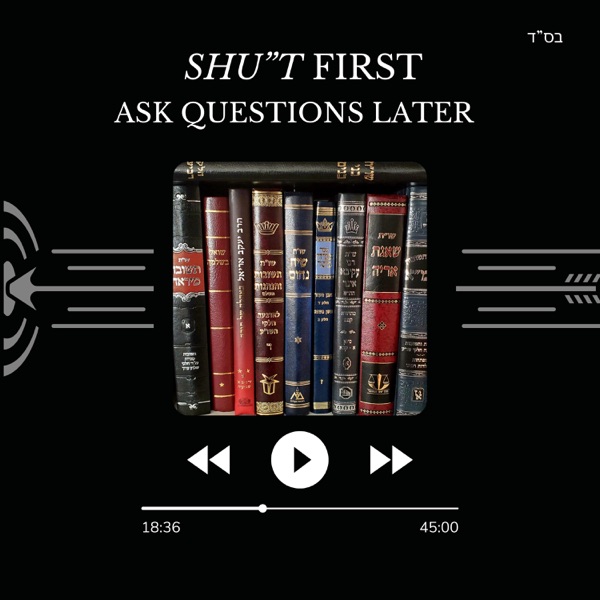
Shu"T First, Ask Questions Later puts the study of Torah front-and-center by inviting guest scholars to present, debate and provide listeners with a dynamic conversation of the topic at hand. In addressing the responsum of their choice, they will be asked to provide relevant historical background, distill the halachic/social considerations, offer unique methodological insights, and make an argument for its relevance today.
On the charts
Every published chart this podcast appears in, in the snapshot behind this page. Each one links to the chart it came off.
From the feed
The latest episodes published to this podcast’s own RSS feed. Titles and descriptions are the publisher’s.
Our friend, Rabbi Yehoshua Domosh, returns with three Sephardic seforim that caused - or should have caused - quite a stir. Can you guess what they are?
Sefer Meoros Moshe As I Walk Through the Valley podcast
We have the privilege of being joined by Rabbi Bezalel Naor, author of The Project of Hasidism (Kodesh Press), in order to take a more careful look at the Chassidic approach to zmanim . We take a look at Sha'agas Aryeh (no. 15) among several other responsa that help us get to the bottom of how the prescribed times for prayer and time-bound commandments, for many, became negotiable.
As listeners might know, the host of this show, Moshe Kurtz, has the honor of serving as the rabbi of Congregation Sons of Israel in Allentown, PA. In this episode, he is joined by Dr. Noam Cohen , a professor at Muhlenberg College who will be teaching a course on the history of the Jews of Allentown. He shares with us a responsum ( Orach Mishpat , #131) written by Rav Avraham Yitzchak HaKohen Kook to Rav Shlomo Zalman Krevsky , who served as the Chief Rabbi of Allentown during the 20th century. Today's episode is dedicated in honor of the birthday of our loyal listener, R' Yitzchak Friedman - by the Friedman, Cohen, and Poliakoff children. Happy birthday!
Dr. Yaakov Weinstein shares with us how the Netziv ( Meishiv Davar 1:24) and other prominent poskim addressed a request to prevent the publication of another rabbi's Torah and its implications for intellectual property. We also briefly discussed his Torah from Narnia blog at the end. https://torahfromnarnia.blogspot.com/
Rabbi Pinny Rosenthal, OU-JLIC's National Development Director, reveals a game-changing responsum of the Rashba (1:581) that informs how we understand the world of fundraising and Jewish philanthropy today.
Rabbi Michael J. Broyde is the author of Jewish Law and the American Thanksgiving Celebration: Secular or Religious Holiday? He is the expert on all things Judaism and Thanksgiving related. So, naturally, we were excited to hear his perspectives in advance of the holiday. His book can be purchased here: https://www.amazon.com/Jewish-Law-American-Thanksgiving-Celebration/dp/1962609111
Should L'Shem Yichud be said before giving a gett (bill of divorce)? Should it be said before any mitzvah? What even is L'Shem Yichud in the first place? In this episode, Rav Avi Kahan discusses the Noda B'Yehuda's approach and contextualize it in the broader discourse. ---Rav Avi Kahan is a Dayan at the Vaad Hadin V’Horaah Beis Din, with over a decade of experience in mediation, arbitration, and matrimonial conflict resolution. He has guided countless individuals and couples through emotionally complex disputes, helping them reach clarity and resolution through a halachic yet practical framework.In addition to his work in family and matrimonial matters, Rav Kahan advises healthcare organizations, nonprofits, and lending institutions on how to structure their operations, loans, and partnerships in halachically compliant ways. His expertise bridges the worlds of Jewish law, finance, and modern governance, ensuring that faith-based values and regulatory integrity work hand in hand.Having received semicha from both the Rabbanut of Israel and the Eidah Chareidis, Rav Kahan integrates deep halachic understanding with real-world experience in negotiation, corporate ethics, and conflict resolution. His work reflects a commitment to bringing order, trust, and integrity to both personal and institutional relationships.
We welcome back Rabbi Elli Fischer who regales us with his historical detective work to piece together an angle to the 18th-19th century umbrella controversy that most readers miss when they study the Noda B'Yehuda (vol. 2, O.C. #30) and Chasam Sofer (O.C. #72). Our discussion serves a perfect case study for how responsa not only inform the study of history, but how history informs our understanding of the responsa.
Rabbi Dr. Tzvi Sinensky is Director of the Lamm Legacy Project and Director of Judaic Studies at Main Line Classical Academy. We wish him a mazal tov on the re-launch of the new and improved Lamm Legacy Archives . And to celebrate it, we are sharing this special bonus episode. To browse the archives, click here: https://lammlegacy.org/
Rabbi Dr. Jason Weiner joins the podcast to discuss a new paradigm in palliative care, one that redefines the conversation around end-of-life decisions. This episode explores how two of today's most respected halachic authorities, Rav Asher Weiss and Rav Hershel Schachter, have provided rulings that completely change the game. Rabbi Dr. Weiner unpacks these "never-before-seen" piskei halacha, which allow for a more nuanced approach. The discussion delves into the ethical and practical implications of these rulings for patients, families, and medical professionals. Rabbi Dr. Weiner shares powerful stories from his work as a hospital chaplain, illustrating how this new approach can enable patients to find comfort and dignity in their final days. The episode offers a crucial and timely conversation for anyone grappling with end-of-life care decisions.To learn more about Rabbi Dr. Wiener and what he offers, please view his website: rabbiweiner.com
Rabbi Dr. Tzvi Sinensky shares with us the scholarship of Rabbi Dr. Norman Lamm, who was a leading figure in Modern Orthodoxy known for his ability to bridge traditional Jewish law with contemporary thought. R. Dr. Sinensky highlights a particularly challenging case that he addressed: whether a kohanim who did not observe Shabbos could duchen (perform the priestly blessing). R. Dr. Lamm's ruling represents a hallmark of his nuanced approach. Through this lens we better understand his commitment to a compassionate and pragmatic application of Jewish law, even in the face of broader communal complexities.
"Which way is Mizrach (East)?" is a common refrain we hear at pop-up minyanim . The intent is to face Jerusalem, and more specifically the Temple Mount. But does a New Yorker facing East actually directing his prayers toward the holy city or to somewhere in central Africa instead? R. Yosef Weisenfeld , author of Derech Ha'Ir , addresses this and many other questions through a responsum of the Matai Moshe (no. 7). To purchase his sefer, please click here: https://www.judaicaplace.com/derech-hair-hardcover/9781680256727/
While our podcast is on a brief hiatus, we feature an episode from our friends at "Shtark Tank" in which Rabbi Yaakov Wolff interviews Rabbi Shalom Rosner about the legacy of his illustrious father, R. Dr. Fred Rosner zt"l. If you enjoy this episode, consider subscribing to Shtark Tank, here: https://open.spotify.com/show/34xll8GhTfu1BiRdhb8AyR?si=VMsfrrg9Tvy7bm-0omCxCw
This is a very special episode for me, in which we discuss my Rebbe, HaGaon HaRav Moshe Dovid Tendler zt"l . We are joined by one of his granddaughters and a longtime colleague of mine, Rachel Rosensweig . She provides a synopsis of the Conjoined Twins ruling he was involved in and speaks more broadly about more personal aspects of Rav Tendler that many are likely unfamiliar with. Bio : Rachel Rosensweig teaches Gemara and Halacha at Ma’ayanot Yeshiva High School for Girls in Teaneck, New Jersey, where she also coaches the school’s Torah Bowl team. Rachel received her B.A. in Judaic studies and biology from Stern College for Women. She holds an M.A. from Yeshiva University’s Graduate Program in Advanced Talmud and Tanach Studies (GPATS) as well as a dual M.S.-M.A. from the Azrieli School of Jewish Education and Administration and the Bernard Revel Graduate School of Judaic Studies. She was honored to receive the Wexner Graduate Fellowship/Davidson Scholarship as part of Class 33, the final cohort of the program. Rachel lives in Washington Heights, NY with her husband Moshe and daughter Miriam Shifra.
In this episode we are joined by R' Yitzy Tanner who shares with us a responsum of the Beis Dovid (no. 71) about Kohanim - or any Jewish male - serving in their country's armed forces. We also learn about the author, Rav Zev Wolf Leiter zt"l, who was a local rabbi in Pittsburgh, but who earned an international reputation.
We are joined by Rabbi Daniel Korobkin , medieval scholar and the translator/annotator of the Feldheim edition of Rabbi Yehuda HaLevi’s Kuzari, who takes us into the story of a community in arms over whether and when to permit the study of secular knowledge. By looking at several responsa of the Rashba (1:415-417; Kisvei Yad no. 150) we get a glimpse into the age old question of how Judaism ought to interact with the broader world around it.
Can I drink beer and Scotch on Pesach? Don't get your hopes up just yet, but Rabbi Yehoshua Domosh , a trained Kashrus professional, takes us through some fascinating halachic analysis ( Responsa of Rivash , no. 255) about why distilled alcoholic beverages might not be so bad afterall - and also why an innocuous, unflavored seltzer may indeed have some potential issues bubbling just under the surface....
Rabbi Yehuda Halpert takes us 5 years back to the COVID Zoom Seder controversy, contrasts the different rabbinic responsa, and unpacks their significance for the post-pandemic era. Stay tuned for his upcoming book: Speaking to an Empty Shul: Timeless Lessons from Unprecedented Times (Mosaica Press, 2025).
Rabbi Ariel Rackovsky shares with us a whimsical, yet real, case adjudicated by the Beis Yitzchak (E.H. 1:23) about a man who "purchased" for himself the Kohen status...which sounded good at first, until it had serious ramifications for his marriage. We delve into the principles of halacha which govern speech, deed and much more to understand how this case was resolved and how it served as a precedent for future batei din .
Ranking source
Apple Podcasts rankings via the Mato Topic Intelligence Platform.
Observed November 3, 2026. Cached outside the daily freshness window; the positions keep the date they were taken on.
Apple and Apple Podcasts are trademarks of Apple Inc., registered in the U.S. and other countries.
Pairs with
Bring this source into Mato to read its transferable patterns, then turn them into an original show for your own audience.