Mato just raised pre-seed Read more

Podcast charts
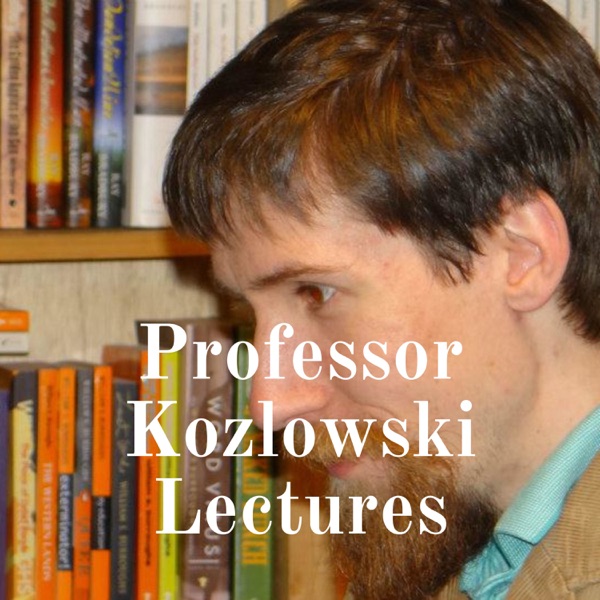
Published by Benjamin Kozlowski
Professor Kozlowski lectures on various subjects in Philosophy, Theology, and the Humanities. For a list of courses and projects, visit his website at: https://professorkozlowski.wordpress.com/
On the charts
Every published chart this podcast appears in, in the snapshot behind this page. Each one links to the chart it came off.
From the feed
The latest episodes published to this podcast’s own RSS feed. Titles and descriptions are the publisher’s.
Today we kick off our discussion of William Blake with a little history catch-up, some discussion of his biography, and a [brief] analysis of the "Songs of Innocence and Experience," and the "Marriage of Heaven and Hell." We'll discuss Blake's religious perspective, his creative interpretation of Milton, and the ideas that will go on to influence Romanticism, magicians, and 20th century thinkers of many stripes.
Today we finish our discussion of Milton's Paradise Lost with a close examination of Books 9-10. Along the way we'll look at Satan's last chance to make peace with God, his rhetorical strategies to convince Eve to fall, and Milton's relentlessly debilitating portrayal of Eve herself. It's rough, folks. We won't go on to examine Books 11-12, where Milton summarizes the rest of the Bible and concludes with the promise of Christ's salvation - but instead we'll spend the next week discussing William Blake and his interpretation of Milton's poetry and theology.
Today we wrestle with the whole of Raphael's digressions from the central plot of Paradise Lost - the war of the angels in heaven, Milton's recapitulation of Genesis 1 and 2, and some interesting side questions about the Renaissance controversies surrounding the nature of the cosmos, angelic diet and sexuality, and a big glaring theological muddle surrounding human sexuality.
Now that our discussion is officially behind our reading, let's take the opportunity to run through some of the main ideas in Books 3-5 of Paradise Lost , including Milton's (perhaps inconsistent) emphasis on human (and angelic) freedom, Satan's doubts, and the characterization of Eve, God, and Adam.
Today we set out many of the topics we'll need to know in our ongoing study of British Magick - including the varieties of Magical practices common among Renaissance thinkers, some of the ideas of especially prominent Renaissance magicians, and the 17th-century British history surrounding John Milton and the writing of Paradise Lost.
Today we discuss the opening chapters of Milton's Paradise Lost , to ask ourselves: why do we find Satan so compelling in this poem? We'll discuss the reasons why Satan seems persuasive, as well as Milton's hints that Satan is not trustworthy - and why they don't seem to be sufficient.
Today we get as close as we're going to get to reading actual magical grimoires and practical magic instruction - we're looking at three famous texts with differing relationships to the Judeo-Christian Canon and theology. Namely, 1. The Book of Tobit , an Intertestimental book included in some Biblical traditions and not in others, about driving off a demon with some fish parts. 2. The Apocryphon of John , a key text associated with Gnosticism, supposedly written by John the apostle, but which presents a very different interpretation of the Genesis creation story. 3. The Testament of Solomon , a catalogue of demons that continues to baffle scholars, insofar as it invokes a tradition as old as Christianity, and bears some of the hallmarks of ancient composition, but probably didn't exist in its present form until the Renaissance.
Today we discuss how the New Testament came to be: first, by looking at the historical evidences surrounding Jesus of Nazareth, then by examining the complicated and confusing world of writers and writings that emerged in the first centuries of Christianity's growth, then finally by looking at Constantine and Eusebius' efforts to codify Christian teaching, theology, and canon.
Today we talk about the Old Testament's complicated relationship to magic. We'll discuss passages that seem to acknowledge the existence of magical or spiritual forces, familiar texts that are fertile ground for magical interpretations, and strange and esoteric prophecies that become the template for later would-be prophets and magicians.
Today we discuss the text, context, and legacy of Virgil's Aeneid . We'll talk about its role as the preeminent poem of Western literature, its value as propaganda to Augustus Caesar, and the myths and legends that shaped it. We'll also examine the changing face of religion and mythology in the Roman empire, as Christianity and Zoroastrianism supplant the pagan practices that predated them. And, finally, we'll discuss the complicated art of translation by contrasting several translations of the Aeneid against one another.
Today we discuss Hesiod's Theogony and The Homeric Hymn to Demeter , not necessarily for the stories, but to understand how the Greeks conflate their understanding of magic, myth, religion, and history.
Today we take our first look at the study of nonsense with a discussion of logical fallacies - some familiar and well-worn, and some that I dare to invent and name like I'm a real bigshot scholar. We'll also talk about my expectations for good writing - which makes sense in a class about writing. Readings for today include "On Bullshit" by Harry Frankfurt and the Informal Fallacies site on Texas State's philosophy page . EDIT: I've apparently run into some errors and debates in my discussions of grammar here. 1. "To the store" is a prepositional phrase, NOT a dependent clause. Dependent clauses have a subject and verb but are nonetheless NOT complete sentences (like "When I went to the store"). 2. There is apparently some debate about whether or not "when" is a preposition. Since it usually connects two clauses, it is typically considered a conjunction ("When I went to the store, I bought milk."). Since it modifies a verb, it is also often considered an adverb. Some argue that it is a preposition because it locates an action in time, but the debate remains ongoing. (English is weird.) ALSO: RE: Eco's Fallacy - My man Wes from VGA pointed out that the terms apophenia and pareidolia could be used to describe what I call Eco's Fallacy here. But I'm sticking to my guns on this one. Both the other terms are used in psychological circles to describe delusion or hallucination-related phenomena: pareidolia typically refers only to visual hallucinations (like the canals of Mars) while apophenia refers to any erroneous connection between two things (including conspiracy theories). But both are used predominantly in psychology, as far as I can tell, and not as rhetorical activities. I don't think either have been applied to the phenomena we're encountering in this class - full-throated, seemingly-logical arguments for the connections common to, say, conspiracy theories, perceived spiritual contact or magical exercises, or the assumption that the stars govern our destinies. When apophenia is used to describe conspiracy theorists, it is usually employed to discuss their erratic behavior or cycles of belief; Eco's Fallacy would instead concentrate on the allure and contagiousness of conspiracy theories as persuasive arguments. There is overlap here - I'm extending "logical fallacy" to cover psychological and sociological tendencies beyond the mere granular fallacies we usually discuss (like those on the Texas State page), but it is all rooted in rhetoric, not delusion. People are persuaded by folks on the internet arguing that the earth is flat, because these arguments seem logical in some way. That's a rhetorical error, not a symptom of mental illness, and we should be able to discuss these errors in terms of their fallacious value. "Eco's Fallacy" stands.
Professor Kozlowski introduces his students to the ins and outs of his Studies in Arts and Humanities class for Fall of 2026.
At long last, we begin our study of British Magick with an introductory lecture about what you can expect from the series, our goals and parameters for the study, and how we will structure the lectures. So it begins. If you wish to be initiated into the greater mysteries of magickal thinking - or just want to support the show - please visit our Patreon ! For more forays into the secret wisdom of art, literature, and philosophy, check out our website ! And for more detail about how this series came to be, check out the Professor Kozlowski Lecture Notes podcast!
Today we discuss Jason Stanley's How Propaganda Works - a book I've been reading on-and-off since the History of Social Thought class, but which seems more important and relevant every day. Please support my work through Patreon Check out our sister channel: Professor Kozlowski Lecture Notes And check out my other projects on my website
Shamelessly promoting our new paid sister channel, Professor Kozlowski Lecture Notes , where you can find our discussions of V for Vendetta, Watchmen, Sandman , and all the rest of our forthcoming research into "A Brief History of British Magick" and beyond. You can also listen along by joining the Patreon - paid patrons get access to all Notes recordings without paying for each lecture individually. It's a BARGAIN!
Today Professor Kozlowski does some long-overdue housekeeping. We'll talk about our ambitions for the future, specifically our project on The History of British Magick for the summer of 2026, and how we might get paid doing it - as well as the usual pleas for Patreon subscriptions and other contributions. (Like, Share, Subscribe!) Please support my work through Patreon And check out my other projects on my website
The Bible is a long, difficult text with many apparent conflicts, especially when it comes to a believer's responsibilities to secular government. Here we will look at the seven most obvious models of political participation in the Bible, and try to reach a theology of Godly government. This lecture is intentionally brief (at least by Professor Kozlowski standards), in the interest of clarity and ease of access. If you think it might start some productive conversations, please share it with those who might benefit from hearing it - but be careful : words may be more dangerous than they appear in 2026. Some may be interested in peaceful disagreements; others may only pretend to be; others still may react with violence. Use your discretion. If you are interested in the more robust version of this discussion, with all the direct quotes and references put back in, I recommend my lectures on Politics and the Bible , Medieval Christian Political Philosophy , Conservatism , Communism and Anarchism , and Activism . Just because I don't always show my work doesn't mean I'm not doing it. If you're interested in my other projects, check out my website: ProfessorKozlowski.wordpress.com If you want to support what I'm doing, please consider contributing to my Patreon: patreon.com/professorkozlowski
Professor Kozlowski finally reaches plot development in Goethe's Faust, Part One . He discusses Margareta as a character, Faust's (and the audience's) relationship to her, and the looming sense of destruction hanging over everyone. What could go wrong?
Professor Kozlowski, introvert and buzzkill extraordinaire, poops on that most famous of lavish, extravagant parties: the one thrown by Gatsby in Chapter 3 of The Great Gatsby . A century of interpreters have mythologized this party as a symbol of doomed American innocence and romance - an innocence Hollywood and the Trump administration seem determined to re-create. Are we right to idolize the rich, raucous world of Gatsby's roaring twenties - or does the party just suck? To see what other literary classics Professor Kozlowski can ruin for you, check out his website: ProfessorKozlowski.wordpress.com If you want to contribute to Professor Kozlowski's war on fun, please consider his Patreon: patreon.com/professorkozlowski
Ranking source
Apple Podcasts rankings via the Mato Topic Intelligence Platform.
Observed September 16, 2026. Cached outside the daily freshness window; the positions keep the date they were taken on.
Apple and Apple Podcasts are trademarks of Apple Inc., registered in the U.S. and other countries.
Pairs with
Bring this source into Mato to read its transferable patterns, then turn them into an original show for your own audience.