Mato just raised pre-seed Read more

Podcast charts
Published by David McWilliams & John Davis
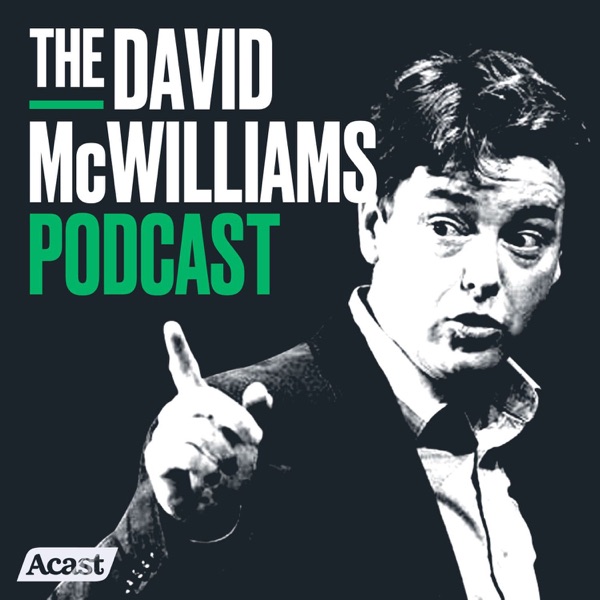
The aim of this weekly podcast is to make economics easy, uncomplicated and accessible. With the world at a political, technological and financial tipping point, economics has never been so important to all of us and yet, it’s made inaccessible and complicated by so many. I’ve always thought what is complicated is rarely important and what is important is rarely complicated. That will be our motto. Every week we are going to tease out some big economic or political issue facing us, not just here in Ireland but in Europe and further afield. Globalisation has brought us all together. We all face similar challenges whether you live in Dublin, London, Minnesota or Milan. If you would like to enjoy all of our content ad-free and have early access to episodes, subscribe to DMCW+ on Apple Podcast. You can also find our early access ad-free episodes on Spotify by searching for the David McWilliams Podcast Premium Feed on the app or by clicking here . Want to join our crew? Join at davidmcwilliams.ie/crew , where you can enjoy ad-free listening, as well as exclusive bonus content such as premium episodes, our macroeconomics course, early access to episodes and pre-sale access to tickets for Dalkey Book Festival & Kilkenomics. Hosted on Acast. See acast.com/privacy for more information.
On the charts
Every published chart this podcast appears in, in the snapshot behind this page. Each one links to the chart it came off.
From the feed
The latest episodes published to this podcast’s own RSS feed. Titles and descriptions are the publisher’s.
For Halloween, we start with Ireland’s first witch trial: Alice Kyteler, the Kilkenny moneylender who buried four husbands and skipped town, leaving her servant to burn at the stake in 1324. For a real scare, we dive into the five numbers that should keep you up at night. The Shiller index at 41 (last seen in 1999, just before the dot-com crash), global government debt at 94% of GDP, The US paying $1 trillion a year just to service its debt, more than its defence budget, the 10-year Treasury yield at 5.36%, a 24-year high and oil at $110, 80% up on last year, thanks to the Strait of Hormuz. If it all goes pear-shaped, the question is simple: who’s the witch? Use code WITCH at kilkenomics.com for 20% off tickets all day October 30th & 31st Hosted on Acast. See acast.com/privacy for more information.
A week of rioting in France, but we argue it’s no blip. Marine Le Pen is polling around 35%, with the next candidate on just 14%, and she could become the first ever to win outright in the first round. French public spending is 57% of GDP (31% in Ireland, and above anything the Soviet Union managed), over-65s have gone from 12% of the population in 1968 to 25% today, and bond yields have jumped from 3.4% to 4.8%. We unpack the poly-crisis behind it: the 68ers versus their grandchildren, diesel prices and the ghost of the Gilets Jaunes, a left captured by the educated elite, AI anxiety, and half of French schools missing a teacher. Plus 68% of French voters say democracy isn’t delivering, Meloni getting outflanked on her right, and whether the European project survives the generation that built it. Hosted on Acast. See acast.com/privacy for more information.
Canada has appointed the world’s first minister for AI, and Evan Solomon joins us to explain why. Canada invented modern AI through Hinton, Bengio and Sutton, then watched big tech harvest it. Now Ottawa is subsidising up to 80% of compute for home-grown firms and has put €150 million behind Bengio’s “safe by design” AI. How do slow, deliberate democracies regulate a technology teaching itself at lightning speed? Plus Carney’s coalition of middle powers, why Trump is the best thing to happen to Canadian nationalism, and “ancestral intelligence.” Hosted on Acast. See acast.com/privacy for more information.
Broadcasting from the Aran Islands, where the population has crashed from 48,000 to 3,000, we look at what may be the biggest data point of 2026: for the first time ever, the human race is shrinking. The global fertility rate has dropped to 1.8, below the 2.1 needed to replace ourselves, and of 236 countries studied, 219 are in decline. The twist is that it’s happening fastest among poorer, less-educated women in poorer countries, which wrecks the old rule that you have to get rich before you get old. So is modernity itself the culprit, and could tradition stage a comeback? Plus, why AI scepticism sent investors rushing back into bonds this week. Hosted on Acast. See acast.com/privacy for more information.
Live from New York, with a radical idea: treat the Irish diaspora as our greatest soft power asset. Every Irish child costs the state about €500,000 to educate, and America pockets the return when they emigrate. So scrap tax for two years for anyone coming home, and give citizenship to a third generation of Irish Americans. Then the midterms, four weeks out. Trump is on 33%, the lowest of any midterm president since 1974, petrol is back above $4, and markets give Democrats a 65% shot at both chambers. A blue wave makes him a lame duck. Hosted on Acast. See acast.com/privacy for more information.
Ireland’s budget surplus is €9 billion, but the Department of Finance reckons €23 billion of the €34 billion in corporation tax is transient AI-boom money. Strip it out and we’re looking at a €13-14 billion deficit, heading for €20 billion by 2029. Meanwhile we’ve just pumped €7.4 billion of tax cuts and handouts into an economy already at full employment. Recorded live from New York, where financiers are getting twitchy about an AI bubble: US long-term rates are creeping towards 6%, and superscalers now gobble up 17% of the capital the Treasury needs. We ask whether Ireland is Norway or Nigeria when it comes to managing a windfall, why a hard budget focuses the mind, and why a rotating Taoiseach and a split Department of Finance add up to ordering two tiramisus because the voucher is free. Hosted on Acast. See acast.com/privacy for more information.
Calouste Gulbenkian never drilled a well, never owned a rig, and still died the richest man in the world. We follow the Armenian fixer from Constantinople who took 5% of everything: the Turkish Petroleum Company, Royal Dutch Shell, even a deal with Stalin paid in Hermitage art. His maps shaped modern Iraq and left the Kurds sitting on top of the oil, and his split of upstream, refining and distribution still defines Big Oil today. Plus why diesel is spiking, what a 100 million barrel release really does, and why this misanthropic networker gave his fortune to art while today's billionaires build spaceships. Hosted on Acast. See acast.com/privacy for more information.
Dublin prices have fallen 5.2% last year, the biggest drop since 2014, and the buyer's strike is real. The premium over asking has shrunk from 7% to 2.6%, and the average couple on €108k can borrow just enough for a €484k home when a three-bed semi in Dublin asks €635k. We break down why: young people are maxed out, we're still building 1980s houses for a 2020s population, and the force driving prices this time is people, not credit like in 2008. Plus the Spanish eviction story that had Madrid in uproar, and why "the cure for high prices is high prices." Hosted on Acast. See acast.com/privacy for more information.
15-year-olds across the OECD are now testing at levels last seen among 14-year-olds a decade ago, we've lost a full year of cognitive ability in ten years. One in five teenagers in the rich world would struggle to read their own phone bill. We dig into why: screens, AI shortcuts, the death of patient reading, and a "snowflake-isation" of education that's swapped hard exams for soft assessment. Ireland's own numbers aren't pretty either, with reading and maths both sliding since 2015. Is this really decline, or have we simply hit a natural ceiling on middle-class intelligence, meaning the real gains left are among poorer kids? Hosted on Acast. See acast.com/privacy for more information.
Can a generous welfare state and large-scale immigration coexist? Fresh research says it depends on who arrives and what kind of welfare state they arrive in. In the UK, an average migrant couple needs a primary earner in the 55th percentile to pay their way. In Germany, it's the 28th. In Ireland, our back-of-envelope sums say the 65th, or about €62,000 a year. We break down why Ireland's tax and welfare system, where someone on €27,000 gets €11,000 back from the state and someone on €104,000 pays in €40,000, changes the whole debate. Hosted on Acast. See acast.com/privacy for more information.
Trump and Xi sit down in Washington today, but the real story is how China actually built its economic juggernaut. China expert Yanmei Xie breaks down the "catfish in the sardine tank" strategy behind China's EV dominance, why Chinese carmakers compete profit margins down to 3-4% just to win market share, and how a Leninist system mobilises household savings to fund it all. Hosted on Acast. See acast.com/privacy for more information.
This episode provides a midterm assessment of the Irish economy, exploring the disconnect between record-breaking macroeconomic data and the lived experience of the public. We analyse the "Ed Sheeranization" of Ireland,the delicate balance between American corporate reliance and European political identity, and the systemic risks posed by the global AI arms race. From "Dutch disease" to the challenges of economic gluttony, we examine why Ireland’s future is now entirely in its own hands. Hosted on Acast. See acast.com/privacy for more information.
There has been a transition from a world of abundant capital to one of scarcity. With the rising interest rates across the US, UK, and France, we discuss the economic implications of Donald Trump’s "fairway diplomacy" in Ireland, the structural fragility of European bond markets, and the sudden shift in rhetoric from AI leaders calling for regulation. Is the move to "pace the frontier" is a moral awakening regarding existential risk or a strategic play for state protection in a tightening financial landscape? NYC Tickets: https://irishartscenter.org/event/an-evening-with-david-mcwilliams-2026 Hosted on Acast. See acast.com/privacy for more information.
This week, we analyse the collapse of Ireland's night-time economy, noting that 2,205 pubs, one in four nationwide, have closed since 2005. With regional closure rates hitting 37% in Limerick and 33% in Cork, the discussion highlights how high excise duties and archaic licensing laws are strangling a $4 billion industry that supports 92,000 jobs. The episode explores why a country that markets itself on fun is systematically shutting down its social infrastructure. Hosted on Acast. See acast.com/privacy for more information.
Donald Trump touches down in Doonbeg this weekend for the Irish Open at his own golf course, and we're asking whether Ireland should protest or play along. We unpack the extraordinary Irish-American relationship: 40 daily flights to the US, $1.3 trillion in American investment, 300,000 jobs, and a bond built more on kitchen tables than diplomacy. We're joined by Donal Casey, former CEO of Rory McIlroy Inc., to talk golf's economics, why LIV Golf failed despite Saudi billions, and how the fairway - not the barricades, might be Ireland's smartest move with America's most unpredictable president. Hosted on Acast. See acast.com/privacy for more information.
A deep dive into the AfD’s 44% victory in Saxony-Anhalt and its implications for the European Union. We analyse the collapse of Germany’s political center, the demographic divide among young voters, and the historical tensions between East and West that are reshaping the continent’s future. Hosted on Acast. See acast.com/privacy for more information.
We explore the new ideological divide between Silicon Valley’s techno-optimists and institutional economists like Daron Acemoglu. Will AI drive shared prosperity or concentrate wealth among a new technocratic elite? Hosted on Acast. See acast.com/privacy for more information.
Our population's just hit 5.5 million, and 72% of that growth is migration, not births. Five years ago 57% of work permits went to doctors, nurses and scientists. Now it's just 30%. We crunch the CSO numbers and ask the question nobody wants to: how many migrants can Ireland's housing market actually take before something breaks? Hosted on Acast. See acast.com/privacy for more information.
As global central bankers convene for the Jackson Hole symposium, the interrogation of American fiscal credibility takes center stage. With US national debt surpassing $40 trillion and interest payments now exceeding the defense budget, the Treasury faces a critical standoff with the bond market. This analysis explores the limits of yield manipulation, the threat to the dollar’s role as global collateral, and the inevitable market-driven correction facing a politically paralyzed Washington. Hosted on Acast. See acast.com/privacy for more information.
On the anniversary of the St. Bartholomew’s Day Massacre, we explore the extraordinary economic impact of the French Huguenots. Discover how these religious refugees pioneered the merchant class, redefined the relationship between faith and finance, and built the foundations of modern capitalism. From the streets of Paris to the boardrooms of the Bank of Ireland, this episode uncovers the hidden history of the people who transformed the global economy. Hosted on Acast. See acast.com/privacy for more information.
Ranking source
Apple Podcasts rankings via the Mato Topic Intelligence Platform.
Observed November 4, 2026.
Apple and Apple Podcasts are trademarks of Apple Inc., registered in the U.S. and other countries.
Pairs with
Bring this source into Mato to read its transferable patterns, then turn them into an original show for your own audience.