Mato just raised pre-seed Read more

Podcast charts
Published by Rocky Ruggiero
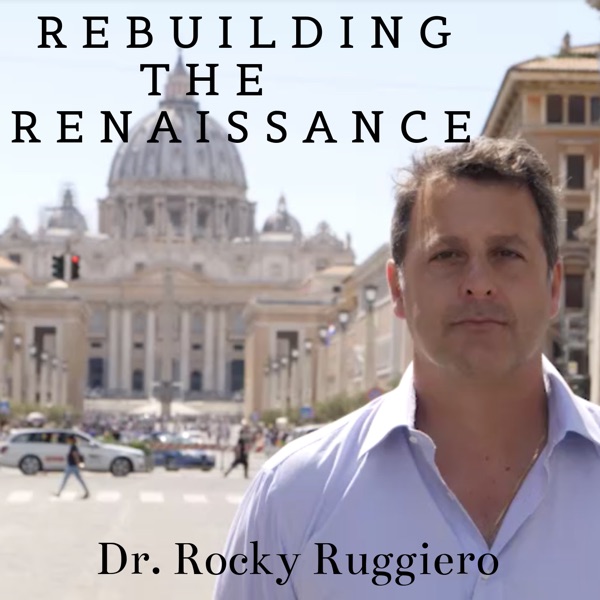
This podcast will explore the development of the art, architecture, culture and history in Italy, from ancient Roman times through the Renaissance. Listeners will develop an understanding of Italy's role in the development of Western civilization and an ability to appreciate and understand works of art in their historical context.
On the charts
Every published chart this podcast appears in, in the snapshot behind this page. Each one links to the chart it came off.
From the feed
The latest episodes published to this podcast’s own RSS feed. Titles and descriptions are the publisher’s.
The archeological park of Siracusa, Sicily is in one of the five ancient districts of Siracusa known as the Neapolis - "the new city." Its two major ancient monuments are a massive ancient Greek theater from the 5th century BCE carved directly into the limestone rock of the Temenite hill and an equally impressive ancient Roman amphitheater which had a seating capacity of some 20,000 spectators. But the park's most famous site is the so-called "Ear of Dionysius" which was named by the celebrated painter Caravaggio and has extraordinary acoustic properties.
Ortygia is a small island forming the historical center of the Sicilian city of Siracusa. While already inhabited by native Sicels in ancient times, Siracusa became an ancient superpower after Greek colonists settled there in the 8th century BCE and became part of Magna Graecia. In fact, Ortygia contains many of the city's oldest landmarks, including the Greek Temple of Apollo, the Fountain of Arethusa, and the Temple of Athena, which is today the Cathedral of Siracusa. It was later home to the legendary mathematician and inventor, Archimedes.
Covering nearly 3,500m 2 of floor surface, the mosaic decoration of the Villa Romana del Casale in Piazza Armerina, Sicily, are almost unique not only in their scale, but also in their extraordinary state of preservation. The two most noteworthy and famous mosaics are the "Great Hunt," which is nearly 70m long and the surprising "Bikini Girls" mosaic which has gained international notoriety.
Located in the very heart of Sicily in a town called Piazza Armerina, the Villa Romana del Casale is an archeological site containing the remains of an ancient Roman "Latifundium," or agricultural estate. The massive building is incredibly well preserved and provides us with a vivid glimpse of Roman life in the early 4 th century CE. It is also home to an extensive mosaic program covering 3,500m 2 (38,000ft 2 ) of surface and including the famous "bikini girls" mosaic.
Situated about 750m above sea level in the northwestern part of Sicily, Erice is one of the most charming of Sicilian towns. Characterized by narrow, medieval streets flanked by churches and palaces, Erice is simply a delight to stroll through. Its main church is known as the "Chiesa Matrice" ("Mother church") and was built at the beginning of the 14 th century. The Norman castle in Erice is known as the "Castello di Venere" ("Castel of Venus") offers breathtaking views of the Tyrrhenian coast.
Selinunte is home to one of the most important archaeological sites from the Greek period in Italy. Located on the west coast of Sicily, it was the most westerly of ancient Greek colonies and one of the most important. I ts ancient public spaces, temples, fortifications, and houses are remarkably well preserved and date as far back as far as the middle of the 6 th century BCE.
Located about an hour west of Palermo in Sicily, Segesta is home to a magnificent Greek-style, Doric order temple built in the 5 th century BCE. Perched high up on a hill, offering breathtaking views of the nearby Gulf of Castellammare, the temple and nearby ancient theater are testimony to the ancient people of Segesta who were known as Elymians.
From how I go about recording my podcasts, to great Italian Renaissance art in England, to where to stay in Sicily, to the similarities between Michelangelo ' s unfinished " Entombment " and Pontormo's "Capponi Altarpiece," to Parmigianino ' s ceiling in Fontanellato, to where Michelangelo got his talent, and much, much more - this episode answers the very questions that you ask me about the great art, artists, and history of the Italian Renaissance.
The Valley of the temples in Agrigento, Sicily, is an archeological area containing the remains of seven ancient Greek temples, in varying states of conservation. Located along a ridge with breathtaking views of the Mediterranean Sea in the distance, it represents one of the world's most important collections of Ancient Greek architecture.
The southern Sicilian city of Agrigento was founded in 580 BCE by a group of Greek colonists from the nearby town of Gela with the name "Akragas." It quickly became one of Magna Grecia's most important cities and eventually defeated a Carthaginian army at the Battle of Himera in 480BCE. To celebrate the victory, a series of majestic temples were built along a nearby and known today as "The Valley of the Temples."
Covering some 6,500m 2 (70,000ft 2 ), the spectacular mosaic cycle of Monreale Cathedral in Sicily is one of the largest in the world. The mosaics were created in the 12th and 13th centuries by order of Norman King William II in the Byzantine style. While the nave and clerestory mosaics depict Old Testament stories, the side aisle walls, instead, depict New Testament stories. The entire program culminates in the apse of the great cathedral with a massive "Christ Pantocrator" image.
According to legend, in the 12th century, the Virgin Mary appeared to King William II of Sicily while he was napping and ordered him to build a church on a hill just 7km south of Palermo, Italy. The result is one of the greatest churches of the Middle Ages - Monreale Cathedral. Next to the majestic church, whose interior contains Italy's largest mosaic, is an exotic cloister that was clearly influenced by Islamic architecture.
Originally built in the 14 th century, the Dominican church and convent were both renovated in the 16 th century. While the church displays a n almost dizzying example of Sicilian Baroque architecture, the well-preserved convent is instead quite sober and reflects what mosaic life was like for the nuns. The convent is also home to a still active bakery called "I Segreti del Chiostro" which offers visitors delicious local specialties.
Originally carved in 1554 for the garden of a Spanish nobleman in Florence, the so-called "Fountain of Shame" was dissembled in 644 pieces and transported to Palermo, Sicily, after having been sold to the Senate of Palermo. Situated on the western side of the Dominican church and nunnery of Santa Caterina, the abundant nudity of the fountain was thought to be shameful in such proximity to the chaste nuns.
The Quattro Canti is a spectacular example of Sicilian Baroque architecture on a grand scale! Marking the entrance to Palermo's historic district, the Quattro Canti (technically Piazza Vigliena) is a large octagonal piazza laid out in the early 17th century, four side of which are occupied by Baroque facades. Each of these facades contains allegorical fountains on the ground level, statues of Sicily's Spanish rulers of Sicily on the next, and Palermo's four patron saints above.
Construction on the church of Sant Maria dell'Ammiraglio in Palermo, Italy, began in 1143 CE under the patronage of George of Antioch, admiral of King Roger II's navy, from which the church gets its name. The church preserves an extraordinary collection of 12th-century mosaics, the two most important of which are "Christ Coronating King Roger II" and " George of Antioch at the Feet of the Virgin Mary." In later centuries, the church received various Baroque-style additions and decorations, and the nickname "La Martorana" from the nearby Benedictine nunnery.
Built as a royal chapel in the 12 th century CE by King Roger II, the Norman ruler of Sicily, the Palatine Chapel is a beautiful manifestation of the influences of Byzantine, Norman, and Islamic art and architecture. The chapel is home to one of Italy's most important examples Byzantine mosaic decoration and an almost unique example of a non-Islamic muqarnas ceiling.
Born to a noble Norman family in the 12 th century, Santa Rosalia became Palermo's most important patron saint when she miraculously saved the city from a devastating plague in 1624. Still today, she is venerated and celebrated by both the people of Palermo as well as Sicilians throughout the world.
Originally built in the 12 th century, Palermo Cathedral was continually modified for the next six centuries. While much of its original and rather exotic Norman architecture survives on the exterior, the interior is entirely Neoclassical in design. Palermo Cathedral is home to the tomb of Holy Roman Emperor Frederick II and the remains Palermo's patron saint, Santa Rosalia.
Founded by the Phoenicians nearly 3,000 years ago, Palermo subsequently became a Greek, Carthaginian, Roman, Arab, and Norman city. This mix of civilizations is palpable in Palermo art, architecture, food, and customs of the city. This podcast explores this magical Sicilian city's three millennia of history, beauty, and traditions.
Ranking source
Apple Podcasts rankings via the Mato Topic Intelligence Platform.
Observed September 21, 2026.
Apple and Apple Podcasts are trademarks of Apple Inc., registered in the U.S. and other countries.
Pairs with
Bring this source into Mato to read its transferable patterns, then turn them into an original show for your own audience.