Mato just raised pre-seed Read more

Podcast charts
Published by Andrew Heaton
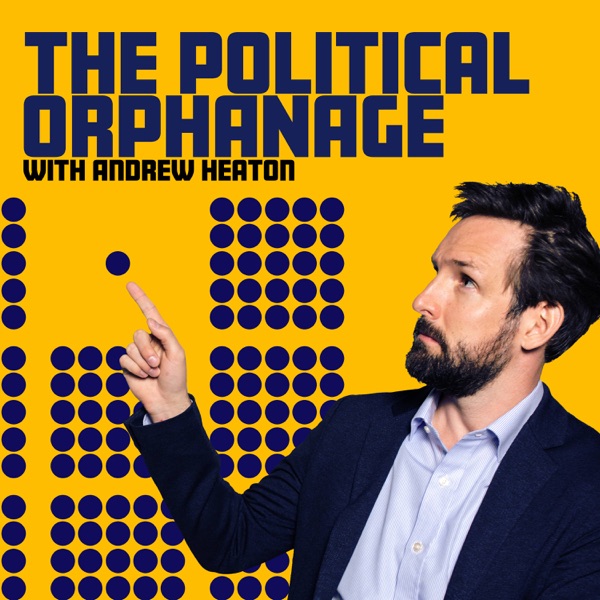
Politics minus bile plus jokes. Comedian and avowed independent Andrew Heaton interviews authors and thought leaders about policy and big thinky stuff.
On the charts
Every published chart this podcast appears in, in the snapshot behind this page. Each one links to the chart it came off.
From the feed
The latest episodes published to this podcast’s own RSS feed. Titles and descriptions are the publisher’s.
What if, instead of electing politicians, we selected them at random—like jury duty? It's called sortition , and for centuries it was considered an essential ingredient of democracy. From the democratic ideals of ancient Athens to the blood-soaked conquests of Norman England, the murderous family rivalries of Renaissance Italy, and the ingenious anti-corruption lotteries of Switzerland, the history of sortition is a fascinating but now-neglected electoral mechanism. In this episode we explore the origins and purposes of sortition, and ask: could it work for more than just jury duty?
What happens when the opposition actually has to govern? Georgia State Representative Scott Holcomb discusses the transition from legislative minority to majority, how to pass meaningful laws when the other party holds power, and why he refuses to keep score of colleagues' votes. From clearing untested sexual assault kits to debating Medicaid expansion and mandatory minimum sentences, the conversation explores the relationships, tradeoffs, and budget decisions behind getting things done. This conversation was edited for reasons of time and continuity. The full, unedited interview can be found here: https://drive.google.com/file/d/1AiQGQmXRvKOJvuX4qBaz1ZVEHbpJGfu0/view?usp=sharing
The Neoliberal in your life cares enough about you to ask you to listen to this audio cassette. After completing this course, you will understand the basics of neoliberal psychology. And be able to engage in productive conversations about political economy with your neoliberal, without resort of violence or condescension. You'll be well on your way... to Talking with Your Neoliberal Shill! Audio book by Andrew Heaton
Why did America close its psychiatric hospitals, and what happened to the people who needed them? Writer and cultural critic Freddie deBoer, author of All in Your Head: Illness as Identity, Trauma as Fashion, and the Desire to Be Disordered, explores the ideas, political decisions, and good intentions behind deinstitutionalization. From the influence of One Flew Over the Cuckoo's Nest to the promise of community care, the conversation examines how efforts to end psychiatric abuse left profound gaps in treatment—and asks what humane care should look like for people who cannot recognize their own illness.
Corporate personhood is one of the most misunderstood concepts in American law. From ancient Rome and medieval universities to William Blackstone and the modern Supreme Court, this episode explores why corporations have legal identities, how limited liability works, why companies can be prosecuted for crimes, and whether they can receive the corporate equivalent of the death penalty. Then, a look at three competing philosophies of corporate personhood—Association Theory, Concession Theory, and Real-Entity Theory. Are corporations simply groups of individuals exercising their freedoms collectively? Artificial creations granted privileges by government? Or institutions with identities and rights of their own? And which constitutional rights should corporations actually possess? SUPPORT THE SHOW! www.JoinTheOrph.com
Why is Germany's anti-immigration AfD surging in popularity? And why does immigration seem to work better in America than in Europe? Harris, a Bosnian refugee turned American citizen who now lives and works in Germany, joins us to explore the economic, cultural, and political tensions fueling Europe's immigration backlash. We discuss Germany's sprawling welfare state, bureaucratic obstacles to integration, immigrant crime statistics, the challenges of assimilating refugees, and the difference between civic and ethnic nationalism. Along the way, we examine whether the AfD's rise reflects legitimate grievances, xenophobia, economic stagnation, or a growing sense that Germany's political establishment has lost control. Discord Server: https://discord.gg/D2uBGknhe NOTE: This episode has been edited for purposes of brevity and flow. On occassions when I do this, I make the unedited vrsion available as well. The original can be found here: https://drive.google.com/file/d/1HP02k2rFmgs1neximy-jeF6cqa30_x4l/view?usp=sharing
Americans pay vastly more for medicine than citizens of other wealthy countries, but are those countries getting a bargain at our expense? David Goldhill, author of Catastrophic Care and founder and CEO of the healthcare marketplace Sesame, joins the show to explain why he considers American healthcare a kind of "second NATO"—one in which the United States shoulders a disproportionate share of the costs of medical innovation while the rest of the world reaps the benefits. We discuss why American healthcare is so outrageously expensive, whether adopting a European-style system would undermine medical innovation, why hospitals compete on everything except price, and whether healthcare can ever function like a normal market.
When does a successful company become a dangerous monopoly? Heaton traces the strange history of American antitrust law, from railroad barons and Standard Oil to Hollywood studios and Big Tech, before diving into the intellectual cage match between Louis Brandeis and Robert Bork. Should regulators worry about corporations getting too big and powerful, or only step in when consumers actually get hurt? Along the way, Heaton encounters natural monopolies, vertical integration, glitter cartels, cowboy boots, suspiciously powerful coffin companies, and the surprisingly difficult question of what even counts as a market.
Alex Mayyasi of NPR's Planet Money joins me to explore some of the stranger forces shaping the economy. Why did the federal government create a legally mandated raisin cartel? Why are so many American corporations technically from Delaware? Should companies exist solely to make money? And are there times when price controls actually work? We also dig into Baumol's cost disease—the counterintuitive reason that as society gets richer, childcare, healthcare, restaurants, haircuts, teachers, and live performances can become increasingly expensive. Plus: how rising labor costs might be contributing to the loneliness epidemic, and how Lucille Ball and Desi Arnaz helped invent the modern television business. His book: "Planet Money: A Guide to the Economic Forces That Shape Your Life"
Are we racing toward an AI-powered golden age—or building something we won't be able to control? Justin Robert Young joins to explore the emerging philosophical divide over artificial intelligence: accelerate innovation and reap potentially enormous benefits, or slow down before we unleash risks we don't understand. We discuss OpenAI and Anthropic, the politics of AI regulation, competition with China, whether the AI boom is a bubble, the strongest case for the AI doomers, and the possibility that advances in AI could transform medicine, work, and even human aging. Plus: Justin explains why the best way to prepare for the AI revolution is surprisingly simple—start asking it dumb questions.
Dr. Steve Fuller of Warwick University says the meaningful split in society is not Leftwing vs. Rightwing, but rather Upwing vs. Downwing. Both have radically different attitudes to both risk and human nature, which informs their policy decisions and the direction they want to steer society. SUPPORT THE SHOW! www.patreon.com/andrewheaton Dr. Fuller's book at: www.mightyheaton.com/featured Referenced in the show today: TPO: "Was Abraham Lincoln Leftwing or Rightwing?" https://politicalorphanage.libsyn.com/hyrum-lewis "Transcendant Man" – Documentary by Ray Kurzweill about the Singularity https://www.amazon.co.uk/Transcendent-Man-Ray-Kurzweil/dp/B016V7WCLA ATA: The Bioethics of Gattica – Discussed on Alienating the Audience https://alienating.libsyn.com/gattaca ATA: How Cryonics Works – Interview on Alienating the Audience https://alienating.libsyn.com/we-can-freeze-you-how-cryonics-works ORIGINAL AIR DATE: August, 2023
Healthcare in America is more expensive than anywhere else in the world—but what are other countries actually doing differently? Physician and Slice of Life MD author Sally Primus joins me to tour healthcare systems from Germany and Britain to Japan, Australia, and Estonia. We look at single payer, private insurance, wait times, doctor shortages, drug prices, bureaucracy, and the strange economics of American healthcare—and ask which ideas the United States might actually want to steal.
Donald Trump has renamed Lake Ontario "Lake America" for federal purposes—but can a president actually rename a place, or only change what the government calls it? Andrew Heaton traces the strange history of who gets to control language, from ancient river names that survived Romans and Normans, to Cardinal Richelieu's Académie française, to Noah Webster, John Adams, Thomas Jefferson, and America's long refusal to appoint an official authority over English. Along the way: French language purism, loanwords, bad translations, official English, and why language usually belongs less to governments than to the people who actually speak it.
The DSA recently released a policy platform establishing the goals of their political movement. In this episode we got through the main planks of that document, namely the bits about "socialism" and "democratic." We likewise go through a few articles and interviews of prominent DSA members to get an idea of what, in their own words, they're actually up to. (Spoiler: it's socialism.)
The Save Our Bacon Act, now repackaged into the Farm Bill, would upturn state rights in favor of federal prohibitions on animal cruelty laws. It's being pushed, in large part, by Chinese-owned conglomerates irritated by federalism. Lewis Bollard is the Farm Animal Welfare Managing Director at Coefficient Giving on Substack. He joins to discuss the Save Our Bacon Act, and the economic tradeoffs of better animal welfare against higher meat prices. Senate switchboard number: (202) 224-3121 Prior Episode: "Big Ag's Meat Ethics"
What is The Odyssey actually about beyond a clever guy trying to get home? Classicist Isabella Reinhardt joins to dig into the poem's deeper themes of civilization, hospitality, identity, belonging, and what it means for a warrior to return from war. Then we turn to adaptation itself, and the choices involved in translating an ancient epic for a modern audience. Using Christopher Nolan's The Odyssey as our case study, we ask what an adaptation is free to change, what it has to preserve, and at what point a new version stops being The Odyssey at all. "All the Gods Suck Except Circe" https://alienating.libsyn.com/all-the-gods-suck-except-circe
It's not that America won't spend money on mass transit, it's that we piss it away when we do. Our transit system is a mess, with a lot of problems in spending, procurement, NIMBYism and good 'ol fashioned idiocy. Will Poff-Webster is the Director of Infrastructure Policy at the Institute for Progress, where he works on energy, transportation and housing policy.
Should you trust experts—or trust yourself? Richard Hanania, author of Kakistocracy: Why Populism Ends in Disaster joins to discuss why populism has become one of the defining forces in modern politics. We discuss whether elites really deserve their bad reputation, why expertise and institutions matter, where academia and the media have genuinely failed, and whether movements built around "the wisdom of ordinary people" inevitably drift toward conspiracy theories, corruption, and bad governance.
Why has trust in the news collapsed—and is it really all the media's fault? Tangle founder Isaac Saul joins for a candid conversation about the incentives driving modern journalism, from clickbait and audience capture to ideological groupthink and the collapse of local news. We explore whether readers are rewarding the very coverage they claim to hate, why viewpoint diversity matters inside newsrooms, whether AI poses a real threat to journalism, and what it would actually take to rebuild public trust. It's a nuanced discussion about media, incentives, and why fixing the news may require fixing ourselves first.
Is Rumpsringa real? Are Amish people happier than you? Let's visit Amish country! Heaton visits Muhlenberg County, Ohio, to investigate America's unique subculture of pacifistic, techno-phobic Anabaptists. We meet Marcus Yoder, the Executive Director of the Amish and Mennonite Heritage Center, and talk to him about all things Amish. Why do they have weird beards? Why eschew buttons, automobiles, and smartphones? And, crucially… are they onto something?
Ranking source
Apple Podcasts rankings via the Mato Topic Intelligence Platform.
Observed November 23, 2026.
Apple and Apple Podcasts are trademarks of Apple Inc., registered in the U.S. and other countries.
Pairs with
Bring this source into Mato to read its transferable patterns, then turn them into an original show for your own audience.