Mato just raised pre-seed Read more

Podcast charts
Published by Craig S. Smith
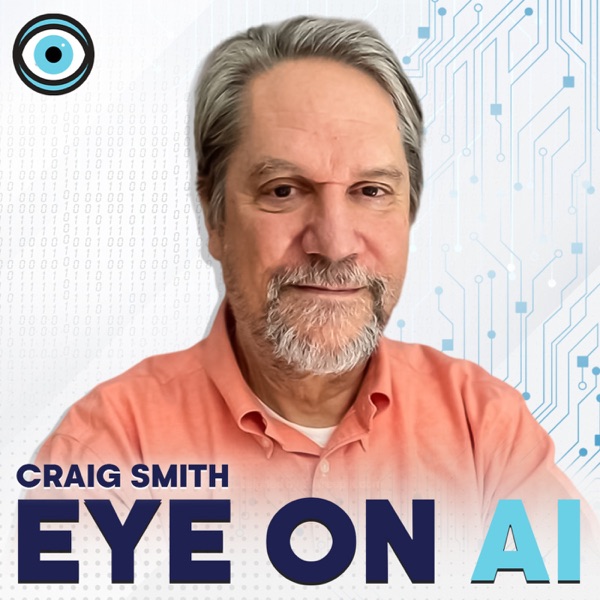
Eye on A.I. is a biweekly podcast, hosted by longtime New York Times correspondent Craig S. Smith. In each episode, Craig will talk to people making a difference in artificial intelligence. The podcast aims to put incremental advances into a broader context and consider the global implications of the developing technology. AI is about to change your world, so pay attention.
On the charts
Every published chart this podcast appears in, in the snapshot behind this page. Each one links to the chart it came off.
From the feed
The latest episodes published to this podcast’s own RSS feed. Titles and descriptions are the publisher’s.
Most companies investing in AI visibility are optimizing for the wrong thing. Being cited by an AI response and being recommended by an AI response are completely different outcomes, with click-through rates that differ by a factor of 70. Tim Sanders, Chief Innovation Officer of G2 and executive fellow at Harvard's AI Institute, joins Craig Smith to explain the hidden mechanics behind how ChatGPT and Gemini actually decide which software to recommend, and why the answer has almost nothing to do with what's on your website. When a user asks a commercial intent question, both models enter a "validation layer" process that specifically down-weights vendor content and seeks verified third-party signals: appearance on authoritative lists (41% of the recommendation weight), awards and accreditation (18%), and online reviews (16%). None of these can be manufactured. They must be earned. The conversation covers the structural transformation in how B2B software buyers behave, half now start their search with an AI prompt, up from 29% a year ago, with two-thirds projected within a year, and why most companies' organic search traffic is on a structural path toward zero. Sanders also delivers some of the most specific competitive data on AI model usage available anywhere: ChatGPT does live retrieval 100% of the time on research queries; Claude does it less than 40% of the time. ChatGPT and Gemini account for 81% of G2's AI research citations. And more than one in four enterprise employees bypass corporate AI tools entirely, using their personal ChatGPT because it has their memory and none of the guardrails. The episode closes with Sanders' most forward-looking prediction: within three years, AI agents will write the prompts, locate the software, and purchase it on behalf of businesses - with minimal human checkpoints - making the trust infrastructure G2 has built over more than a decade the most valuable asset in the AI-driven buying cycle. Subscribe to Eye on A.I. for weekly conversations with the people building and deploying the future of AI.
Every major data breach in the last 30 years shares the same root cause: the data inside the wall was never protected, only the wall. And AI frontier models are now making that wall easier to breach than ever, scanning codebases externally to discover undisclosed vulnerabilities and write exploits before anyone knows the hole exists. Trent Telford, Chairman, CEO & Founder of Qanapi, joins Craig Smith to explain why the entire architecture of conventional cybersecurity is structurally broken, and what a genuinely different approach, built from the opposite assumption, looks like. Rather than trying to build a better wall, Qanapi starts from the baseline that the data will eventually be exposed, and encrypts it at the individual word, paragraph, or database cell level, tying each unique key to a verified identity and a set of conditional policies that must all be met simultaneously before anything can be decrypted. The most commercially urgent application of this architecture is one that unlocks AI adoption for enterprises that have been sitting on the sidelines: Qanapi's gateway service encrypts sensitive fields before data reaches Claude, ChatGPT, or any other frontier model, and the model simply reports it cannot read the encrypted sections, while still reasoning over everything else. Trent discusses how Qanapi's Fathom tool confirmed in testing that Claude could not read the encrypted sections. He describes two major retailers - one using AI heavily, one abstaining entirely because of data security concerns - and asks the question every enterprise leader should be sitting with: how long can you last off the train before you get blitzed? The episode also covers drone security in denied wireless environments, the post-quantum encryption mandate that federal agencies have no practical plan to execute, and why Qanapi's business has exploded in the last six months as the AI gold rush has finally turned its attention from models to infrastructure. Subscribe to Eye on A.I. for weekly conversations with the people building and deploying the future of AI.
Every AI model in production today has the same hidden tax: doubling the context window quadruples the compute. That's what quadratic compute complexity means in practice, and it's the reason enterprises are spending most of their AI engineering budget on context management rather than on the actual problems they're trying to solve. Alexander Whedon, co-founder and CTO of Subquadratic, joins Craig Smith to explain how SubQ's sparse attention mechanism eliminates that tax, achieving 40 times faster inference and 64 times less compute than standard attention at one million tokens, and what becomes possible when that constraint disappears. The conversation covers striking benchmark findings: 86% of what frontier coding agents do is "read steps," just trying to gather and organize context before the actual problem-solving begins, and frontier models drop well below 50% accuracy on financial document analysis at 500,000 tokens, revealing how asymmetric long context capability actually is across industries. The most commercially important argument in this episode is about enterprise data. Most large organizations are sitting on hundreds of billions of tokens of data they've never been able to put to work in an AI product, told they need a $10 million data transformation project before they can even start building. Alex's core claim is that SubQ's architecture makes that barrier no longer necessary, enabling enterprises to process far more of their data with far less curation, at a fraction of the cost. He closes with what he describes as the most important and underexplored frontier in AI right now: we are still very far from understanding what users actually want from models reasoning over millions of tokens, and the product and alignment work needed to answer that question has barely begun. Subscribe to Eye on A.I. for weekly conversations with the people building and deploying the future of AI.
In 2023, General Cherry started making 10 drones a month. Today they're approaching 100,000. Marko Kushnir, communications director of one of Ukraine's top-five drone manufacturers, joins Craig Smith for one of the most operationally specific conversations available about what drone warfare looks like at industrial scale, from the daily feedback loops with front-line units that drive product iteration, to the $2,000 interceptor drone that can destroy a $100,000 Shahed, to the on-device AI targeting model that guides an interceptor to impact at 70% accuracy after the operator activates it and steps back. The conversation's most important insights are structural rather than technical. Marko describes the fundamental asymmetry of the conflict with unusual precision: Ukraine's decentralized, startup-driven ecosystem produces new technologies faster than Russia's command economy, but Russia's vertical industrial structure copies and scales those technologies faster than Ukraine can stay ahead. He also expresses genuine alarm about fully autonomous AI drones, not from an ethical standpoint but from a practical one: any autonomous capability Ukraine deploys will be in Russian hands within weeks, making full autonomy a danger Ukraine would share immediately with its enemy. The episode closes with his most far-reaching argument: just as the internet era created a cybersecurity industry that every organization eventually had to build, the drone era is now beginning, and every government, police force, and major corporation will soon need a drone security department to function safely in a world where drones are as common as smartphones. Subscribe to Eye on A.I. for weekly conversations with the people building and deploying the future of AI.
A Ukrainian entrepreneur who spent 14 years building cameras for pets pivoted to building cameras that down Shaheds, and is now building the autonomy software that could define how wars are fought for the next generation. Yaroslav Azhnyuk, co-founder of Fourth Law, joins Craig Smith in Kyiv to explain why Ukraine has become what he calls the Defense Valley or the Florence of Defense: a dense, fast-moving ecosystem of founders, engineers, and military operators who are building, testing, and iterating on autonomous drone systems in real combat conditions, with a feedback loop that no defense contractor in the West can currently match. The conversation covers Azhnyuk's five-level autonomy framework for drones, the eight-dimensional model for what a fully autonomous battlefield ecosystem requires, and the economic math that he believes makes global rearmament inevitable: a $500 drone that can already destroy a $5 million tank becomes roughly 10,000 times more capable when full autonomy is added for a few hundred dollars more. The competitive landscape is mapped with unusual candor, an "Apple vs. Android" comparison between Eric Schmidt's vertically integrated interceptors and Fourth Law's modular platform approach, alongside two arguments that cut against the mainstream narrative. First, that within 5 to 10 years it may become unethical to use weapons without AI, because non-AI weapons cause more collateral damage, not less. And second, that the real AGI risk isn't Skynet, it's the subtle transfer of power that happens when 100 smarter advisors gradually stop waiting for the President to decide, and nobody notices until the President is no longer the one making decisions. Subscribe to Eye on A.I. for weekly conversations with the people building and deploying the future of AI.
The most consequential arms race in the world right now isn't nuclear, it's software. Craig Smith speaks with Alexander Palamarchuk, an engineer in the R&D department of Ukraine's Azov Brigade, calling in from approximately 18 kilometers from the front line in the Pokrovsk region. What emerges is one of the most technically candid accounts available of what drone warfare actually looks like from the inside: how Ukraine went from homemade reconnaissance drones in 2014 to AI-guided systems being developed and tested in real combat today, how the jamming arms race has forced his unit to develop custom frequency systems spanning 100 to 3,000 megahertz in a constant search for clean windows Russia hasn't yet closed, and why the tank - once the defining weapon of land warfare - has been reduced on the modern battlefield to a mobile jamming platform. The most important distinction Alexander draws is one that rarely surfaces in mainstream coverage: AI already exists that can recognize and classify vehicles and people with high accuracy. The unsolved problem isn't recognition, it's discrimination, determining with certainty whether a recognized target is military or civilian. That gap is the only thing standing between today's AI-assisted drones and fully autonomous lethal systems, and Alexander puts the timeline for closing it at approximately two years. The US maintains an official policy of not developing fully autonomous lethal weapons for ethical reasons. On the battlefield 18 kilometers from where Alexander is speaking, that policy is being outpaced in real time, and he is clear that NATO's software advantage positions Western countries to win that race before anyone else gets there. Subscribe to Eye on A.I. for weekly conversations with the people building and deploying the future of AI.
It takes a few hours to build an AI agent. It takes six to seven months to get it into production. Manoj Saxena - the executive who commercialized IBM Watson - built TrustWise around one thesis: intelligence without control is not deployable. In this episode, he joins Craig Smith to explain why 95% of enterprise AI agent projects are stalling between pilot and production, and why the answer has nothing to do with the quality of the underlying models. The bottleneck, Saxena argues, is the absence of an entirely new class of infrastructure, something that can evaluate every tool call, every action, every output of every agent at runtime, in milliseconds, against the full stack of alignment requirements that govern what an AI is actually allowed to do inside a real enterprise. TrustWise's AI Control Tower does that across all vendors and agent frameworks simultaneously, operating in live, sidecar, batch, or simulation mode and aligning agent behavior against six layers of requirements - from UN Human Rights frameworks down to individual customer SLA commitments - in 10 to 300 milliseconds per decision. The conversation covers demonstrated results (83% cost reduction, 40% safety improvement), the token consumption paradox that's making agentic AI far more expensive than expected even as token costs fall, and a milestone Saxena compares to the moment data traffic surpassed voice on AT&T's network: last month, for the first time ever, agent traffic on the internet exceeded human traffic. The episode closes with a preview of Genesis agents, TrustWise's next product, designed not just to prevent bad outcomes but to surface beneficial hypotheses by looking 95 moves deep into enterprise data, in domains like fraud detection and revenue leakage, in the way Deep Blue looked 95 moves deep in chess. Subscribe to Eye on A.I. for weekly conversations with the people building and deploying the future of AI.
Most humanoid robot companies are still running curated demos in replica environments. Foundation Future Industries is running 150 robots on real automotive production lines in Georgia, and heading to Ukraine this year to deploy on the battlefield. Mike LeBlanc, the co-founder of Foundation Future Industries - currently the only company supplying humanoid robots to the US Department of Defense, with contracts across the Army, Navy, and Air Force, joins Craig Smith to explain why the race is moving faster than almost anyone in the industry believes, and why the companies that are moving cautiously are about to be left behind. His frame is striking: he keeps a framed 1906 New York Times article on his office wall predicting that human flight would take between one million and ten million years. It was published three months before the Wright Brothers flew. He thinks humanoids are in exactly that moment right now. The conversation covers the full operational picture: how Foundation trains robots using video rather than simulation; why the fry-cook robot that couldn't open the bag of fries is a perfect metaphor for everything wrong with how most companies approach go-to-market in this space; why the human form factor isn't a philosophical preference but an empirical fact, humans are still doing every job in every factory that other robots can't, and that's the proof of concept; and why Mike LeBlanc isn't particularly worried about competing against Boston Dynamics backed by Google DeepMind, because they're still demoing in replica sites while Foundation is deploying on production lines. The episode ends with a bet: LeBlanc tells Craig that in twelve months, he'll be back to report 10,000 robots deployed in the world. Craig says he remains cautious. One of them is going to be right. Subscribe to Eye on A.I. for weekly conversations with the people building and deploying the future of AI.
The AI chip market looks monolithic from the outside - NVIDIA dominates, and everyone else is fighting for scraps. But d-Matrix's CEO Sid Sheth argues that the market is quietly splitting into two distinct tiers, and the one that's exploding right now is the one NVIDIA's architecture isn't built for. In this episode, Sid joins Craig Smith to explain the "premium token economy": a new class of AI inference where interactivity is the product, users pay ten times more per million tokens for instant responses, and the memory bandwidth limits of GPU-based systems create a structural ceiling that purpose-built architectures don't have. The conversation is unusually candid about what AI actually looks like at the executive level: Sid describes using Claude as a sounding board for M&A strategy, producing full integration plans in 15 minutes that used to require entire banking advisory teams, and watching AI shift from a tool that echoed his ideas back at him to one that genuinely disagrees, flags what he missed, and pushes back with enough confidence to be useful. He also makes the case that we're at the beginning of a shift from individual agents to what he calls "organizational AI" - teams of agents running entire company functions at a high level of abstraction - and that the infrastructure bet d-Matrix is making positions them directly in the path of that wave. Subscribe to Eye on A.I. for weekly conversations with the people building and deploying the future of AI.
The same tools that slowed the U.S. military down in Afghanistan (PowerPoint, Excel, email, and Word) are now slowing American businesses down in the AI race. Drew Cukor spent 30 years as a Marine intelligence officer, helped build Project Maven into a battlefield command and control system, served as Chief Data Officer at JP Morgan, and is now leading AI transformation at TWG AI. In this episode, he joins Craig Smith to make a case that most enterprise AI strategies are fundamentally broken, not because the technology isn't there, but because companies are storing their data in Microsoft file folders where it becomes inaccessible to AI, appointing AI officers who block progress rather than enable it, and mistaking chatbot deployments for transformation. Cukor's prescription is specific: take a company's core workflows apart, how it acquires customers, delivers services, handles back office operations, and rebuild them from scratch with AI embedded throughout, protected inside Palantir Foundry, delivered within 36 months, with the CEO owning the outcome rather than delegating it to a CTO or a made-up AI officer role. The stakes, he argues, are not abstract: China is going AI-native from the start without the legacy infrastructure that's slowing American enterprise, token spend is approaching the cost of a human salary making poorly designed AI workflows as expensive as bad hiring decisions, and the window for acting is closing. The most important video he recommends any business leader watch isn't one where the AI wins, it's the footage of Lee Sedol losing to AlphaGo and realizing mid-game that he no longer understands how the game works. That moment, Cukor says, is coming for every legacy business that doesn't move now. Subscribe to Eye on A.I. for weekly conversations with the people building and deploying the future of AI.
Hundreds of billions of dollars are flowing into AI data centers right now, and Paolo Ardoino, CEO of Tether - the company behind the world's most widely used stablecoin with 573 million users - thinks that investment is going to age very badly. In this episode, he joins Craig Smith to explain QVAC, Tether's open-source platform for running AI on smartphones, laptops, and edge devices, and to make a case that within five years, 90% of what ordinary people use AI for will run entirely on consumer hardware, without touching a data center. The evidence is already there: Tether's team built a 4-billion-parameter medical AI model that outperforms Google's 27-billion-parameter MedGemma, running on a good smartphone, and a 1.7-billion-parameter version that runs on the average $80 smartphone available in Africa. The deeper argument in this conversation is philosophical as much as technical. Ardoino applies the same disintermediation logic that made sending dollars to the world's unbanked free - zero transaction fees, revenue from treasury bill interest - to AI: "not your AI, not your intelligence." If you don't control how your AI runs and your data never leaves your device, the AI is genuinely yours. If it does, someone else is getting smarter with your information. He also makes a pointed economic argument: the AI companies currently charging $200 for subscriptions that cost $1,000 to $5,000 to deliver are subsidizing growth while private, and when they go public, retail investors will absorb the gap. His prescription isn't to stop building, it's to build differently, toward millions of small interacting models rather than trillion-parameter monoliths, toward devices that think locally rather than systems that route everything through Ireland and back. Subscribe to Eye on A.I. for weekly conversations with the people building and deploying the future of AI.
Most enterprise IT teams spend the majority of their time fighting the same fires repeatedly. BMC Helix is building the AI system that handles those fires automatically, detecting anomalies, tracing root cause through millions of asset relationships, generating remediation plans, and learning from every incident it resolves. Craig Smith sits down with Erhan Giral, VP of AI Strategy and Innovation at BMC Helix, and Ryan Manning, Chief Product Officer at BMC Helix, to explain how agentic AI is transforming IT service management from a reactive, human-driven process into something closer to a self-healing system, and why doing that at enterprise scale requires a fundamentally different architecture than most AI deployments attempt. The most technically interesting part of this conversation is where BMC Helix is headed: building "gyms", synthetic data center environments where AI agents deliberately break things and learn to fix them overnight, 24 hours a day, generating the bespoke operational training data that text-based foundation models can no longer provide. Erhan describes an architecture of specialized sub-agents, anomaly detection, log analysis, root cause analysis, remediation planning, that work in a hierarchy, passing hypotheses between each other until they converge on an answer, fine-tuned to reason the way a specific enterprise's best IT engineer would rather than the way a generic documentation page reads. For customers, the results are measurable: 25 to 50% cost reduction, fewer recurring outages, and IT staff who can finally go home at a predictable time rather than spending their nights firefighting problems that could have been prevented. Subscribe to Eye on A.I. for weekly conversations with the people building and deploying the future of AI.
Most companies think they're transforming with AI. They're not, and the gap between what they believe and what's actually happening on the ground is costing them far more than they realize. In this episode, Craig Smith sits down with Chris Blackburn, founder and CEO of Liatrio, a consultancy that has spent a decade embedding directly inside large enterprises to help them actually change how they work, not just what tools they use. The conversation opens with a striking data point: the average enterprise Blackburn works with operates at just 5 to 6% efficiency, meaning employees spend only three to three-and-a-half hours per week on work that genuinely creates value, compared to Toyota's benchmark of 70%. The core argument is that AI is being applied to the wrong part of the problem: individual productivity gains don't flow through to the bottom line if the organizational system around the individual - the approvals, handoffs, bureaucracy, and middle management layers - stays exactly the same. Blackburn introduces a concept he calls "strangling the enterprise": rather than trying to transform a 5,500-person organization all at once, build a small, low-bureaucracy unit inside it that operates with radical autonomy, proves the model works, and expands outward. The episode closes with a frank conversation about what real transformation actually costs: roughly half of total compensation spend across the organization, sustained for two years, a number Blackburn describes as "absolutely insane" and one he believes most CFOs aren't yet prepared to confront. Key Topics Covered: ● Why the average enterprise operates at 5-6% efficiency, and what Toyota's 70% benchmark reveals about the scale of the opportunity AI could unlock ● The critical distinction between individual productivity gains and system-level improvement, and why saving an hour doesn't automatically improve the bottom line ● "Strangle the enterprise": how to build a small, autonomous AI-native unit inside a large organization rather than trying to transform the whole thing at once ● Why most CEOs are dangerously disconnected from the actual work being done, and what McKinsey says about how much time they should be spending on transformation ● What AI transformation actually costs: roughly half of total compensation spend, sustained over two years, and why most CFOs aren't ready for that number ● Why AI isn't just changing jobs but changing life - from shorter work weeks to longer health spans - and what the farming analogy reveals about how slowly societies absorb new productivity As enterprises pour money into AI tools while reporting little bottom-line impact, this conversation offers the most operationally honest account available of why that gap exists, and what organizations that actually want to close it need to be willing to do differently. Subscribe to Eye on A.I. for weekly conversations with the people building and deploying the future of AI. Craig Smith on X: https://x.com/craigss EYE On A.I. on X: https://x.com/EyeOn_AI Connect with Chris Blackburn LinkedIn: https://www.linkedin.com/in/chrisblackburn
Nobody has ever built a cell from scratch - assembled entirely from purified molecules on a shelf - that can feed itself, grow, and split into daughter cells through its own genetic activity. Until now. Dr. Kate Adamala, a synthetic biologist and a professor of genetics at the University of Minnesota, whose lab just published a landmark paper on what she calls "spud cells," joins Craig Smith to explain what her team built, why it matters, and what it will take to go from proof of concept to a platform that could eventually replace every molecule civilization currently extracts from petrochemicals. The conversation is as philosophically rich as it is technically specific: Adamala argues that life has no magic ingredient, and that the universe itself is predisposed to give rise to it. She describes the spud cell not as a mic drop but as biology's Sputnik moment: proof that you can escape the gravity well of evolution and build lifelike systems from the ground up. The episode also covers the most alarming biosecurity question in synthetic biology right now: mirror life - cells built from mirror-image molecules that would be invisible to every immune system on earth and potentially capable of replicating uncontrollably in the environment. Adamala led the global call to pause all mirror life research in 2024, and she explains both why that research was so dangerous and why the spud cell doesn't move the field any closer to that red line. Craig also asks the question nobody else thought to ask: could AI now simulate the billions of years of molecular evolution that a primordial sea would need millions of years to complete - running a few trillion iterations computationally to find what emerges? Subscribe to Eye on A.I. for weekly conversations with the people building and deploying the future of AI.
Every company is creating content that nobody reads, nobody watches, and nobody remembers, and the CEO of the AI platform that 90% of Fortune 100 companies use to fix that just explained what comes next. In this episode, Craig Smith sits down with Victor Riparbelli, co-founder and CEO of Synthesia, to discuss the $4 billion company that is now redefining what video communication means for the enterprise. The conversation opens with the founding insight that still drives the company: AI is going to drive the marginal cost of creating video to zero, which changes not just how content is produced but who can produce it and for whom. Victor describes how Synthesia found its first real market not in Hollywood - which rejected the technology as too low quality - but in corporate trainers and educators who were comparing it not to a film but to a 10-page PDF no one was reading. The most forward-looking section of the conversation covers Synthesia's next product: moving video from a one-way broadcast into a two-way interactive conversation, where an AI avatar can conduct a real-time sales demo, simulate a customer for sales training, draw graphs on screen to explain pricing, and score whether the person on the other side actually understood the content. Victor also makes a sharp prediction about where AI entertainment will actually emerge, not in cinemas or on Netflix, but from film students with laptops posting 17-minute short films on Instagram, the same way synthesizers didn't replace pianos but created entirely new genres of music. Key Topics Covered: ● How Synthesia found its first real market: corporate trainers creating content nobody was reading, who compared AI video not to Hollywood but to a PDF, and found it vastly superior ● The transition from one-way video broadcast to two-way interactive avatar conversations, and what that means for sales demos, corporate training, and education ● Why Hollywood will be the last industry to adopt AI video, and why the first AI-generated entertainment will come from broke film students on Instagram, not studios ● Why AI content won't replace real video, it will become its own genre, the same way synthesizers didn't replace guitars but created electronic music ● How the CEO uses Claude daily for strategic thinking, playing devil's advocate, and replacing the long memo with a voice note As AI video tools proliferate, this conversation offers one of the clearest frameworks for understanding where the technology is actually headed, not toward Hollywood, but toward transforming the way every company communicates internally and externally, with interactive AI avatars replacing the static website as the primary interface between a business and its customers. Subscribe to Eye on A.I. for weekly conversations with the people building and deploying the future of AI. Craig Smith on X: https://x.com/craigss EYE On A.I. on X: https://x.com/EyeOn_AI Connect with Victor Riparbelli LinkedIn: https://uk.linkedin.com/in/victorriparbelli
Every company is creating content that nobody reads, nobody watches, and nobody remembers, and the CEO of the AI platform that 90% of Fortune 100 companies use to fix that just explained what comes next. In this episode, Craig Smith sits down with Victor Riparbelli, co-founder and CEO of Synthesia, to discuss the $4 billion company that is now redefining what video communication means for the enterprise. The conversation opens with the founding insight that still drives the company: AI is going to drive the marginal cost of creating video to zero, which changes not just how content is produced but who can produce it and for whom. Victor describes how Synthesia found its first real market not in Hollywood - which rejected the technology as too low quality - but in corporate trainers and educators who were comparing it not to a film but to a 10-page PDF no one was reading. The most forward-looking section of the conversation covers Synthesia's next product: moving video from a one-way broadcast into a two-way interactive conversation, where an AI avatar can conduct a real-time sales demo, simulate a customer for sales training, draw graphs on screen to explain pricing, and score whether the person on the other side actually understood the content. Victor also makes a sharp prediction about where AI entertainment will actually emerge, not in cinemas or on Netflix, but from film students with laptops posting 17-minute short films on Instagram, the same way synthesizers didn't replace pianos but created entirely new genres of music. Key Topics Covered: ● How Synthesia found its first real market: corporate trainers creating content nobody was reading, who compared AI video not to Hollywood but to a PDF, and found it vastly superior ● The transition from one-way video broadcast to two-way interactive avatar conversations, and what that means for sales demos, corporate training, and education ● Why Hollywood will be the last industry to adopt AI video, and why the first AI-generated entertainment will come from broke film students on Instagram, not studios ● Why AI content won't replace real video, it will become its own genre, the same way synthesizers didn't replace guitars but created electronic music ● How the CEO uses Claude daily for strategic thinking, playing devil's advocate, and replacing the long memo with a voice note As AI video tools proliferate, this conversation offers one of the clearest frameworks for understanding where the technology is actually headed, not toward Hollywood, but toward transforming the way every company communicates internally and externally, with interactive AI avatars replacing the static website as the primary interface between a business and its customers. Subscribe to Eye on A.I. for weekly conversations with the people building and deploying the future of AI. Craig Smith on X: https://x.com/craigss EYE On A.I. on X: https://x.com/EyeOn_AI Connect with Victor Riparbelli LinkedIn: https://uk.linkedin.com/in/victorriparbelli
Nobody has ever built a cell from scratch - assembled entirely from purified molecules on a shelf - that can feed itself, grow, and split into daughter cells through its own genetic activity. Until now. Dr. Kate Adamala, a synthetic biologist and a professor of genetics at the University of Minnesota, whose lab just published a landmark paper on what she calls "spud cells," joins Craig Smith to explain what her team built, why it matters, and what it will take to go from proof of concept to a platform that could eventually replace every molecule civilization currently extracts from petrochemicals. The conversation is as philosophically rich as it is technically specific: Adamala argues that life has no magic ingredient, and that the universe itself is predisposed to give rise to it. She describes the spud cell not as a mic drop but as biology's Sputnik moment: proof that you can escape the gravity well of evolution and build lifelike systems from the ground up. The episode also covers the most alarming biosecurity question in synthetic biology right now: mirror life - cells built from mirror-image molecules that would be invisible to every immune system on earth and potentially capable of replicating uncontrollably in the environment. Adamala led the global call to pause all mirror life research in 2024, and she explains both why that research was so dangerous and why the spud cell doesn't move the field any closer to that red line. Craig also asks the question nobody else thought to ask: could AI now simulate the billions of years of molecular evolution that a primordial sea would need millions of years to complete - running a few trillion iterations computationally to find what emerges? Subscribe to Eye on A.I. for weekly conversations with the people building and deploying the future of AI.
Companies are spending billions building AI factories, but most of them can't tell you why their AI workloads are failing, whether their GPUs are actually being used, or what their infrastructure is going to cost them when agents start running at scale. Paul Appleby, CEO of Virtana, joins Craig Smith to discuss the findings of their AI Factory Reality Check study, a research report that reveals a striking and underappreciated gap between the pace of AI infrastructure investment and the governance needed to run it safely and efficiently. Six in ten enterprises, the study found, cannot automatically identify root cause when an AI workload fails, a problem that compounds fast once you're running critical services on AI infrastructure at scale. The conversation covers the mechanics of Virtana's observability platform, capturing 20,000 metrics per second across the entire AI stack, correlating them in real time, and increasingly using agentic capabilities to remediate failures automatically, but its most important insights are structural. Appleby makes a sharp observation that cuts through a lot of AI optimism: token costs are falling, but token consumption is exploding, meaning the total cost of running agentic AI systems is still going up even as the per-unit price drops. He also tracks a cultural shift inside enterprises - IT resilience reporting that used to happen annually now happens weekly - as evidence that technology risk has become a board-level conversation in a way it simply wasn't before. The result is a conversation that's less about the promise of AI and more about what it actually takes to make it work at production scale. Subscribe to Eye on A.I. for weekly conversations with the people building and deploying the future of AI.
AI is moving faster than enterprise security systems were designed to handle. In this episode of Eye on A.I., Craig Smith speaks with Bradon Rogers, Chief Customer Officer at Island, Island about how companies are struggling to govern the rise of AI agents, browser-based workflows, and unsanctioned AI tools inside the workplace. The conversation explores why traditional "block-and-control" security models are breaking down and how a new approach, embedding policy directly into the browser and user workflows, may offer a path forward. It also dives into emerging risks like prompt injection and autonomous agent behavior, and why enterprises are increasingly becoming multi-AI environments by default. Subscribe to Eye on A.I. for weekly conversations with the people building and deploying the future of AI.
Most AI is built for people sitting at desks. Kriti Sharma builds it for the people who work in refineries, aircraft hangars, and utility networks responding to wildfires at 4 a.m. and she spends weekends on-site with them to make sure what she builds actually holds up. In this episode, Kriti joins Craig Smith to discuss what industrial AI really looks like when failure genuinely isn't an option, and why the gap between an impressive AI pilot and a production-grade AI system is so much wider in the physical world than most technology companies appreciate. The conversation is grounded in three specific products from Nexus Black, the elite AI unit Kriti leads inside IFS. The first is Resolve, a predictive maintenance platform built in close collaboration with William Grant's - the distillery behind Glenfiddich and Hendricks Gin - that is projected to save £8.4 million per year at a single factory by reading complex engineering schematics, identifying failure patterns before they occur, and giving frontline technicians step-by-step guidance on their phones without requiring them to remove a safety glove to type. The second is an airworthiness compliance tool for commercial airlines that automates a process currently consuming weeks of human engineering time, where a single mistake carries regulatory fines of up to $20 million and grounding a fleet costs $140 million per day. The third is a disaster response coordination system for utilities, built in partnership with Anthropic, designed to help field crews coordinate during wildfires, hurricanes, and grid outages in ways that, as a California disaster responder told Kriti directly after the most recent wildfire season, will get communities back online and hospitals lit up faster than ever before. Subscribe to Eye on A.I. for weekly conversations with the people building and deploying the future of AI.
Ranking source
Apple Podcasts rankings via the Mato Topic Intelligence Platform.
Observed September 21, 2026.
Apple and Apple Podcasts are trademarks of Apple Inc., registered in the U.S. and other countries.
Pairs with
Bring this source into Mato to read its transferable patterns, then turn them into an original show for your own audience.