Mato just raised pre-seed Read more

Podcast charts
Published by Dr Karl Kruszelnicki
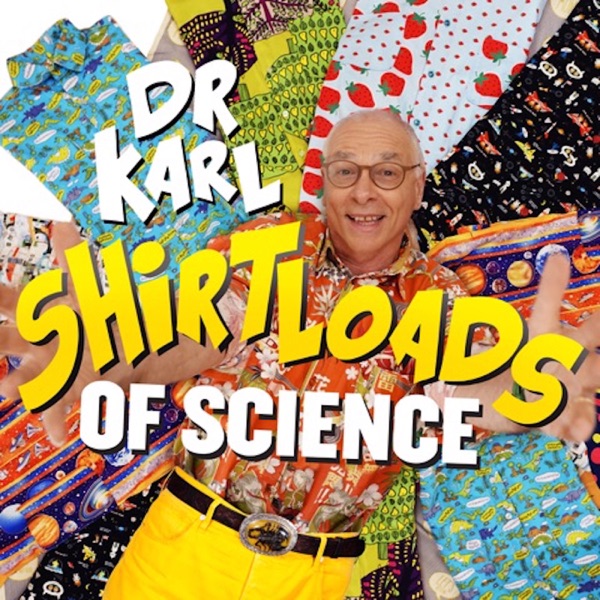
Dr Karl's a curious optimist. Join him as he explores the latest developments in science with leading researchers and communicators. And remember, it's never too late for a happy childhood. Series Producer: Isabelle Benton Technical Producer: Maya Cook Contact: shirtloadspodcast@gmail.com Watch Shirtloads on Youtube! www.youtube.com/watch?v=D5v8fnD27rc&list=PLbDH9bxN-EryKiiRoeFnOm0Ejif3-rdIx
On the charts
Every published chart this podcast appears in, in the snapshot behind this page. Each one links to the chart it came off.
From the feed
The latest episodes published to this podcast’s own RSS feed. Titles and descriptions are the publisher’s.
Science writer and journalist Marcus Chown returns for a shorter, more philosophical chat. When Einstein first proposed gravitational waves, atoms hadn't even been discovered, so who knows what the next century holds? We dig into the strange idea of the universe's "mathematical twin," and discuss the Standard Model of physics - a brilliant framework, but riddled with holes. www.marcuschown.com
Science writer and former astrophysicist Marcus Chown joins us to discuss the elusive graviton - the theoretical particle behind gravity. In this chat we dig into the four fundamental forces of nature, why gravity is so uniquely hard to pin down, and why detecting a graviton would require a detector larger than Jupiter. Marcus also unpacks string theory, the only framework that manages to fold gravity in with the other forces, and why it's fallen out of favour with much of the physics community. www.marcuschown.com/
A bonus episode straight from the audience at Geraint Lewis' book launch for "The Shortest History of Reality." Listeners fire off some big questions: where do we sit with the 95% of the universe we can't explain? What is dark energy? Why does time feel so different experientially? Along with other questions concerning the Theory of Everything, whether light really has a speed, what happens to our mass when we die, consciousness and the Twin paradox!
Join us for a special live episode of Shirtloads of Science, recorded at Willoughby Library for the launch of Professor Geraint Lewis' new book, "The Shortest History of Reality" - a compelling journey tracing the evolution of humanity's understanding of reality. In this live session, Geraint touches on a number of deep and puzzling concepts concerning reality (according to an astrophysicist) - from the baffling fact that 95% of the universe remains a mystery, to the clash between relativity and quantum mechanics, space and time, dark matter and dark energy, the mind-bending one-electron theory, and the ever-elusive Theory of Everything. https://www.geraintflewis.com/
Motor journalist Toby Hagon returns to Shirtloads of Science for round two on electric vehicles. Toby shares how he got into motoring journalism and what the job really involves. We break down 400V vs 800V batteries, charge cycles, and the reality of battery degradation, decode WLTP vs NEDC ratings, and marvel at just how powerful EVs really are. evcentral.com.au outbacktravelaustralia.com.au evcentral.com.au outbacktravelaustralia.com.au
Motor journalist Toby Hagon joins Shirtloads of Science to talk all things electric vehicles. We break down the often-confused difference between kilowatts and kilowatt-hours, compare EVs against petrol cars on performance, energy use, and cost, and explore everything from single to quad-motor setups. Toby unpacks AC vs DC charging and battery basics, looks at how servicing costs stack up, and separates real EV fire statistics from the hype. This was a big one, so we split it in two - catch part two next week evcentral.com.au outbacktravelaustralia.com.au
Associate Professor Anai Gonzalez-Cordero joins us on Shirtloads to explore the remarkable world of stem cells and how they can develop into almost any cell in the human body! She explains how her team is using stem cell technology to better understand and develop potential treatments for inherited retinal diseases, including Stargardt disease and Usher syndrome. We also discuss her work at the Children's Medical Research Institute and the importance of supporting genetic research through Jeans for Genes Day (coming up on the 7th of August!) If you'd like to help fund life-changing genetic research, consider making a donation this Jeans for Genes Day www.cmrijeansforgenes.org.au/
What if evolution isn't just about the survival of the fittest? Rowan Hooper, senior editor at New Scientist, joins Shirtloads to discuss his new book Togetherness - a challenge to the idea that nature is defined purely by competition. From the fig and wasp's ancient partnership to the mycorrhizal fungal networks threading through forest soils, Hooper makes a compelling case that relationships and symbiosis are overlooked fundamental aspects of evolution.
This conversation was originally recorded and published in November, 2024. In light of Richard's passing, we wanted to share it again because his insights remain as inspiring and relevant as ever. We extend our deepest condolences to his family, friends and colleagues.
Dr. Ann Jones joins me to chat about her hilarious new What the Duck? series, Nature's Most Wanted , which dives into the wild world of criminal animals. We investigate some of nature's strangest case files… a duck caught speeding (twice), drug-addicted parrots, an underwear-nicking cat, drunk elephants, and heavyweight hamsters! A funny look at the surprising ways animals collide with the human rules we've created. What The Duck?! Nature's Most Wanted
Marine Ecologist Assoc. Professor Alex Campbell takes us into the wonderful, under-appreciated world of seaweed and makes the case that it might be one of our most powerful allies against climate change! We dive into seaweed's evolutionary history and the troubling decline now underway: as ocean temperatures rise, marine organisms are shifting toward the poles at a rate of over 60km per decade to escape the heat, with Tasmania's once-thriving giant kelp forests shrinking by a staggering 90% since the 1990s due to devastating changes to their habitat. But the story isn't all bad news. Seaweed also holds genuine promise as a climate solution - from carbon sequestration and biofuel production, to a renewable alternative to plastic, to livestock feed additives that can dramatically cut methane emissions. Alex makes a compelling case for why this humble marine organisms deserves a much bigger role in how we tackle climate change.
I'm joined by Dr Nick Fuller to dissect the long-term effectiveness of weight loss medications and why lasting results do actually require more than medication alone. Nick explains why evidence-based behavioural weight management programs remain the first-line approach to weight loss built on three key pillars: diet, exercise and sleep (did you even know that sleep plays a big role in regulating hunger hormones?!) Drawing on his team's research, Nick shares why many people regain weight after stopping medication and why behavioural change is essential for sustainable success (and keeping weight off for good!)
This episode I'm joined by Dr Peter Lee, Head of Research at Microsoft, to explore the ideas shaping the future of technology. Leading 14 research laboratories globally and overseeing a research and development program that receives more than 10% of Microsoft's overall budget, Dr Lee shares his journey to the top of one of the world's largest innovation engines. From AI tools transforming early cancer detection and predicting protein structures in hours (instead of years!), to discovering new battery materials and improving weather forecasting through deep learning, the conversation reveals how research is moving from possibility to real-world impact. We also explore Microsoft's investment in open-ended innovation, research not driven by immediate products, but by imagining entirely new experiences and technologies. Encrypted Spaces - Microsoft Research | Microsoft Research
In this episode, we speak with Dietmar Müller about the "Boring Billion", a seemingly quiet period in Earth's deep history that may have been crucial for the evolution of complex life. Drawing on his latest research, Müller explains how plate tectonics, passive continental margins, and volcanic outgassing shaped Earth's slow carbon cycle and gradually oxygenated the oceans during the mid-Proterozoic era. Müller also reflects on how young the science of plate tectonics really is, and discusses the open-source EarthByte tools his team at the University of Sydney has developed to model Earth's ancient geological past. www.earthbyte.org/
Astronomer and soon-to-be Dr. Kovi Rose joins us to discuss his newly published Nature Astronomy paper on one of the universe's newest mysteries: strange repeating flashes of radio waves and X-rays coming form deep within our galaxy! His team's discovery of ASKAP J174 has helped identify the source as a pair of stars orbiting each other, with a white dwarf pulling or accreting material from its companion. This discovery could help unlock the origins of mysterious signals flashing across the sky, unlocking even more secrets of the universe.
Professor Clare Collins returns to the pod to answer a common question: does coffee raise your blood pressure? We also discuss how genetics influence whether you're a fast or slow caffeine metaboliser, the beneficial phytonutrients found in coffee, why decaf still has health benefits, and when people with high blood pressure may need to be more cautious with their intake. nomoneynotime.com.au
Friend of the pod Professor Clare Collins returns to dive down into the sticky depths of the surprisingly powerful world of honey - far beyond being "just a sugary liquid". From the hallucinogenic "mad honey" of the Rhododendrons to the science behind medical-grade honey dressings that can heal wounds days faster than conventional treatments, Dr. Clare explains why this ancient food deserves a second look. We dive into honey's beneficial micronutrients, anti-inflammatory properties, and why the nutritional profile can vary dramatically depending on where bees source their pollen. Clare also busts the myth that honey is "bee vomit", revealing the fascinating biology behind how bees actually make honey and why these incredible insects deserve our respect! nomoneynotime.com.au
What is the universe actually made of? Particle physicist Theresa Fruth join us at Shirtloads to explore one of science's greatest unsolved mysteries - dark matter! Making up roughly 85% of the universe, yet appearing in none of our known particles, dark matter is invisible, elusive and almost certainly the reason the universe (and us!) exist at all. Theresa and her team are hunting for it anyway. Working 1.2 kilometres underground in a converted gold mine in regional Victoria, they're searching for WIMPs - weakly interacting massive particles - in one of the quietest, most interference-free environments on Earth. The lab is being built out now, and further experiments are on the horizon. We may be closer to one of the biggest discoveries in scientific history than we realise.
Professor Ollie Jay, a leading expert in heat and health, returns to Shirtloads to discuss the growing toll of climate change on human wellbeing and global economics. Insights drawn from the latest Lancet Countdown report show that over half a million people die from heat-related causes each year, and a million more from fossil fuel pollution - deaths that are largely preventable. Rising temperatures are quietly reshaping our daily lives, from reducing physical and cognitive productivity, to costing the global economy an estimated trillion dollars annually. But it's not all bleak - Professor Jay highlights that meaningful change is within reach. With the right political action and long-term interventions, we can protect both public health and economic stability - the solutions are already in our hands.
In this episode, we speak with Professor Emmanuel Stamatakis about Vigorous Intermittent Lifestyle Physical Activity (VILPA) - short bursts of high-intensity movement built into everyday life, like walking briskly or carrying groceries. With only a quarter of adults exercising regularly, his research highlights how incidental activity, when done with enough intensity, can offer meaningful health benefits. We discuss how VILPA is grounded in observational research and the idea of "exercise snacks" which describes quick, accessible moments of effort that add up. The focus is on helping people recognise and maximise these daily opportunities to improve fitness and support long-term health.
Ranking source
Apple Podcasts rankings via the Mato Topic Intelligence Platform.
Observed September 19, 2026.
Apple and Apple Podcasts are trademarks of Apple Inc., registered in the U.S. and other countries.
Pairs with
Bring this source into Mato to read its transferable patterns, then turn them into an original show for your own audience.