Mato Recordings example. Source recording: USGS: 2021 November Yellowstone Volcano Update, by the U.S. Geological Survey (public domain). Made with Mato from this recording. Fault Lines is a show produced on Mato; the source publisher is not affiliated with it.
From the November 2021 Yellowstone Volcano Update: the story of one small explosion at Norris Geyser Basin.
Source
USGS video
Update
November 2021
Read
7 min
Figures
2
The day Porkchop Geyser blew up: what a small 1989 explosion says about Yellowstone's hazards
Porkchop Geyser went from a quiet pool to a perpetual geyser to an explosion in about two decades. Its 1989 blast shows what hydrothermal hazards look like in Yellowstone and why thermal basins are monitored.
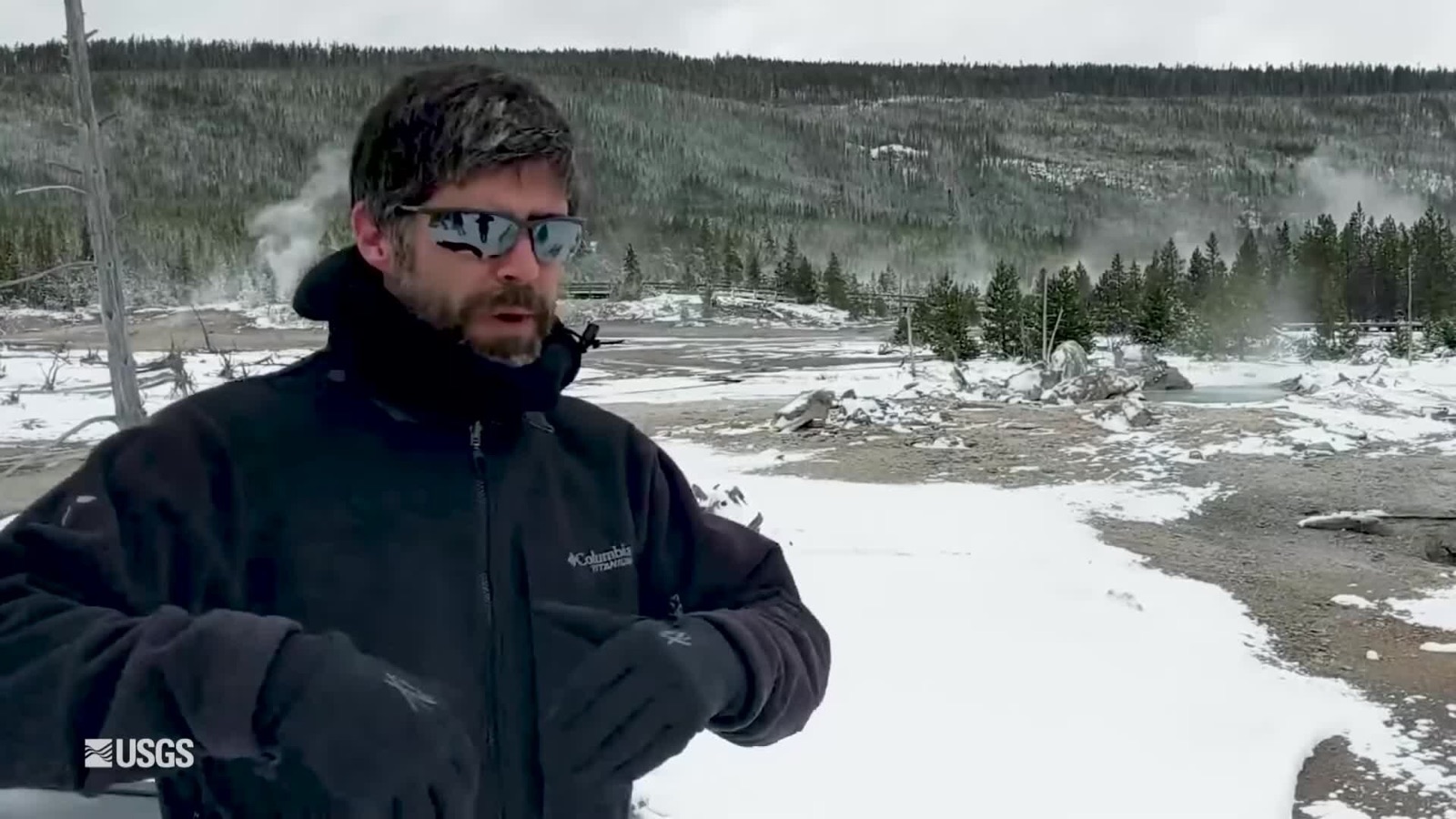
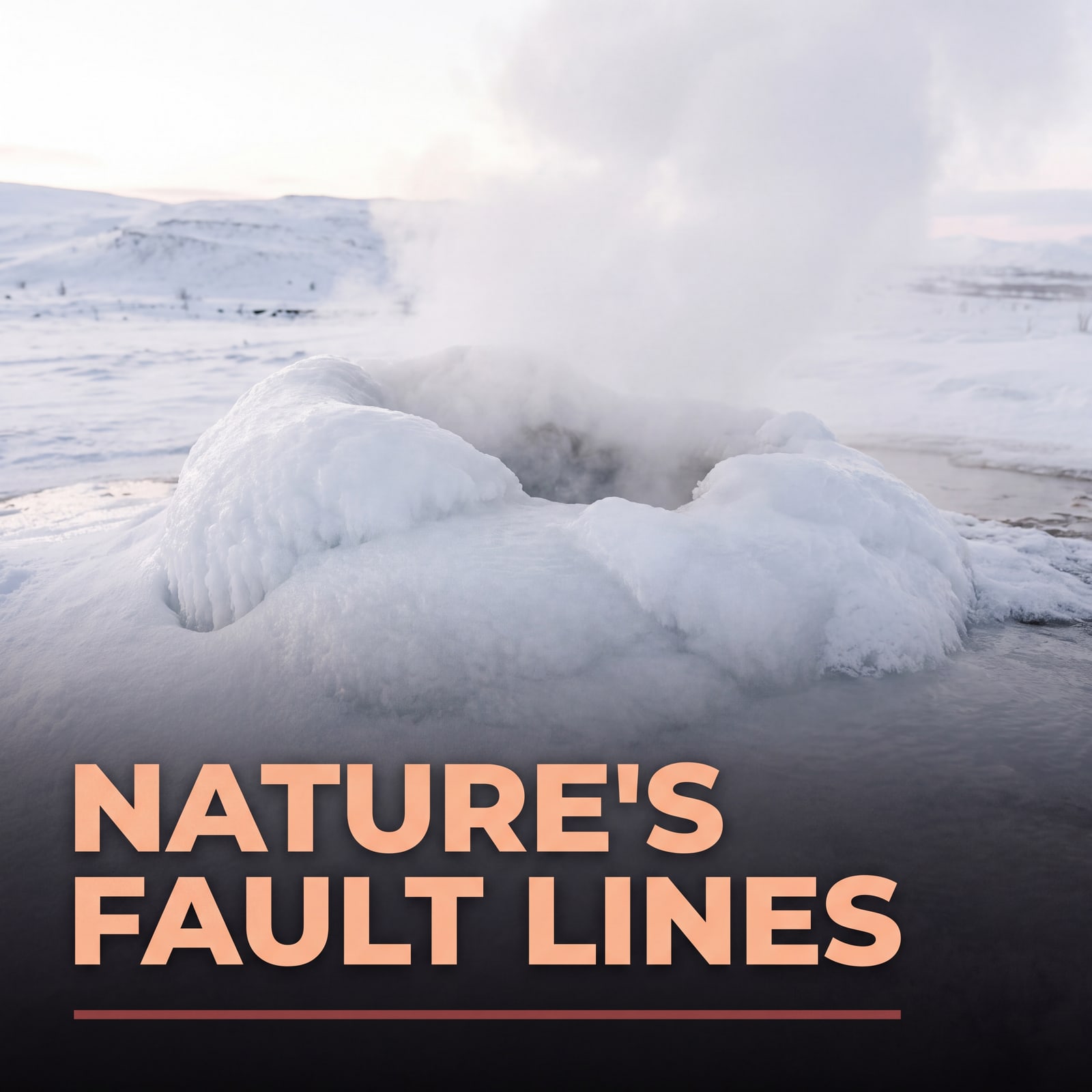
Recorded outdoors in snowy Yellowstone terrain, beside steaming thermal vents.Still from USGS: 2021 November Yellowstone Volcano Update (public domain)
The day a quiet pool blew up
On September 5, 1989, Porkchop Geyser exploded1USGS: 2021 November Yellowstone Volcano Update. U.S. Geological Survey video, edited by Liz Westby, videographer Mike Poland. Public domain. in Yellowstone's Norris Geyser Basin. Its vent had become so constricted that pressure built until it blew up, and rocks were thrown about 200 feet.
Figure 1
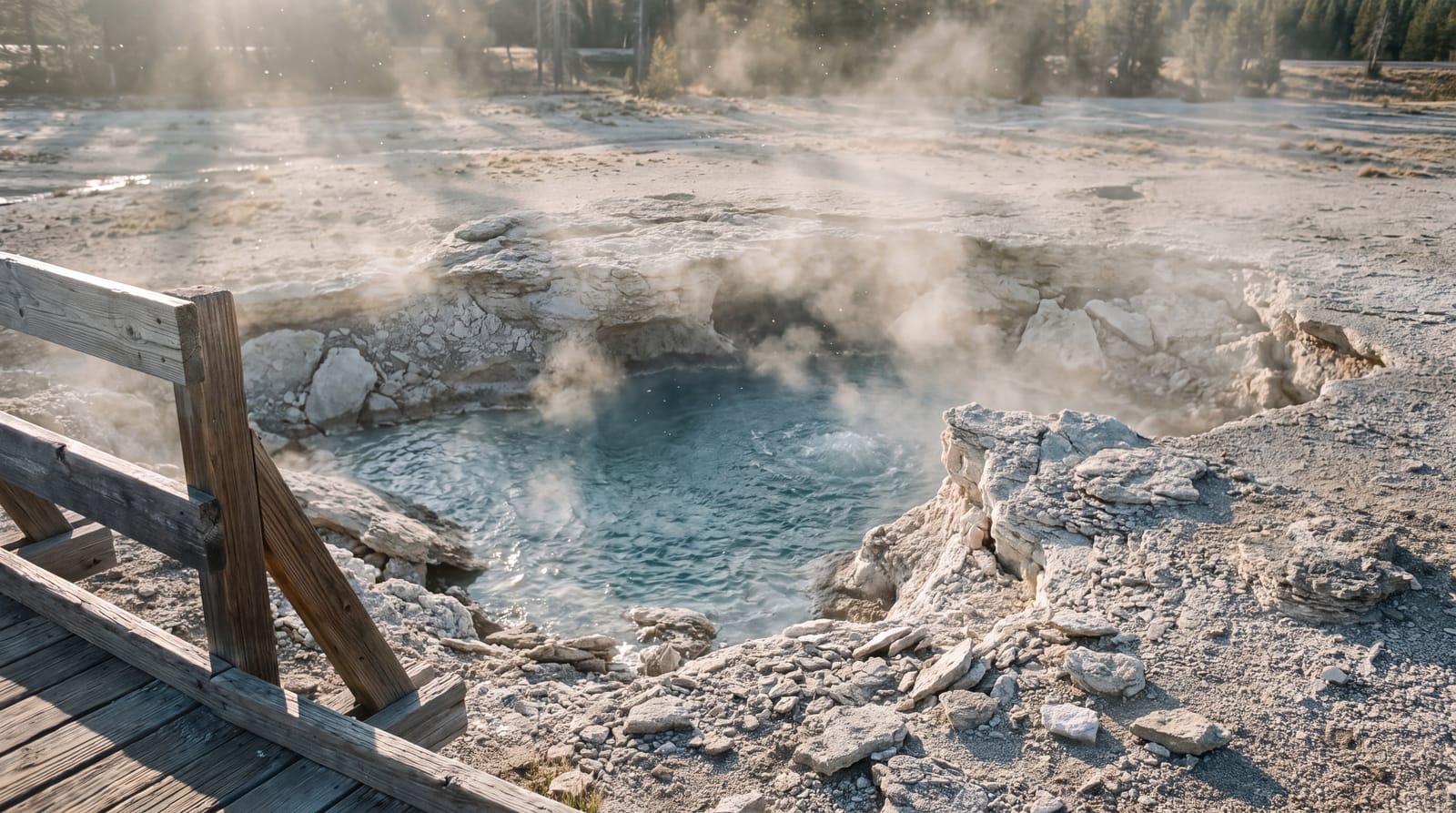
Porkchop Geyser at Norris Geyser Basin
Swipe sideways to see the whole image.
Porkchop Geyser at Norris Geyser Basin, where a 1989 explosion scattered rock fragments across the surrounding sinter. Generated with Gemini.
Mike Poland, the scientist in charge of the Yellowstone Volcano Observatory, described it in a November 2021 video update1USGS: 2021 November Yellowstone Volcano Update. U.S. Geological Survey video, edited by Liz Westby, videographer Mike Poland. Public domain. as a relatively small hydrothermal explosion. He called it one of the hazards Yellowstone has and one of the reasons the thermal basins are monitored.
Explosion is a loaded word in Yellowstone, where it tends to bring the supervolcano to mind. This kind of event runs on a different process. Water turns to steam inside a confined space, and magma is not the direct trigger2Hydrothermal explosions: a worldwide phenomena. USGS Yellowstone Volcano Observatory..
From pork chop-shaped pool to perpetual geyser
Porkchop was named in the 1960s because it looked like a pork chop, and at that point it was little more than a thermal pool.In the recordingPoland says the name came from the '60s, "because it looked like a pork chop," and that it was "really just sort of a, a thermal pool." In the 1970s and into the 1980s it began erupting intermittently and became Porkchop Geyser, as Poland explains in the observatory's video update1USGS: 2021 November Yellowstone Volcano Update. U.S. Geological Survey video, edited by Liz Westby, videographer Mike Poland. Public domain.. A USGS Volcano Watch column says the feature sprang to life from a small hot spring3Volcano Watch: thermal activity at Yellowstone sparks increased monitoring. USGS column, 2003. in 1971.
By the mid-1980s the eruptions were perpetual. Emeritus USGS geologist Pat Shanks writes that the geyser became a perpetual spouter4Can a geological thermometer help forecast hydrothermal explosions?. USGS Yellowstone Volcano Observatory. that reached heights of 6 to 9 meters (20 to 30 feet).
Winter made it photogenic. Photos from the 1980s show large mounds of ice over the geyser, formed as steam condensed very quickly into ice crystals.In the recordingPoland points to winter photos where "large mounds of ice would form over the geyser." Porkchop kept getting more active through the late 1980s, and the trend ended with the explosion.
Why the vent became a pressure trap
A geyser works on a version of the same problem. Geysers are caused by constrictions in the plumbing5Hydrothermal hazards on display in Yellowstone National Park. Eos. that temporarily trap boiling water and steam until the pressure is high enough for the water to erupt. Hydrothermal explosions occur less often. They are primed by a gradual pressure increase in a confined system, followed by rapid decompression from a rupturing seal or from an outside event such as a landslide or earthquake.
At Porkchop, the vent became so constricted that pressure built up and the geyser blew up. The general mechanism, according to the Yellowstone Volcano Observatory, is that when water boils inside a confined space that becomes sealed, expanding steam bubbles eventually overcome2Hydrothermal explosions: a worldwide phenomena. USGS Yellowstone Volcano Observatory. the strength of the rock.
The line between a geyser and an explosion is blurry. Large geyser eruptions can destroy a geyser's plumbing and throw rock and mud like hydrothermal explosions, and small, spontaneously recurring explosions may be closer to geyser activity.
What happened on September 5, 1989
The blast left marks that visitors can still see. Poland says the upturned rocks around Porkchop today were formed during the explosion. He also says a number of people were in the basin that day, which gives scientists a very good record. Eos puts the count at nine witnesses5Hydrothermal hazards on display in Yellowstone National Park. Eos., none of whom were injured.
Sources give slightly different distances for the rock throw. Poland says rocks were thrown 200 feet from the vent. Eos says small rocks and debris traveled 60 meters, and a 2003 USGS column says some rocks were thrown more than 66 meters3Volcano Watch: thermal activity at Yellowstone sparks increased monitoring. USGS column, 2003. (216 feet). Sixty meters is about 197 feet, so the three figures sit within roughly 20 feet of one another.
The crater is easier to pin down. The explosion left a new crater more than 10 meters4Can a geological thermometer help forecast hydrothermal explosions?. USGS Yellowstone Volcano Observatory. (33 feet) across.
Small by Yellowstone standards, still a hazard
Poland's phrase "relatively small" holds up against the park's geologic record. Since the end of the last glaciation roughly 14,000 years ago, at least 18 massive hydrothermal explosions5Hydrothermal hazards on display in Yellowstone National Park. Eos. have formed craters 300 to 2,500 meters across. The largest, formed about 13,000 years ago, is the biggest explosion crater on Earth. Porkchop's crater, a little over 10 meters wide, is tiny beside the smallest of those.
Small events still matter where people are present. The National Park Service called the 1989 Porkchop event and the April 15, 2024 Porcelain Terrace explosion similar to, but smaller than6Yellowstone news release on the Biscuit Basin explosion. National Park Service. the July 23, 2024 explosion at Biscuit Basin. That blast destroyed a boardwalk while visitors were in the area, though no injuries were reported. Officials said it was not caused by volcanic activity.
Hydrothermal explosions typically occur in the park one to a few times per year, often in the backcountry where they may not be detected right away. Poland's estimate is that events the size of the Biscuit Basin explosion probably occur every decade to a few decades2Hydrothermal explosions: a worldwide phenomena. USGS Yellowstone Volcano Observatory..
Were there warning signs?
Looking back, yes. Years of changes in water chemistry2Hydrothermal explosions: a worldwide phenomena. USGS Yellowstone Volcano Observatory. at Porkchop preceded the 1989 explosion. The hot spring at the site had been sampled frequently from the 1920s until the explosion, which left scientists a long record to work with.
After the blast, Robert Fournier used that historical chemical data to calculate subsurface temperatures and found increases of about 40 to 60 °C4Can a geological thermometer help forecast hydrothermal explosions?. USGS Yellowstone Volcano Observatory. (72 to 108 °F) in the years before the event. Shanks reads the result as evidence that rising temperature in fluid from depth can drive at least some hydrothermal explosions. The method has limits, though. Conventional geothermometers carry uncertainties of plus or minus 25 to 50 °C, which can hide some temperature changes.
The broader picture is less encouraging. Precursors to hydrothermal explosions are not well documented, and the changes that are common in hydrothermal areas are usually recognized as precursors only in hindsight. Eos reports no known universal precursory signals5Hydrothermal hazards on display in Yellowstone National Park. Eos. on which forecasts can be based. Before the Biscuit Basin explosion, seismicity, ground deformation, and gas and thermal emissions stayed at background levels. Forecasting remains unproven.
What Porkchop is like today
Since 1989 Porkchop has been a relatively calm pool with a clear blue color. It has not been entirely quiet. In July 2003 it erupted for the first time since 19893Volcano Watch: thermal activity at Yellowstone sparks increased monitoring. USGS column, 2003., during a summer of significant changes in many Norris geysers and higher ground temperatures in the western part of the basin. Scientists installed seven broadband seismic stations and five high-precision GPS receivers to learn from the activity, and they found no evidence that magma was directly involved.
Today a thermal data logger records Porkchop's temperature, and the data can be found on the Yellowstone Volcano Observatory website1USGS: 2021 November Yellowstone Volcano Update. U.S. Geological Survey video, edited by Liz Westby, videographer Mike Poland. Public domain..
How thermal basins are monitored now
Temperature data are the main tool in Yellowstone's hydrothermal monitoring. Sensors in geyser runoff channels7Hydrothermal monitoring in Yellowstone National Park. USGS. in the Upper, Lower and Norris geyser basins record temperature every 30 to 60 seconds, and a rise above baseline for a set time implies an eruption. Thermal infrared imagery from helicopters and satellites shows larger changes in heat flow, and images taken at night reduce the influence of the Sun.
The observatory's 2022 to 2032 monitoring plan includes hydrothermal hazards and calls for broadband seismic, infrasound, thermal and deformation sensors inside geyser basins. A prototype station installed in Norris Geyser Basin in 2023 detected infrasound from nearby geyser eruptions and the small explosion of April 15, 2024, the first hydrothermal explosion in the park5Hydrothermal hazards on display in Yellowstone National Park. Eos. documented by instrumental monitoring.
Coverage is uneven. No hydrothermal monitoring station was in Biscuit Basin in July 2024, and the observatory's network barely detected the explosion there. Prediction is still out of reach, though Shanks says newer geothermometry methods may be precise enough to track changes in hot springs, maybe even before explosions.
Figure 2
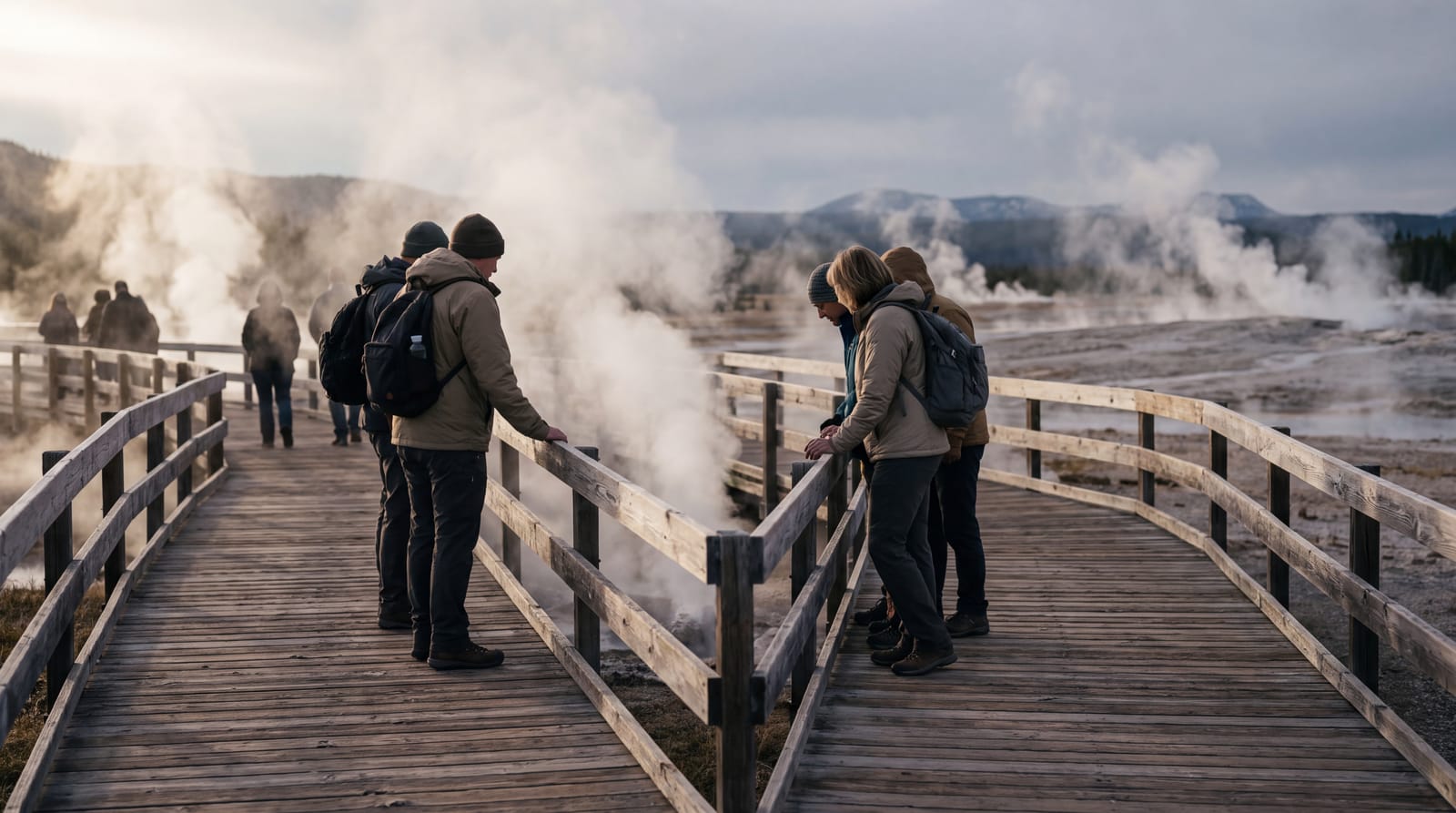
Stay on boardwalks and obey closures
Swipe sideways to see the whole image.
Visitors on a boardwalk across pale, steaming ground. Generated with Gemini.
What the Porkchop explosion means for visitors
Porkchop shows what a typical hazardous event in Yellowstone looks like: a constricted vent, rising pressure, a sudden release and debris thrown tens of meters. Could it happen again? Small explosions probably happen multiple times each year2Hydrothermal explosions: a worldwide phenomena. USGS Yellowstone Volcano Observatory. somewhere in the park and usually go unwitnessed. Nobody can put a probability on a single feature, because no universal precursory signals exist.
“This is one of the hazards that we have in Yellowstone and one of the reasons that we need to monitor the thermal basins like we do.”
Mike Poland, Yellowstone Volcano Update, November 2021
For visitors, the practical advice is to stay on boardwalks and obey closures. After its 2024 explosion, the park closed Biscuit Basin for the remainder6Yellowstone news release on the Biscuit Basin explosion. National Park Service. of the 2024 season.
Key takeaways
Porkchop Geyser exploded on September 5, 1989, after its vent became so constricted that pressure built until it failed.
A hydrothermal explosion comes from water flashing to steam in a sealed space, and magma is not the direct trigger.
Sources put the rock throw at about 200 feet, 60 meters, or more than 66 meters, and the crater at more than 10 meters across.
Water chemistry and geothermometry showed changes before 1989, but precursors are usually recognized only in hindsight and forecasting is unproven.
A short letter from Fault Lines. The latest issue covers the November 2021 update: October's earthquakes, the sinking caldera, Norris and Steamboat Geyser.
✓ Preview page: signups are not collected here.
Unsubscribe in one click.
Field Notes from Fault LinesLatest issue
Yellowstone in October: 267 quakes, a sinking caldera, and Norris may be rising again
Steamboat's October 25 eruption was its 17th of 2021; another major eruption looked likely within days to a week.
Porkchop Geyser’s vent narrowed until pressure built up and blew it apart on September 5, 1989. Rocks flew 200 feet. The explosion is why Yellowstone monitors its thermal basins closely.
Yellowstone recorded 267 earthquakes in October, within normal background levels; the largest was magnitude 2.6.
The caldera continued subsiding about an inch a year, with no real change in the trend.
Norris may be starting to uplift again after a few years without deformation, with about one to one and a half centimeters of uplift over the summer.
Steamboat Geyser erupted on October 13 and 25, bringing its 2021 total to 17; another major eruption was likely within days to a week.
Elsewhere on social
The story, as it traveled. Follow @faultlinespod wherever you scroll.
Threads
Fault Lines@faultlinespod
267 earthquakes in Yellowstone in October sounds like a lot. The speaker called the month "pretty typical of normal background levels."
The largest was a magnitude 2.6, just east of Norris Geyser Basin on October 4th. There were also three swarms, including one north of the Old Faithful area with 109 earthquakes, a continuation of a swarm from September.
Their summary: "normal background seismicity for the month."
LikeReplyRepostShare
X
Fault Lines @faultlinespod
Porkchop Geyser exploded on September 5, 1989. The speaker says its vent became "so constricted that pressure built up" and rocks flew 200 feet. The upturned rocks there today came from that blast, and plenty of people saw it.
ReplyRepostLikeShare
Instagram
faultlinespodYellowstone National Park
LikeCommentShare
faultlinespod Porkchop Geyser started out as a pool.
In the Yellowstone volcano update from November 2021, the speaker explains the name came from the '60s, "because it looked like a pork chop," and says it was "really just sort of a, a thermal pool."
Then in the mid-'80s it began "perpetual geyser eruptions." The speaker points to spectacular winter photos from that time, where "large mounds of ice would form over the geyser" as steam condensed quickly into ice crystals.
The speaker says it kept getting more active through the late '80s. Later in the talk, they point out the "nice blue color" of the pool and mention that a thermal data logger monitors its temperature.